Do French drains need maintenance?
Yes, though not much. Most of the work is keeping leaves and silt out: clearing catch basin grates and the outlet, keeping gutters clean upstream, and watching the drain during a heavy rain to see that water reaches the outlet. Clogging is the most common problem with gravel drains. A drain that floods, sinks or stops discharging needs a contractor to inspect it.
Free to ask. Local shops send quotes, and you pay only when you book one.
By Kasra Taheri, Founder, LoclisPublished
Researched and drafted with AI, then checked claim by claim against the sources listed below before it was published. Prices and rules change; the dates beside each source say when it was last checked.
This is a job for a licensed pro in Virginia
This page explains what the work involves, the permits, what a licensed pro does and what drives the cost. It does not give step-by-step instructions, because this work needs a licence, a permit or both, and doing it wrong can injure someone. Before you hire, check the licence on Virginia's DPOR record.
Yes. A French drain is one of the lower-maintenance ways to deal with a wet yard, but it is not a fit-and-forget one. Most of the care is keeping leaves, mulch and silt out of it and checking, during a real storm, that water still reaches the outlet. Drains that fail most often clog, slowly, so the habit that matters is noticing early.
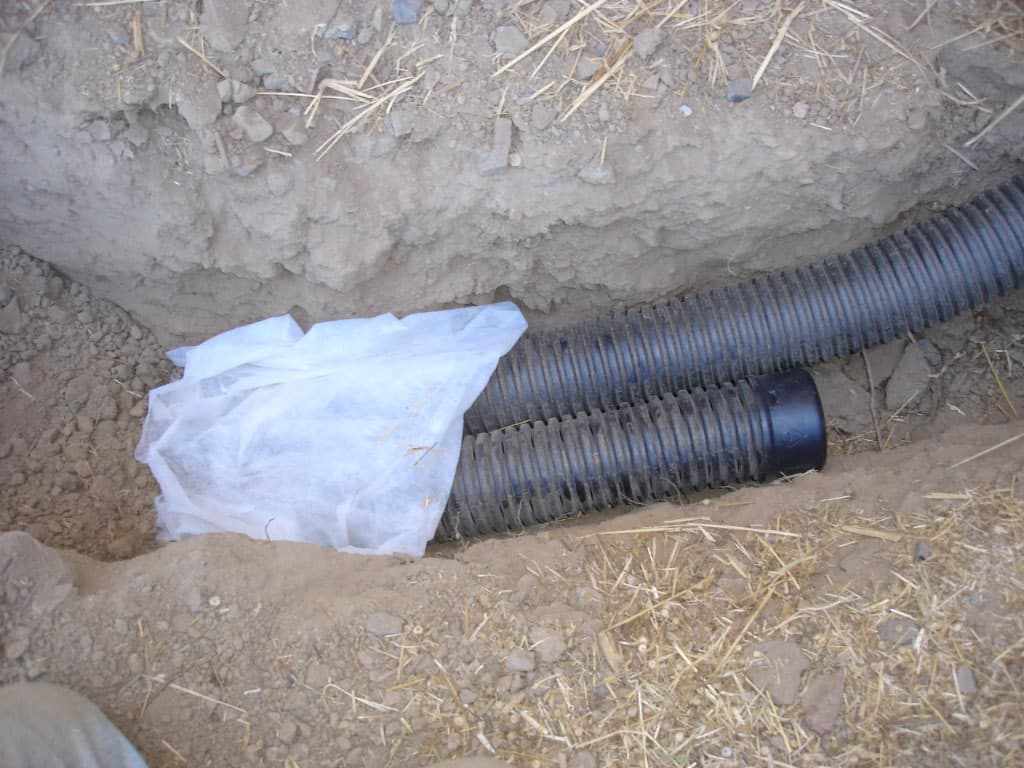
Why French drains clog
A French drain is a trench of gravel around a perforated pipe, and both the gravel and the pipe holes can fill with fine soil. Writing about infiltration trenches, a close cousin of the French drain, the EPA puts it plainly: "The most frequent maintenance challenge with infiltration trenches is clogging."[2] And it adds that infiltration trenches can have a relatively high rate of failure without regular maintenance or adequate pretreatment.[2]
Fabric is the main defense. In the Northern Virginia Soil and Water Conservation District's description, landscape fabric lines the trench and is pulled over the top of the gravel before topsoil and sod go on, and where the gravel is left exposed, the edges are protected to keep sediment out of the drain.[1] A drain built without fabric, or with gravel left open to a mulched bed, is more likely to clog early.
The other common sources of trouble are what flows in: leaves and roof grit from downspouts, mulch and soil washing off beds, and silt from bare ground uphill.
What to keep an eye on
Most upkeep is looking. A few times a year, and after big storms:
- Watch it work. During a heavy rain, water should be coming out of the outlet. If the outlet is dry while the yard is soaked, something upstream is blocked.
- Look along the line. Standing water or a soggy strip over the trench means water is not getting into the drain, or not getting out.
- Check the gutters upstream. Virginia Cooperative Extension's advice for downspout lines is to use screens or clean the gutters regularly so leaves and debris do not clog them,[6] and to check the extension pipe periodically to make sure it is not crushed or clogged, is still moving water where it should, and is not causing erosion.[6]
- Keep the grates clear. Catch basin grates collect leaves in the fall.
- Keep the outlet open. Grass, mulch and soil creep over the end of a pipe or a pop-up emitter.
The outlet and the inlets
The ends of the system need the most attention, because a blockage there stops everything behind it.
A pop-up emitter is the small capped outlet set flush in a lawn. NDS, which makes them, says to extend their life with routine inspections, because "a clogged pop-up emitter can potentially back up the entire drainage system."[3] Its upkeep is clearing debris from the cover and cap and checking the drain pipe underneath.[3]
Catch basins collect surface water into the pipe, and they collect leaves too. NDS sells fabric filters for its 9 inch and 12 inch catch basins that capture fine debris,[4] which help where a basin sits under trees. For trench drains, Fairfax County's flood program notes that regular upkeep, meaning debris removal, is necessary for them to keep working.[5]
Signs a drain needs a pro
Some symptoms are past what a rake and a glove can fix.
- A sunken line over the trench. Soil that was not properly placed and compacted over buried drainage pipes can settle over several years into a hole or a shallow, linear trench on the surface.[7] It can also mean soil is washing into the drain.
- Water bubbling up out of a catch basin or along the line during rain, which suggests a blockage downstream.
- An outlet that never runs, even in a downpour.
- Wetness returning to an area the drain had kept dry.
- Water against the foundation. If a gutter line has been tied into the perforated drain beside the house, that is a problem in itself. The Department of Energy's Building America guidance warns: "Do not connect the gutter drain pipe to the perforated foundation drain pipe; this practice will soak the foundation."[8]
A contractor can often flush a pipe or run a camera through it from a cleanout or the outlet. Where silt has filled the gravel and fabric, that section often has to be dug out and rebuilt with clean stone and new fabric.
Building maintenance in from the start
The cheapest maintenance is designed in. When you hire someone for a new drain, ask for fabric around the stone, solid pipe where roof water joins, a cleanout or inspection point at the high end, and an outlet you can see and reach. For gravel infiltration trenches, the EPA notes that an observation well, a perforated PVC pipe that leads to the bottom of the trench, lets inspectors monitor how fast the water drains down,[2] which serves the same purpose.
If a drain was paid for through the Virginia Conservation Assistance Program, the Northern Virginia district says you are responsible for its functioning for 10 years under the program's maintenance agreement.[9] Keep the plan, the invoice and photos of the open trench; they show the next contractor where everything is.
When to call a licensed pro
Call a pro when the drain overflows, sinks or stops discharging, or when water reaches the foundation. Digging up a drain line is excavation, so Virginia 811 needs a new locate request at least 3 working days ahead each time, even where lines were marked before, and on a hired job your contractor is responsible for contacting Virginia 811.[10]
Virginia's Board for Contractors places excavation and grading of land under the landscape service contracting specialty, and the home improvement contractor specialty also covers that work.[11] Check the licence on DPOR's License Lookup before you hire.[12]
For background, read how a French drain works and what a French drain costs in Virginia; for the roof water that often feeds a drain, see how to keep downspouts from clogging. Browse drainage and French drain businesses, find excavation businesses in Blacksburg, or see more excavation answers.
Describe what the drain is doing, and licensed local contractors quote the inspection or repair.
Common questions
- How often should a French drain be checked?
- Look at it a few times a year and after big storms, and check grates and the outlet each fall once the leaves are down. The most useful check is watching the drain during a heavy rain: water should be flowing out at the outlet and not pooling over the trench.
- How long does a French drain last?
- There is no fixed lifespan. A drain wrapped in fabric, fed by clean gutters and ending at a clear outlet can work for many years; one that takes in silt, leaves and mulch can clog much sooner. Clogging is the most common maintenance problem for gravel drainage trenches.
- Can a clogged French drain be cleaned?
- Sometimes. If the pipe has a cleanout or an open outlet, a contractor can often flush it or run a camera through it. If silt has filled the gravel and fabric, flushing the pipe will not help, and that section often has to be dug up and rebuilt.
- Why is there a sunken line in my lawn over the French drain?
- Usually the backfill was not compacted well and is settling, which the Northern Virginia Soil and Water Conservation District describes happening over buried pipes over several years. It can also mean soil is washing into the drain. Ask a contractor to look before simply topping it up.
- Should mulch go over a French drain?
- Keep mulch and loose soil off any exposed gravel and away from catch basin grates, where they wash into the drain. Over a drain covered with fabric, topsoil and sod, a lawn is the simplest cover.
Sources
- [1] Control Heavy Runoff - Solving Drainage and Erosion Problems, Northern Virginia Soil and Water Conservation District, Fairfax County. Checked October 27, 2026.
- [2] Stormwater Best Management Practice: Infiltration Trench (EPA-832-F-21-031C), U.S. Environmental Protection Agency. Checked October 27, 2026.
- [3] Pop-Up Drainage Emitters, NDS. Checked October 27, 2026.
- [4] Catch Basins, NDS. Checked October 27, 2026.
- [5] Flood Proofing Practices: Approved List of Practices, Fairfax County Flood Mitigation Assistance Program, Northern Virginia Soil and Water Conservation District. Checked October 27, 2026.
- [6] Stormwater Management for Homeowners Fact Sheet 1: Rooftop Redirection (Disconnection) (SPES-9P), Virginia Cooperative Extension, Virginia Tech. Checked October 27, 2026.
- [7] Sinkhole - Solving Drainage and Erosion Problems, Northern Virginia Soil and Water Conservation District, Fairfax County. Checked October 27, 2026.
- [8] Gutters and Downspouts, Building America Solution Center, Pacific Northwest National Laboratory for the U.S. Department of Energy. Checked October 27, 2026.
- [9] Conservation Assistance Programs, Northern Virginia Soil and Water Conservation District, Fairfax County. Checked October 27, 2026.
- [10] Homeowners FAQ, Virginia 811. Checked October 27, 2026.
- [11] 18VAC50-22-30, Definitions of specialty services, Virginia Administrative Code, Board for Contractors. Checked October 27, 2026.
- [12] License Lookup, Virginia Department of Professional and Occupational Regulation. Checked October 27, 2026.
Want a pro to handle it?
Describe the job once. Licensed local businesses send quotes, and you pay only when you book one.
Get a quote from a local pro