How much does it cost to install shelving in Virginia?
There is no official or standard rate for shelf installation in Virginia, so the real number is a written quote. What moves it: how many shelves, the kind of system, what the wall is made of and where the studs fall, how heavy the load is, who supplies the hardware, patching old holes, and whether the job is big enough to need a licensed contractor.
Free to ask. Local shops send quotes, and you pay only when you book one.
By Kasra Taheri, Founder, LoclisPublished
Researched and drafted with AI, then checked claim by claim against the sources listed below before it was published. Prices and rules change; the dates beside each source say when it was last checked.
Step by step
Read when to stop and call a pro, further down this page, before you start.
Step 1: List every shelf
Write down each shelf or system with its length, depth, the room it goes in and what it will hold.
Step 2: Photograph the walls
Take a photo of each wall from a few steps back, with any outlets, switches, windows and existing holes in view.
Step 3: Say what the walls are
Say whether each wall is drywall, plaster, tile or brick if you know, and whether you have found the studs.
Step 4: Say who buys the parts
Say whether you have bought the shelves and brackets already, with links to the products, or want the business to supply them.
Step 5: Ask how they charge
Ask whether the price is by the hour with a minimum, per shelf, or a flat price for the whole list.
Step 6: Ask about the extras
Ask whether patching and painting old holes, removing old shelving and hauling away packaging are included.
Step 7: Get written quotes
Ask at least three businesses for written quotes for the same list, and ask about any quote far below the others.[4]
Step 8: Keep the deposit small
Keep a deposit to no more than 10% of the price or $1,000, whichever is less, and do not pay in full until the work is done.[4]
There is no official or standard price for installing shelving in Virginia. No state agency sets one, and handyman businesses price shelf jobs in different ways, so two quotes for the same wall can look nothing alike. The useful answer is to know what moves the number, describe your shelves the same way to every business, and compare written quotes line by line.
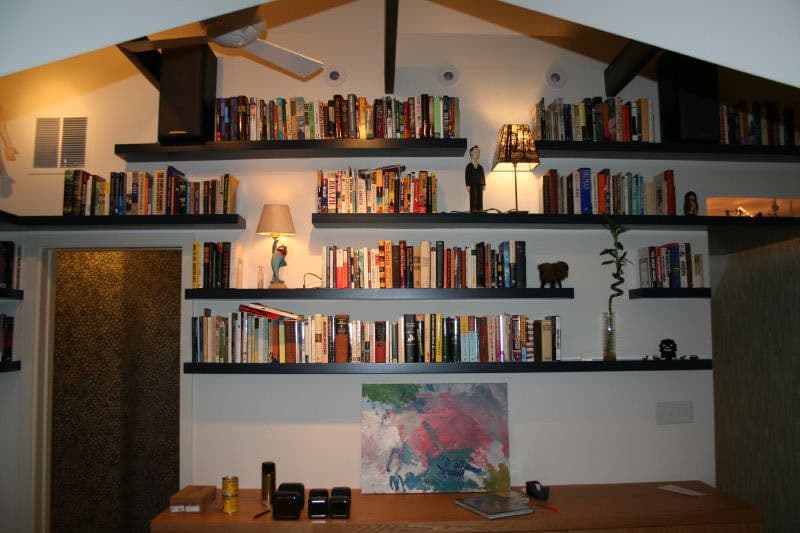
How businesses usually charge
By the hour, with a minimum. Common for a few shelves, or shelves mixed with other small jobs. The minimum covers the trip and setup, so a single shelf can cost as much as an hour of work.
Per shelf or per item. Some businesses quote a flat price per shelf or per bracket set. That is easy to compare, as long as each quote covers the same shelves, the same walls and the same hardware.
A flat price for the project. Usual for a closet system, a garage wall of shelving or a run of built-ins. Ask what is included and what happens if the wall turns out to need extra work.
Materials. Ask whether the shelves, brackets and anchors are in the price, billed at cost, or billed with a markup, and whether shopping time is on the clock.
What drives the price
The kind of shelving. Simple bracket shelves are the quickest. Floating shelves take longer, because the hidden bracket has to be dead level and fixed exactly where the board will sit. Wall standards with adjustable brackets, closet systems and garage shelving take more parts and more fasteners. Some products arrive without the hardware the wall needs: IKEA's 74 3/4-inch LACK wall shelf, for example, comes with its hidden suspension brackets but with the screws for wall mounting sold separately.[7]
The wall and the studs. Studs are usually 16 inches apart,[6] and a shelf that has to sit where the studs don't fall needs heavy-duty anchors instead, which take longer to set. Plaster, tile over drywall and brick walls take different drill bits, anchors and care than plain drywall.
The weight. A bookshelf, a pantry wall or garage storage needs more fasteners and closer brackets than a shelf for photos. A careful installer sizes the anchors with a margin: anchor ratings are the ultimate load in laboratory tests, and industry safety standards recommend about a quarter of that as a working load.[5] TOGGLER adds that the age, capacity and condition of the wall have to be considered.[5] That margin is part of what you are paying for.
Height and access. Shelves above a stairwell, over a toilet or high in a vaulted room need ladders or scaffolding and more time.
The wall afterwards. Removing old shelves, filling the old holes, and sanding and touching up paint can add as much time as the new shelves.
Anything that is a separate trade. Lighting wired into shelving or a new outlet behind a media wall is electrical work. The Board for Contractors' home improvement (HIC) specialty does not provide for electrical, plumbing, HVAC or gas fitting work,[3] so that part of the job may need a licensed electrician and a separate price.
When the licence line matters
Virginia's contractor law covers work on a building or structure permanently annexed to real property, and any other improvements to such real property,[1] and no one may do contracting work in Virginia without a licence under that chapter.[2] A Class C licence covers a single contract or project worth over $1,000 but less than $30,000.[1] A couple of shelves rarely reaches that, but a whole-house closet system or a wall of built-ins can. Finish carpentry, as Virginia's contractor regulations define it, includes installing cabinets and other millwork,[3] which is the kind of work a built-in becomes. Ask for the licence number and check it on DPOR's lookup.
Virginia law requires all licensed contractors to provide a written contract for residential work,[4] and it should list each shelf, the hardware, the price and the start date.
Comparing quotes
DPOR's consumer guide advises that you solicit at least three bids[4] and make sure all the bids are based on the same set of specifications.[4] It also warns: "Beware of any bid substantially lower than the others."[4] On deposits, its rule of thumb is an initial deposit of no more than 10% of the total price or $1,000, whichever is less.[4]
A cheap shelf quote that skips the studs and uses whatever anchors came in the box is not a saving if the shelf comes down. Ask each business how it will fasten the heaviest shelf.
Stop and call a pro if
- The shelving needs wiring for lights or a moved outlet.
- The wall is damp, soft or cracked where the shelves will go.
- The project is a built-in that needs a wall opened or framing changed.
- You are planning a single job worth more than $1,000 and the business cannot show a Virginia contractor licence.
Related answers and getting quotes
Read how to hang heavy shelves on drywall, whether to hire a handyman for shelves, what a handyman costs in Virginia, and how to write a handyman to-do list. Find handyman businesses around Blacksburg or browse the handyman answers. To get quotes, describe the shelving job on Loclis.
Common questions
- Is there a standard price for shelf installation in Virginia?
- No. No Virginia agency sets handyman or shelving prices, and businesses charge by the hour with a minimum, per shelf, or a flat price for a list. The way to know your price is a written quote for your own shelves, walls and hardware.
- Is it cheaper to have several shelves put up in one visit?
- Usually. Each visit carries travel and setup time, and many businesses have a minimum charge, so one visit for a whole room or a list of small jobs often costs less per shelf than several short visits.
- Why does a floating shelf cost more to install than a bracket shelf?
- A floating shelf hides its bracket, so the bracket has to be dead level and in exactly the right place, often into studs that do not line up with the bracket holes. It takes more measuring and fiddling than visible brackets, and mistakes show.
- Should I buy the shelves myself or let the installer supply them?
- Either works. Buying them yourself lets you choose the look, but send the installer the product links first, since some shelves ship without wall screws and need specific anchors. If the business supplies them, ask whether parts are billed at cost or with a markup.
- Does the installer need a Virginia licence?
- Contractor licensing in Virginia starts at Class C, which covers a single contract or project worth over $1,000 but less than $30,000.[^va-contractor] Many handyman businesses hold the home improvement specialty. Check any licence number on DPOR's lookup before you sign.
- What does Loclis charge?
- Businesses on Loclis quote the job themselves. Loclis's own fees are listed on the pricing page.
Sources
- [1] Va. Code § 54.1-1100, Definitions (Contractors), Code of Virginia, Virginia General Assembly. Checked October 27, 2026.
- [2] Va. Code § 54.1-1103, Necessity for license, Code of Virginia, Virginia General Assembly. Checked October 27, 2026.
- [3] 18VAC50-22-30, Definitions of specialty services (Board for Contractors Regulations), Virginia Administrative Code. Checked October 27, 2026.
- [4] What You Should Know Before You Hire a Contractor, Virginia Board for Contractors, DPOR. Checked October 27, 2026.
- [5] TOGGLER FAQs, TOGGLER. Checked October 27, 2026.
- [6] Grab bar installation instructions with SecureMount flanges (INS10862), Moen. Checked October 27, 2026.
- [7] LACK Wall shelf, white, 74 3/4x10 1/4", IKEA. Checked October 27, 2026.
Want a pro to handle it?
Describe the job once. Licensed local businesses send quotes, and you pay only when you book one.
Get a quote from a local pro