How do I hang heavy shelves on drywall?
Screw the brackets or shelf standards into wall studs wherever you can, and where a screw misses a stud use a toggle-style anchor that clamps behind the drywall, sized for the load. Treat the anchor box's number as a test result, not a working load: about a quarter of it is the safe figure. Keep heavy items near the wall and over the brackets.
Free to ask. Local shops send quotes, and you pay only when you book one.
By Kasra Taheri, Founder, LoclisPublished
Researched and drafted with AI, then checked claim by claim against the sources listed below before it was published. Prices and rules change; the dates beside each source say when it was last checked.
Step by step
Read when to stop and call a pro, further down this page, before you start.
Step 1: Weigh the load
Weigh an armful of the books, dishes or tools the shelf will hold on a bathroom scale and add up the total for the whole shelf.
Step 2: Read the ratings
Check the maximum load the shelf and bracket makers give, and plan to stay well under it.
Step 3: Find the studs
Mark the centre of each stud along the shelf line with a stud finder; studs are usually 16 inches apart.[4]
Step 4: Avoid hidden services
Keep holes away from the spaces directly above and below outlets and switches, where wires usually run, and away from plumbing walls.
Step 5: Draw a level line
Draw a level pencil line for the tops of the brackets or standards, and mark every screw hole on it.
Step 6: Fasten into studs
Drill pilot holes and drive wood screws through the bracket or standard into every stud it crosses.
Step 7: Drill for toggles
Where a bracket hole misses a stud, drill exactly the hole size the toggle anchor's instructions give, no bigger.
Step 8: Set the anchors
Set each toggle behind the drywall as its instructions describe, then tighten the bolt until snug and stop.[2]
Step 9: Test each bracket
Before the shelf goes on, pull each bracket firmly down and outward; it should not move or creak.
Step 10: Fix the shelf down
Screw the shelf board to the brackets from underneath so it cannot slide forward or tip off.
Step 11: Load it sensibly
Put the heaviest items at the back and over the brackets, and spread the rest along the shelf.[6]
Step 12: Check it again
After a week of use, look for a gap opening at the top of any bracket, a dip in the board or cracks in the paint around a screw.
Heavy shelves stay on drywall when their load goes into the wall studs, or into anchors that clamp behind the drywall, and when the total weight stays far below what those fasteners were tested to hold. Put brackets on studs wherever you can. Where you can't, use toggle-style anchors sized for the job, not the small plastic plugs that come in many boxes.
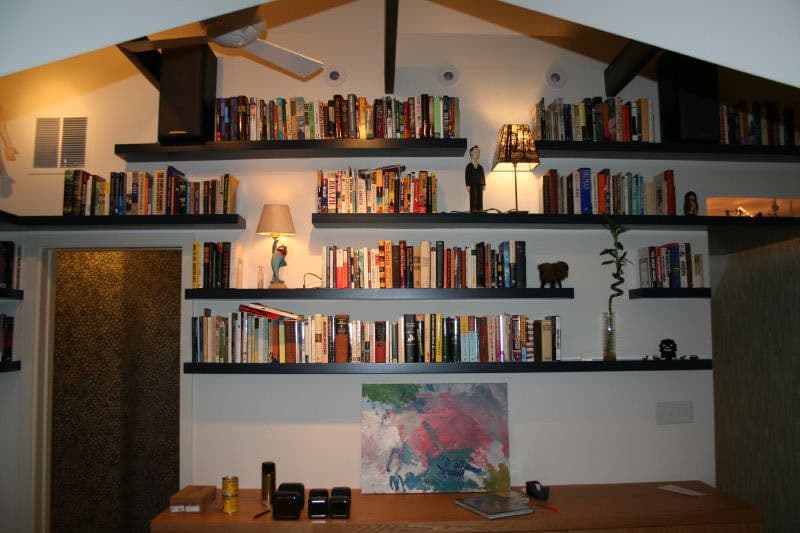
Start with the load, not the hardware
Add up what the shelf will really carry. A run of hardcover books, a stack of plates or a row of paint cans weighs more than most people guess, so weigh an armful on a bathroom scale and multiply.
Then look at what the shelf itself is rated for. Makers publish their own limits, and they can be low: IKEA rates one 31 1/2-inch BERGSHULT/GRANHULT bracket shelf at a maximum of 22 pounds when properly mounted on the wall,[6] and sells it with the screws for wall mounting sold separately,[6] because the right fastener depends on your wall.
The number on an anchor box is not a working load either. Anchor makers list the ultimate load each anchor held in independent laboratory tests,[1] and industry safety standards recommend about a quarter of that ultimate load as a reasonably safe working load.[1][3] A heavy shelf is a matter of enough fasteners in the right places, with a wide margin.
Studs first
A wood screw driven into a stud is the strongest and simplest mount on a drywall wall. Studs are usually 16 inches apart,[4] so a shelf 32 inches or longer can usually catch two or three of them. A stud finder gets you close; a small test hole where the bracket will cover it confirms you have wood, not just the edge of a stud.
Slotted wall standards, the vertical metal strips used for adjustable shelving, help a lot here. Screw the standards into studs and the brackets can then sit at any height along them, and the shelf can be any length you like.
Where there is no stud
Use an anchor that opens or clamps behind the drywall, so the load is spread across the back of the panel instead of resting on the edges of a small hole.
Toggle bolts are the heavy-duty choice. As an example, TOGGLER rates its SNAPTOGGLE toggle bolt at up to 238 pounds in 1/2-inch drywall,[2] so a quarter of that still leaves roughly 60 pounds per anchor. Hole size matters: an old-fashioned 1/4-inch wing toggle needs a 3/4-inch hole, against a 1/2-inch hole for the 1/4-inch SNAPTOGGLE,[2] and it needs at least 1-7/8 inches of clear space behind the wall.[2]
Self-drilling drywall anchors are much lighter-duty. TOGGLER's regular SnapSkru anchor, with a #8 screw, held an ultimate 79 pounds of pull-out and 149 pounds of shear in 1/2-inch drywall in the maker's tests,[3] which works out to about 20 and 37 pounds once you apply the quarter rule. That is fine for a light shelf and not enough on its own for a full bookshelf.
Why the top screws matter most
A loaded shelf levers the top of each bracket away from the wall and presses the bottom into it. CPSC staff found that drywall anchors are strongest when the force runs parallel to the wall, as shear, and that a pull straight out from the wall is the hardest for them to withstand.[5] The further the load sits from the wall, the worse it gets: moving weight toward the far end of a shelf significantly increases its effective weight and greatly reduces what the anchor can safely hold.[1]
That is why a deep shelf needs more and stronger fasteners than a shallow one carrying the same weight, why the top screw on each bracket is the one to put into a stud if you can only reach one, and why heavy items belong at the back, over the brackets.
Bracket spacing and the shelf board
Closer brackets mean less sag and less load on each fastener. For books or kitchen items, plan a bracket at every stud rather than every other one, and keep the overhang past the end brackets short. A thicker board, or solid wood or plywood, sags less over the same span than a thin particleboard shelf.
Spread the weight along the shelf, too. IKEA's maximum load for that shelf is the weight before it risks slanting, and the company advises distributing the weight evenly.[6] One heavy object in the middle of a long span asks more of the board than the same weight spread out.
Stop and call a pro if
- The wall is plaster, tile or masonry and you are not sure which anchor it takes.
- A drill bit hits metal, or you see water, a pipe or a wire in the hole. Stop, and do not simply try the spot next to it.
- The drywall crumbles, feels soft or is stained, which usually means water has been at it.
- The shelf has to hold more than your anchors' quarter-of-rating figures allow, or it will carry a TV, an aquarium or anything people may lean or pull on.
- You want lighting or a new outlet built into the shelving. Virginia treats electrical work done for the public for pay as a licensed trade, and no individual may do it without a tradesman licence unless working under the supervision of a licensed tradesman.[7][8]
- The plan means opening the wall to add wood blocking between studs.
Related answers and getting it done
See how much weight drywall shelves can hold, why wall shelves sag, and how to anchor furniture so it can't tip over for freestanding bookcases. If you would rather hand it off, read whether to hire a handyman for shelves, find handyman businesses around Blacksburg, or browse the handyman answers. To get quotes, describe the shelving job on Loclis.
Common questions
- Can I hang heavy shelves using only drywall anchors?
- Sometimes, with heavy-duty toggle anchors, enough of them, and a load well under a quarter of their tested rating. Small plastic plugs and light self-drilling anchors are meant for light items. For bookshelves, a mix of stud screws and toggles is the sturdier plan.
- How far apart should shelf brackets be for heavy loads?
- Closer than you would use for decorative shelves. For books or dishes, a bracket at each stud along the shelf is a sensible plan, with only a short overhang past the end brackets. Check the shelf and bracket instructions, since some makers give a maximum spacing.
- Are floating shelves strong enough for books?
- Often not, unless they are made for it. Many floating shelves hang on hidden brackets with a low maximum load, and the load sits out from the wall where it pulls hardest on the fasteners. Read the rating before buying, and screw the hidden bracket into studs.
- What if my house has plaster walls instead of drywall?
- Plaster is harder and more brittle, and it often has wood lath behind it. Studs are still the strongest mount, but anchors that suit drywall may not suit plaster. Use an anchor rated for plaster, drill carefully, or have a handyman do it.
- Why did my shelf pull out of the wall at the top screws?
- A loaded shelf levers the top of each bracket away from the wall, so the top screws are pulled straight out, which is the hardest load for a drywall anchor. Re-mount into studs or stronger toggle anchors in fresh holes, and keep heavy items close to the wall.
Sources
- [1] TOGGLER FAQs, TOGGLER. Checked October 27, 2026.
- [2] SNAPTOGGLE Heavy-Duty Toggle Bolt, Carbon Steel, TOGGLER. Checked October 27, 2026.
- [3] SnapSkru Self-Drilling Drywall Anchors, technical flyer (rev. 3/24), TOGGLER (Mechanical Plastics Corp.). Checked October 27, 2026.
- [4] Grab bar installation instructions with SecureMount flanges (INS10862), Moen. Checked October 27, 2026.
- [5] Preliminary Evaluation of Anchoring Furniture and Televisions Without Tools (CPSC/EXHR/TR-15/001, May 2015), U.S. Consumer Product Safety Commission. Checked October 27, 2026.
- [6] BERGSHULT / GRANHULT Wall shelf, white/nickel plated, 31 1/2x11 3/4", IKEA. Checked October 27, 2026.
- [7] Va. Code § 54.1-1128, Definitions (Tradesmen), Code of Virginia, Virginia General Assembly. Checked October 27, 2026.
- [8] Va. Code § 54.1-1129, Tradesman license required, Code of Virginia, Virginia General Assembly. Checked October 27, 2026.
Want a pro to handle it?
Describe the job once. Licensed local businesses send quotes, and you pay only when you book one.
Get a quote from a local pro