How much does it cost to move a hot tub in Virginia?
There is no reliable single Virginia price for a hot tub move, because it is several jobs: the move itself, an electrician at both ends, possibly a new concrete slab, a permit and sometimes a crane. Cal Spas says a crane is not included in standard delivery. Get three written quotes for identical work and compare them line by line.
Free to ask. Local shops send quotes, and you pay only when you book one.
By Kasra Taheri, Founder, LoclisPublished
Researched and drafted with AI, then checked claim by claim against the sources listed below before it was published. Prices and rules change; the dates beside each source say when it was last checked.
Step by step
Read when to stop and call a pro, further down this page, before you start.
Step 1: List every part of the job
Write down the move itself, the electrician at both ends, the new base, any permit, any crane and the water disposal.[1]
Step 2: Measure the route and the new spot
Note the gate widths, stairs and overhead clearance, since a blocked route is what brings in a crane.[1]
Step 3: Check whether a permit applies
Call your county or city building department and ask about a permit for the hot tub at its new location.[2]
Step 5: Ask for three written quotes
Give each company the same description of the job, so the bids can be compared.[3]
Step 6: Compare line by line
Put the quotes side by side and ask each company about any line another one left out.
Step 7: Agree the deposit and terms in writing
Keep the deposit to the DPOR rule of thumb and put the price, payment dates and cancellation terms in the contract.[3]
Moving a hot tub in Virginia costs whatever the several jobs inside it add up to, and no primary source publishes a dated price for the whole thing. So this guide shows what makes up a quote and how to compare quotes, instead of quoting a figure that would be a guess.
What a move is made of
A quote for "moving a hot tub" may cover only one of these, so find out which:
- The move itself. Draining, carrying on a cart and setting down. Distance, stairs and the number of people all push it up.
- An electrician at both ends. Disconnecting at the old spot and reconnecting at the new one.
- The base. The new location needs somewhere solid to sit.
- A permit, if your locality requires one.
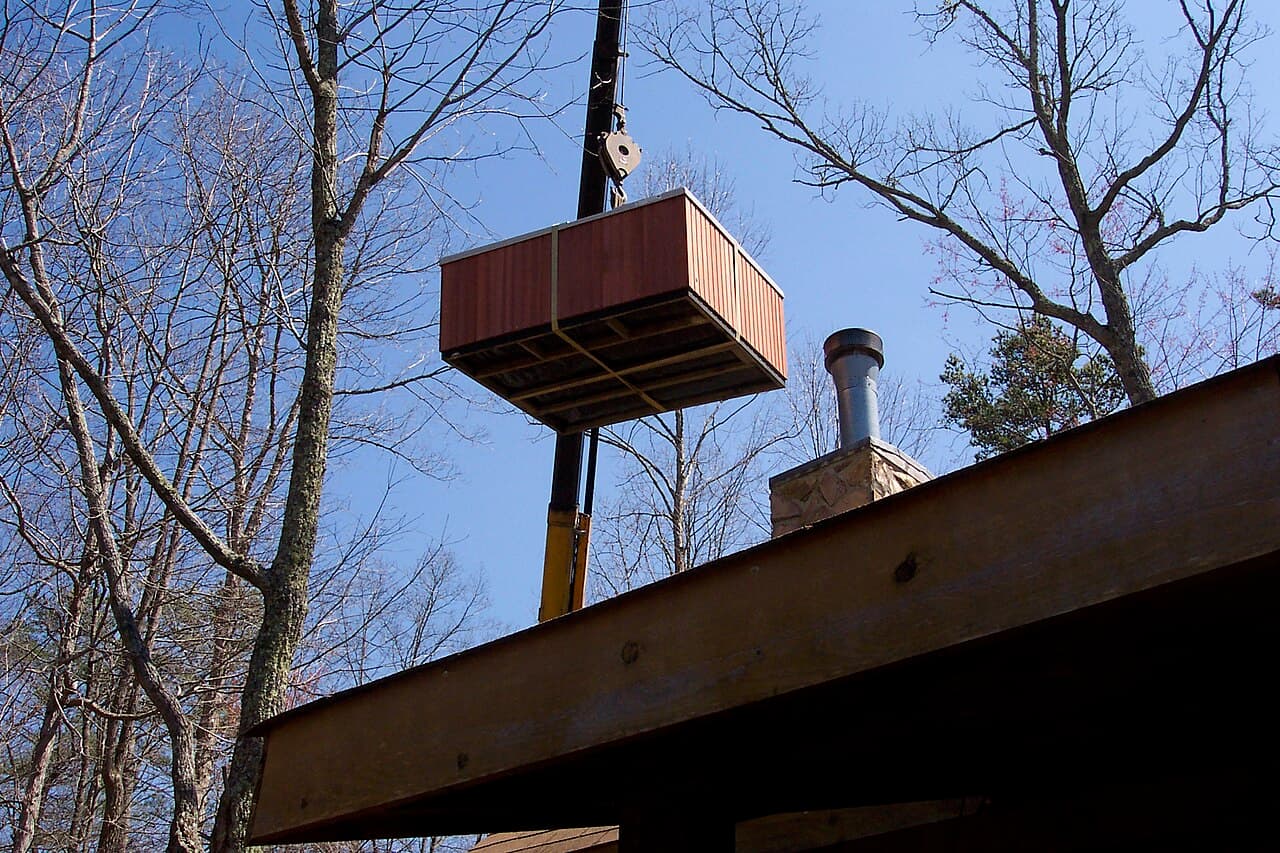
- A crane, if the route is blocked.
- Disposal of the water, which is usually free if you drain it onto your own yard.
The crane line
This is where a quote most often changes on the day. Cal Spas says that if your property requires the use of a crane, the cost of the crane is not something included with a standard delivery service of a spa.[1] It says that if the delivery route has stairs, a crane may be needed to move the spa into its final position.[1] The same guide puts the rule of thumb for gates and clearance at: an 8-foot spa needs a gate at least 44 inches wide and 9 feet of overhead clearance.[1]
Measure your own route before you ask for quotes, so each company prices the same route. All swim spas require the use of a crane to install, so a swim spa quote should always show one.[1]
The electrician
Cal Spas says the circuit must be installed by an electrical contractor and approved by a local building or electrical inspector.[1] Virginia law says no individual shall engage in, or offer to engage in, work as a tradesman without a licence, so the person who disconnects and reconnects your tub needs a Virginia licence in the electrical trade.[4] If the new spot is farther from the panel, the wire run is a separate and larger line on the quote.
The base
Cal Spas says to use an elevated 4 to 6 inch cement slab, and recommends contacting a qualified licensed contractor to prepare the foundation.[1] If the new spot has no slab, budget for one, or find out whether the mover will build it or whether you need a separate concrete contractor.
The permit
Roanoke County says the Virginia Uniform Statewide Building Code requires a building permit for any swimming pool with a surface area greater than 150 square feet or more than 24 inches deep, and that the code makes no distinction between in-ground, above-ground or inflatable pools, hot tubs or spas.[2] All permits there are also subject to a State Levy Fee of 2% and a Technology Fee of 5%, so ask your own locality for its fee estimate rather than assuming another county's.[2]
The water
Draining is normally free, but where you drain matters. Prince William County says that only de-chlorinated, pH neutral, chemical-free, clean water may be slowly discharged to the storm drain system.[5] Let the water sit and run the hose onto grass.
How to compare quotes
DPOR says it is advisable to get at least three written bids or estimates using identical plans and specifications so you can compare prices and contractors.[3] For a hot tub move, "identical" means the same route measurements, the same new location and the same list of inclusions.
Then read each one for what it leaves out. A low quote that excludes the crane, the electrician and the slab is not low. Ask each company:
- Is the electrician at both ends included, and is he or she licensed?
- Is a crane included if the route needs one, and what is the charge if it turns up on the day?
- Does the price cover draining, the cover and any damage to the tub or yard?
- What is the cancellation term?
DPOR says that if the work you are considering is valued at $1,000 or more, a valid Virginia Contractor's License is required, and Virginia law requires all licensed contractors to provide a written contract for residential work.[3] DPOR's rule of thumb on deposits is an initial deposit of no more than 10% of the total price or $1,000, whichever is less.[3]
Stop and call a pro if
- The quote is verbal only. Ask for it in writing, with the price, the payment dates and the cancellation terms.[3]
- The company has no licence number you can look up. For work valued at $1,000 or more, a Virginia contractor's licence is required.[3]
- Nobody has measured the route. That is how a crane appears at the last minute.[1]
- The company wants more than the deposit rule of thumb before it has done anything.[3]
- Someone offers to do the wiring without an electrical licence. Tradesman work needs a licence in Virginia.[4]
Getting help in Virginia
Start with how to move a hot tub, then read who moves hot tubs. See more pool and spa answers or browse pool and spa pros.
When you are ready, describe your hot tub move once and local pros quote it.
Common questions
- Is a crane included in the price of moving a hot tub?
- Not by default. Cal Spas says that if your property requires the use of a crane, the cost of the crane is not something included with a standard delivery service of a spa.[^calspas-pre] Ask any mover whether a crane is in or out of their quote, and what happens on the day if the route turns out to need one.
- Will I need an electrician?
- Almost always for a full-size tub. Cal Spas says its circuit must be installed by an electrical contractor and approved by a local building or electrical inspector.[^calspas-pre] Disconnecting and reconnecting it is tradesman work, and Virginia law says no individual shall engage in, or offer to engage in, work as a tradesman without a licence.[^va-1129] Ask whether the quote covers the electrician at both ends.
- Is a permit needed for the new location?
- It depends on the locality and the tub. Roanoke County says the Virginia Uniform Statewide Building Code requires a building permit for any swimming pool with a surface area greater than 150 square feet or more than 24 inches deep, and that the code makes no distinction between in-ground, above-ground or inflatable pools, hot tubs or spas.[^roanoke] Call your building department and ask what they require for a relocated tub.
- How big a deposit is reasonable?
- DPOR's rule of thumb is an initial deposit of no more than 10% of the total price or $1,000, whichever is less.[^dpor-hire] It adds that a reasonable deposit could be as high as 30% when the job requires custom-made items or special orders, which a plain hot tub move usually does not.
- Can I save money by moving the tub myself?
- You can save on the carrying if you have enough helpers and a clear route, and our guide to [how to move a hot tub](/answers/how-to-move-hot-tub) covers it. You cannot safely save on the wiring, and a failed lift can cost far more than the mover's fee.
Sources
- [1] Portable Spa Pre-Delivery Guide (LTR50001024, Rev. E), Cal Spas. Checked October 27, 2026.
- [2] Residential: Installing a Swimming Pool or Hot Tub, Roanoke County, Virginia, Building Safety. Checked October 27, 2026.
- [3] What You Should Know Before You Hire a Contractor, Virginia Board for Contractors, DPOR. Checked October 27, 2026.
- [4] Va. Code § 54.1-1129, Necessity for licensure, Code of Virginia, Virginia General Assembly. Checked October 27, 2026.
- [5] Stormwater Pollution Reduction, Prince William County, Department of Environmental Services. Checked October 27, 2026.
Want a pro to handle it?
Describe the job once. Licensed local businesses send quotes, and you pay only when you book one.
Get a quote from a local pro