How do you move a hot tub?
Drain it, then move it on a cart or dolly with several helpers, never by dragging. Check the route first: an 8-foot spa needs a 44-inch gate and 9 feet of overhead clearance. Have an electrician disconnect and later reconnect the power. Set it on a level 4 to 6 inch concrete slab, since a filled tub weighs about 5,000 pounds.
Free to ask. Local shops send quotes, and you pay only when you book one.
By Kasra Taheri, Founder, LoclisPublished
Researched and drafted with AI, then checked claim by claim against the sources listed below before it was published. Prices and rules change; the dates beside each source say when it was last checked.
Step by step
Read when to stop and call a pro, further down this page, before you start.
Step 1: Choose and prepare the new spot
Pick a spot with a level 4 to 6 inch concrete slab, at least 3 feet of service clearance and no overhead power lines within 10 feet.[1]
Step 2: Measure the route
Compare the tub's dimensions with every gate, doorway, turn and low branch between the old spot and the new one.[1]
Step 3: Have the power disconnected
Book a licensed electrician to shut off and disconnect the tub's circuit; do not touch the wiring yourself.[1]
Step 5: Clear the last water
Open the pump bleeder valves and use a wet/dry vacuum on the jets, suctions, filter canister and equipment area.[2]
Step 6: Clear a path
Remove any gate, fence section or obstacle on the route that the measurements show will not clear.[1]
Step 7: Lift onto a cart
With enough helpers, lift the tub onto a cart or dolly and keep it on the cart for the whole trip.[1]
Step 8: Set it on the slab
Roll the tub onto the new slab, check it is level and leave service access to every side panel.[1]
Step 9: Have the power reconnected
Have the electrician reconnect the tub to its dedicated GFCI circuit and test it before you refill.[1]
Step 10: Refill and check
Refill with fresh water, put the filters back and look under the cabinet for leaks before you heat the tub.
You move a hot tub by draining it, planning the route, getting an electrician to disconnect and reconnect the power, and carrying it on a cart with several helpers. The tub itself is the easy part. The route, the new base and the wiring are where moves go wrong.
Why you drain it first
Water weighs 8.33 pounds per gallon, and the average spa holds about 500 gallons.[1] Cal Spas puts a full tub at approximately 5,000 pounds when full of water.[1] Nobody lifts that, so the tub always goes empty. Even empty, expect it to need several people and a cart.
Prepare the new spot first
Do the destination before moving day, because a tub that has nowhere to go ends up sitting in the driveway.
Cal Spas says to place the spa on an elevated 4 to 6 inch cement slab, and that pavers, gravel, brick, sand, timbers or dirt are not adequate to support the weight of the spa.[1] It adds that the foundation must extend 12 inches from the spa on all sides.[1] If the new spot is an elevated wooden deck or structure, it must support 150 pounds per square foot, which is a question for a structural engineer or a licensed contractor, not a guess.[1]
Two more placement rules from the same maker: do not place your spa within 10 feet of overhead power lines, and leave about 3 feet of clearance so panels can be reached for service.[1]
Check the route
Walk the whole path with a tape measure. An 8-foot spa needs a gate at least 44 inches wide and 9 feet of overhead clearance, and the turns, low eaves, branches, gas and water meters and air conditioning units along the way all count.[1] Often a gate or a section of fence has to come off for a few hours.
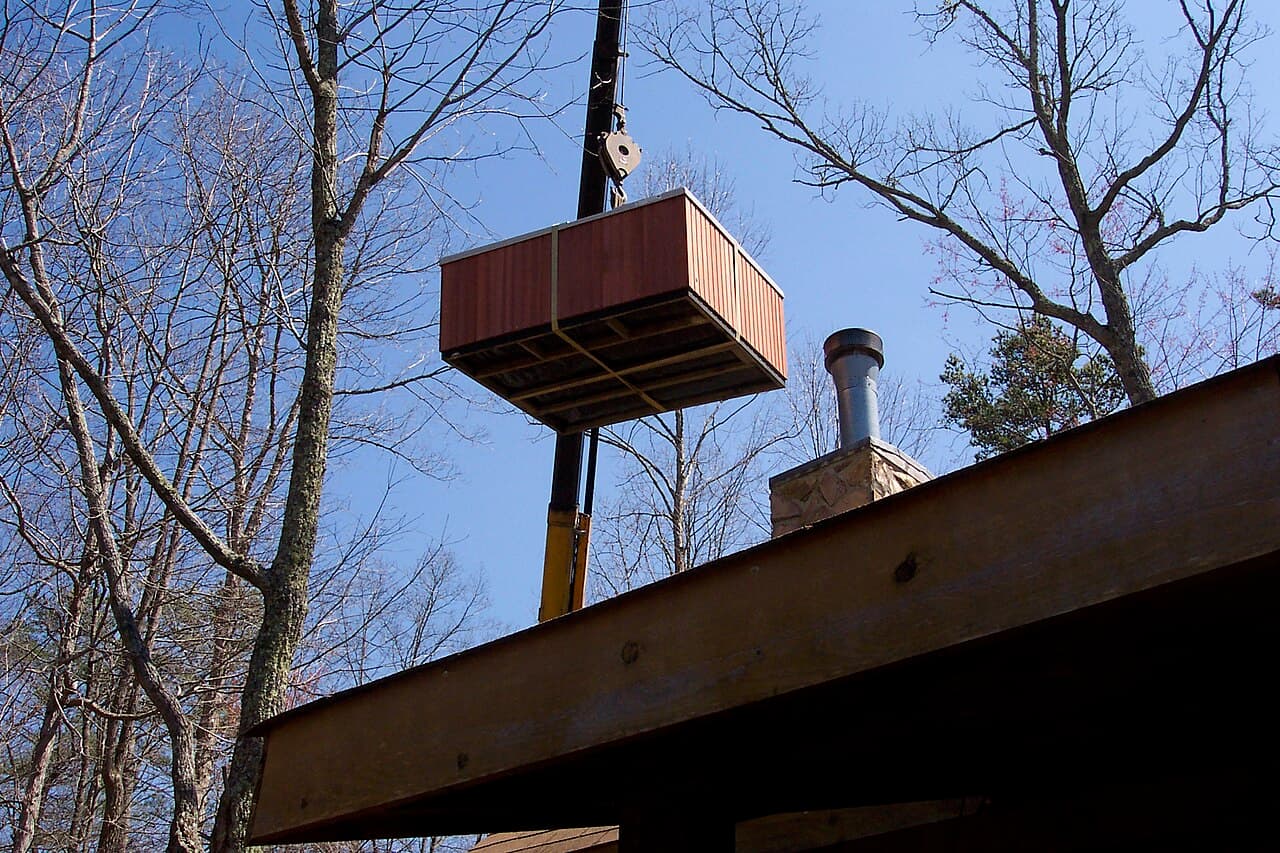
Stairs change the plan. If the delivery route has stairs, a crane may be needed to move the spa into its final position.[1] A crane is a hired service with its own crew, and a reputable hot tub mover will tell you early if the route needs one.
Power: leave it to the electrician
Most full-size tubs are on a dedicated 240V circuit. Cal Spas says all 240V spas must be permanently connected (hard wired) to the power supply, that the circuit must be installed by an electrical contractor and approved by a local building or electrical inspector, and that the power must be on a dedicated GFCI protected circuit.[1] Disconnecting and reconnecting that wiring is tradesman work: Virginia law says no individual shall engage in, or offer to engage in, work as a tradesman without a licence.[6]
Book the electrician for both ends of the move. If the new spot is farther from the panel than the old one, ask for a quote on the longer run and on the permit before moving day.
Drain it
Before you begin, turn the power off to the spa at the breaker and remove your filters.[2] Then connect a garden hose to the drain, open the valve and let it run. Cal Spas' sequence for a tub going into storage is also the right one for a move: open the bleeder valves on the pumps and blow any remaining water out of the jets, suctions, filter canister and equipment area with a wet/dry shop vac.[2] A cup of water left in the plumbing is what sloshes, leaks or freezes later.
Where the water goes matters. Prince William County says that by county ordinance, only de-chlorinated, pH neutral, chemical-free, clean water may be slowly discharged to the storm drain system.[3] Stafford County's brochure lists chlorinated pool water as an illicit discharge and dechlorinated swimming pool discharges as allowable.[4] The safe habit is to stop adding sanitizer a few days ahead and run the hose across grass, away from the street.
Cal Spas also warns that draining a spa brings a risk of water freezing in its equipment and plumbing, and that freeze damage is not covered under warranty.[2] In a cold snap, move the tub and refill it quickly, or wait.
Moving the tub
Use a purpose-built cart or dolly, as many helpers as the tub needs, and a clear path. Cal Spas' rule for deliveries is that during delivery, the spa must remain on the delivery cart at all times.[1] Do not drag or tip it unless the maker's manual says that is acceptable for your model; the shell and the plumbing underneath are what you are protecting.
Strap the cover on so it cannot catch wind, and take the cabinet panels off only if the manual describes how.
Set it down and bring it back to life
Roll it onto the slab, check it sits level, and keep every side panel reachable. Have the electrician reconnect and test the GFCI before you refill. Then refill with fresh water, replace the filters, and check under the cabinet for drips before heating.
Stop and call a pro if
- The wiring needs touching. Disconnecting, extending or reconnecting the circuit is licensed work.[6]
- The route needs a crane, because Cal Spas says a crane is used primarily to avoid injury to delivery personnel and damage to the property and the spa.[1]
- The new spot is a deck or other raised structure. It must support 150 pounds per square foot, and that is for a structural engineer or licensed contractor to confirm.[1]
- A permit may apply. Roanoke County says the Virginia Uniform Statewide Building Code requires a building permit for any swimming pool with a surface area greater than 150 square feet or more than 24 inches deep, and that the code makes no distinction between in-ground, above-ground or inflatable pools, hot tubs or spas.[5] Call your building department.
- The tub is cracked, leaking or will not hold water after the move.
Getting help in Virginia
If you would rather hire it out, read who moves hot tubs and what a hot tub move costs. See more pool and spa answers or browse pool and spa pros.
When you are ready, describe your hot tub move once and local pros quote it.
Common questions
- Can I move a hot tub myself?
- You can do the planning, draining and carrying with enough helpers, but not the wiring. Cal Spas says its 240V spas must be permanently connected (hard wired) and that the circuit must be installed by an electrical contractor.[^calspas-pre] Have an electrician disconnect and reconnect the tub.
- How heavy is a hot tub?
- Water weighs 8.33 pounds per gallon, and the average spa holds about 500 gallons.[^calspas-pre] Cal Spas puts a full tub at approximately 5,000 pounds when full of water. Empty, it is far lighter, which is why you drain it first.
- Do I need a permit to put a hot tub in a new spot?
- Possibly. Roanoke County says the Virginia Uniform Statewide Building Code requires a building permit for any swimming pool with a surface area greater than 150 square feet or more than 24 inches deep, and that the code makes no distinction between in-ground, above-ground or inflatable pools, hot tubs or spas.[^roanoke] Rules are applied locally, so call your building department before you move it.
- Where can I drain the water?
- Prince William County says that by county ordinance only de-chlorinated, pH neutral, chemical-free, clean water may be slowly discharged to the storm drain system.[^pwc] Stafford County lists chlorinated pool water as an illicit discharge.[^stafford] Ask your locality, and let hot tub water settle before it goes anywhere near a street.
- Do I need a crane?
- Only when the route is blocked. Cal Spas says that if the delivery route has stairs, a crane may be needed to move the spa into its final position.[^calspas-pre] A fence, a tight side yard or a deck on the second level can all lead to a crane.
Sources
- [1] Portable Spa Pre-Delivery Guide (LTR50001024, Rev. E), Cal Spas. Checked October 27, 2026.
- [2] Patio and Patio Plus Owner's Manual 2025, Cal Spas. Checked October 27, 2026.
- [3] Stormwater Pollution Reduction, Prince William County, Department of Environmental Services. Checked October 27, 2026.
- [4] Illicit Discharge, Detection, & Elimination Program, Stafford County, Virginia. Checked October 27, 2026.
- [5] Residential: Installing a Swimming Pool or Hot Tub, Roanoke County, Virginia, Building Safety. Checked October 27, 2026.
- [6] Va. Code § 54.1-1129, Necessity for licensure, Code of Virginia, Virginia General Assembly. Checked October 27, 2026.
Want a pro to handle it?
Describe the job once. Licensed local businesses send quotes, and you pay only when you book one.
Get a quote from a local pro