How much does landscaping cost in Virginia?
There is no single price: a landscaping job in Virginia costs whatever its plan, plant sizes and site work add up to. Plant count and size, soil preparation, grading or walls, irrigation, design fees and access drive the total. Get a written plan, three written bids on the same plan, and a licensed contractor for any job over $1,000.
Free to ask. Local shops send quotes, and you pay only when you book one.
By Kasra Taheri, Founder, LoclisPublished
Researched and drafted with AI, then checked claim by claim against the sources listed below before it was published. Prices and rules change; the dates beside each source say when it was last checked.
Step by step
Read when to stop and call a pro, further down this page, before you start.
Step 1: Write down the scope
List what you want done, what it should look like when finished, and how much you have to spend before you call anyone.[9]
Step 2: Test the soil first
A Virginia Tech routine soil test tells you what the beds actually need, so you do not pay for amendments they do not.[4]
Step 3: Get a plan with a plant list
Ask for a drawing that names each plant, its size at purchase and the quantity, so every bid prices the same thing.
Step 4: Collect three written bids
Get at least three written bids based on identical plans and specifications.[9]
Step 5: Compare line by line
Check plant sizes, plant counts, soil preparation, mulch depth, cleanup and any replacement terms in each bid.
Step 6: Question a very low bid
A bid far below the others probably means a mistake or missing work.[9]
Step 7: Check the licence
For a job over $1,000, confirm the contractor's Virginia licence on DPOR's License Lookup.[10]
Step 8: Keep the deposit small
Pay no more than 10% or $1,000 down, whichever is less, unless special-order items justify up to 30%.[9]
Step 9: Ask about cost-share
If the project converts lawn to native beds or tree plantings, ask your Soil and Water Conservation District about VCAP.[5]
Landscaping in Virginia has no standard price because no two jobs share a plan: a few foundation shrubs and a whole-yard design with new beds, trees, grading and irrigation are different projects. What you will pay comes down to how many plants you buy and at what size, how much soil and site work the yard needs, whether you hire a designer, and which licensed trades the job involves. The way to a real number is a written plan and comparable written bids.
What drives the price
Design
Design ranges widely. A sketch for one bed costs far less than a scaled whole-property plan with planting lists, hardscape and lighting. Some design-build firms charge for the plan and credit it against installation; ask before you commit.
Plants: how many, how big, what kind
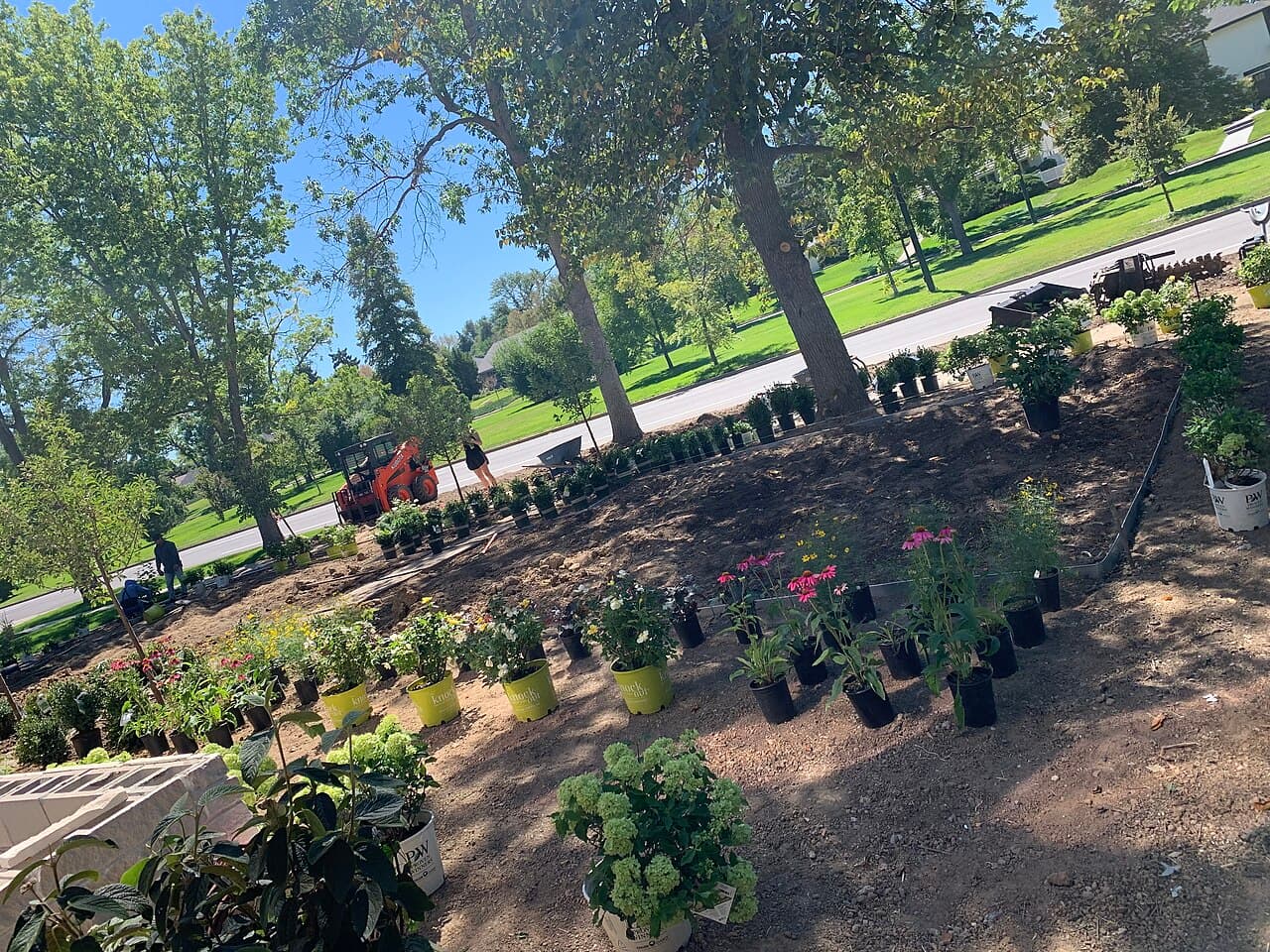
Plants are often a large share of a planting quote, and two decisions set that line. The first is spacing. Closer spacing fills a bed faster but means buying more plants; wider spacing costs less and takes longer to fill in.[1] The second is size at purchase. Larger plants cost more and are heavier to move and plant, but they give an immediate look.
The form matters too. Most shrubs are sold container-grown, and a small share as balled-and-burlapped (B&B) plants.[1] Large B&B trees and shrubs often need more than one person or a machine to set, which shows up in labor.
Soil preparation
Good beds are prepared before anything is planted. For a mass planting, Virginia Tech recommends working 3 to 5 inches of organic matter into the whole bed, to the depth of the root balls.[1] If the existing soil is full of rock or construction debris, it should be replaced with local topsoil,[1] which is common around new houses and adds hauling and material.
A soil test is the cheapest way to avoid paying for amendments you do not need. Virginia Tech's soil lab listed its routine soil test at $10.00 for in-state samples, with soluble salts $2.00 and organic matter $4.00 extra, when we checked on October 27, 2026.[4]
Clearing weeds and turf
Turning lawn or a weedy area into beds takes time. Invasive plants and tough perennial weeds such as nutsedge or bermudagrass should be controlled before planting, which can take several herbicide treatments months ahead.[2] If your contractor will spray, know that anyone who applies pesticides on someone else's property for pay must work for a company with a Pesticide Business License.[8]
Grading, walls, drainage and irrigation
Site work changes the price faster than plants do. Grading, retaining walls for landscaping and landscaping timbers fall under Virginia's landscape service contracting specialty,[7] and irrigation and outdoor sprinkler systems are a separate licensed specialty.[7] Any digging also needs a utility locate: contact Virginia 811 at least 3 working days in advance.[11] The locate is free;[11] working around buried lines can add labor.
Access, cleanup and aftercare
A backyard reached only through a narrow gate, a steep slope or heavy clay usually means more hand labor. Ask whether the quote includes hauling away debris and old plants, mulch, and how long the contractor stands behind the plants. A replacement policy is worth paying for on a large planting.
Licences, bids and deposits
Virginia sets contractor licence classes by job value. Under the Code of Virginia, a Class C contractor licence covers a single job worth over $1,000 but less than $30,000,[6] and Class B covers $30,000 or more but less than $150,000.[6] Check any business on DPOR's License Lookup[10] before you sign.
Virginia's Board for Contractors advises homeowners to get at least three written bids based on identical plans and specifications,[9] and warns that a bid substantially lower than the others probably means a mistake or work left out.[9] Its rule of thumb is an initial deposit of no more than 10% of the total price or $1,000, whichever is less,[9] or up to 30% when the job needs custom-made items or special orders.[9] Virginia law requires licensed contractors to give a written contract for residential work.[9]
Ways to spend less
- Phase the work. Plant trees first, then shrubs, then perennials over two or three seasons.
- Buy smaller and space for mature size. Smaller plants cost less and fill in over time.
- Keep what works. Healthy existing shrubs that suit the plan save money.
- Look for cost-share. Through the Virginia Conservation Assistance Program, conservation landscaping practices, including mulched beds and tree plantings, were reimbursed at 80% of total costs, with a maximum payment of $7,000, when we checked on October 27, 2026.[5] Ask your local Soil and Water Conservation District whether your project qualifies before work starts.
Is it worth it?
A 1999 survey in seven states, summarized by Virginia Cooperative Extension, found that the increase in perceived value from no landscape to a well-landscaped one ranged from 5.5 percent to 11.4 percent across states.[3] The same research found that very minimal landscapes, with a simple design and small plants, detracted from value,[3] and that design sophistication and plant size were the factors that most affected perceived value.[3] Good planning, not just more plants, is where the money shows. Our guide to planning a landscape design walks through the plan itself.
Stop and call a pro if
- The yard needs regrading, a retaining wall or drainage work, which is licensed specialty work.
- You want irrigation installed or repaired.
- The project is large enough to need a scaled plan; see how to choose a landscape designer.
- Large trees need to come down before the new planting goes in.
Browse more lawn and landscaping answers, compare landscape design and installation services, or find lawn and landscaping businesses around Blacksburg. For quotes on your own yard, describe the job once and local businesses respond.
Common questions
- Is landscaping priced by the square foot?
- Some simple jobs, such as mulching or sodding, are quoted by area, but planting and design rarely are. A bed of large specimen shrubs and one of small perennials can cover the same area at very different prices. Ask for a line-item quote by plant, size and quantity, plus labor, soil work and mulch.
- Does a landscape designer charge separately from installation?
- Often, yes. An independent designer usually charges for the plan, while a design-build company may fold design into the installation price or credit the design fee if you hire it to install. Ask how the fee works, what the plan includes, and whether you can take the plan to other installers for bids.
- Does landscaping add value to a house?
- Research summarized by Virginia Cooperative Extension found that buyers place real value on landscaping, with a sophisticated design and larger plants adding the most. Very minimal landscapes did not help. Treat perceived value as a bonus, not a promised return, and plan first for how you will use the yard.
- Is there a price difference between planting in spring and fall?
- Plant prices depend on the nursery and season, so ask your installer. Fall is a good planting season for container-grown shrubs in Virginia, and planting then usually means less summer watering in the first months, which lowers the risk of losing plants you have paid for.
- Do I need a licensed contractor for a small planting job?
- Virginia's Class C contractor licence starts with jobs over $1,000. For anything above that, check the business on DPOR's License Lookup and get a written contract. For a smaller job, references and a clear written quote still protect you.
Sources
- [1] Shrubs: Functions, Planting, and Maintenance (426-701), Virginia Cooperative Extension, Virginia Tech. Checked October 27, 2026.
- [2] Native Plants in the Landscape: Maintaining Native Plants (SPES-799), Virginia Cooperative Extension, Virginia Tech. Checked October 27, 2026.
- [3] The Effect of Landscape Plants on Perceived Home Value (426-087), Virginia Cooperative Extension, Virginia Tech. Checked October 27, 2026.
- [4] Sample Submission: Virginia Tech Soil Tests and Their Cost, Virginia Tech Soil Testing Laboratory. Checked October 27, 2026.
- [5] Conservation Landscaping, Virginia Association of Soil and Water Conservation Districts. Checked October 27, 2026.
- [6] Code of Virginia § 54.1-1100. Definitions, Virginia General Assembly, Legislative Information System. Checked October 27, 2026.
- [7] 18VAC50-22-30. Definitions of specialty services, Virginia Administrative Code, Board for Contractors. Checked October 27, 2026.
- [8] Becoming a Certified Pesticide Applicator, Virginia Department of Agriculture and Consumer Services. Checked October 27, 2026.
- [9] What You Should Know Before You Hire a Contractor, Virginia Board for Contractors, Department of Professional and Occupational Regulation. Checked October 27, 2026.
- [10] License Lookup, Virginia Department of Professional and Occupational Regulation. Checked October 27, 2026.
- [11] Homeowners, Virginia 811. Checked October 27, 2026.
Want a pro to handle it?
Describe the job once. Licensed local businesses send quotes, and you pay only when you book one.
Get a quote from a local pro