How do I care for new landscaping in its first year?
Water is the job in year one: check the soil before watering, soak root balls deeply, and keep at it through the first growing season, since shrubs and trees can take up to three years to establish. Keep mulch 2 to 3 inches deep and off the stems, weed early, skip routine fertilizer, inspect plants weekly, and prune only damaged growth.
Free to ask. Local shops send quotes, and you pay only when you book one.
By Kasra Taheri, Founder, LoclisPublished
Researched and drafted with AI, then checked claim by claim against the sources listed below before it was published. Prices and rules change; the dates beside each source say when it was last checked.
Step by step
Read when to stop and call a pro, further down this page, before you start.
Step 1: Water deeply right after planting
Soak each plant thoroughly and check that water has reached the bottom of the root ball.[1]
Step 2: Check before every watering
Feel the soil about an inch down, and in the root ball itself, before you water.[1]
Step 3: Water container shrubs often in summer
Expect to water container-grown shrubs two to three times a week in summer dry spells; B&B shrubs usually need it weekly.[2]
Step 4: Soak new trees slowly
Run a hose slowly at the base once a week without rain, letting water fill the ring of soil around the tree.[3]
Step 5: Water in the morning
Early morning watering lets plants take up water before the heat of the day.[1]
Step 6: Keep mulch thin and off the stems
Hold mulch at 2 to 3 inches around shrubs and trees and pull it back from the stems.[2]
Step 7: Inspect on a schedule
Check shrubs and trees daily the first week, then weekly through the first growing season.[1]
Step 8: Weed while weeds are small
Cut young weeds off at the ground rather than pulling them, so you do not disturb new roots.[1]
Step 9: Skip routine fertilizer
Feed only if a soil test shows a deficiency, and use a slow-release product if you do.[2]
Step 10: Prune only what is damaged
Remove broken or dead stems, and leave shaping until the plant is established.[1]
Step 11: Take off stakes after one season
If a tree was staked, remove the stakes and ties after one growing season.[3]
Step 12: Keep watering into year two
Fall-planted, slow-growing or B&B shrubs may need extra water in the year after planting too.[2]
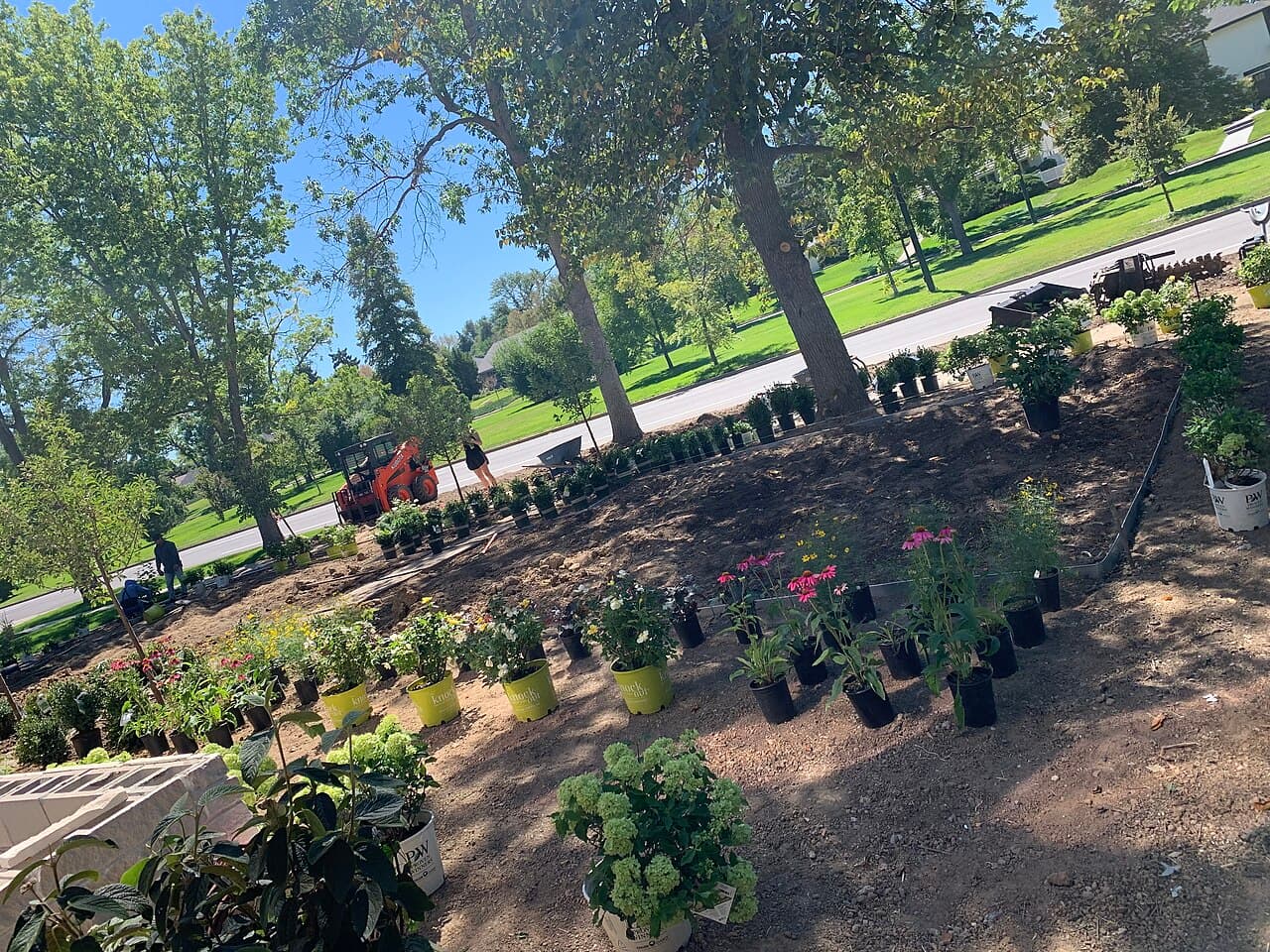
New landscaping lives or dies by its first-year care, and most of that care is watering. New plants have not yet rooted into the surrounding soil, so they depend on the small root ball they came with. Water deeply and on a schedule based on checking the soil, keep mulch thin, weed early, hold off on fertilizer, and look at your plants every week. By the end of the first season the job gets much lighter.
How long "establishment" takes
Plants settle in at different speeds. Seeds and annuals can establish in a few weeks, perennials and vines in a few months to a year, and shrubs and trees can take up to three years.[1] Until then they need more care than the rest of the yard, especially in a hot Virginia summer.
Watering: the main job
The most critical period for watering all plants is right after planting and for three weeks after planting,[1] and for vines, shrubs and trees that period continues through the first growing year.[1]
Check first, then water. Always check the soil about an inch deep to see if it is moist or dry.[1] Check the root ball beside the stem too, since it dries faster than the bed around it. As a guide: with no rain, very sandy soil may need water every 2 to 3 days; otherwise, once a week.[1] Do not water by habit: some native plants do not need much water and can be killed by too much.[1]
Container shrubs. The potting soil of most container-grown shrubs holds only a one- to two-day supply of water,[2] so plan on watering two to three times a week in summer during periods of no rain.[2] B&B shrubs usually need only weekly watering.[2]
New trees. Water heavily once a week during periods of no rain,[3] running a hose slowly and allowing the water to reach the top of the berm built around the plant.[3] A useful measure: for the first 3 years after planting, if the soil is dry, provide about 2 gallons of water per diameter inch of the trunk.[4] To judge timing, check soil moisture about 6 inches below the surface[4], and check every other day in fast-draining soils and weekly in slow-draining soils.[4]
Irrigation systems. A sprinkler zone set for the lawn is rarely right for new shrubs. If you use an irrigation system, Virginia Tech says to set it to run once a week, and to add a rain sensor so it shuts off when it rains.[1] For more on timing, see how often to water new plants.
Mulch and weeds
Place mulch 2 to 3 inches deep around shrubs[2] and trees, and keep it pulled back from the stems and trunks; mulch heaped against them invites disease and pest injury.[2] Do not put any type of fabric or plastic under mulch.[5] Top up thin spots in spring rather than adding a thick new layer every year.
Weeds compete hard with new plants. Walk the beds weekly, and cut weeds off at the ground instead of pulling them,[1] which avoids tearing new roots and turning up more weed seed. If you do pull or dig a weed, cover the bare spot with mulch. Our guide to keeping weeds out of garden beds has more.
Inspect on a schedule
For new plantings, inspect shrubs, trees and vines daily for the first week, then weekly through the first growing year.[1] Look for wilting in the cool of the morning, browning leaves, washed-out mulch after storms, animal damage and mower nicks at the base. Catching a dry root ball or a drainage problem in week two saves the plant; catching it in August often does not. If plants decline anyway, see why new shrubs die after planting.
Fertilizer: usually not yet
Most nursery-grown plants, especially container-grown ones, were well fertilized in production and may not need fertilizer at planting unless the soil is deficient.[2] Feeding a stressed plant can backfire, because fertilizers are salts that may be damaging to plants during dry periods.[2] If a soil test does call for fertilizer, a controlled-release fertilizer reduces the chance of root damage compared with a soluble one.[2]
Pruning and staking
Keep pruning minimal in year one. Prune off any stems or branches that were damaged during planting,[1] and remove dead tips once you can see where live wood begins. Hold off on shaping. Avoid pruning in late summer, because late-summer pruning can push new shoots that may not harden off in time for winter.[2] See when to prune shrubs in Virginia for the calendar.
If a tree was staked, check the ties so they do not cut into bark, and take them off on time: "Remove the stakes and lines after one growing season, or they will inhibit trunk development."[3]
Fall, winter and year two
Do not let new plantings go into winter dry; the Virginia Department of Forestry tree manual says correct watering is critical from spring through autumn and during dry winters, for the first 3 years after planting.[4] And do not stop in year two: slow-growing species, B&B plants and shrubs planted in fall may have grown few roots into the surrounding soil, and may need extra water in the year after planting.[2]
Stop and call a pro if
- Water stands in beds after rain or flows toward the foundation.
- Several plants decline despite steady, checked watering.
- An irrigation system leaks or needs new zones for the beds; irrigation and outdoor sprinkler systems are a licensed specialty in Virginia.[6]
- A new tree leans badly, has a split trunk, or sits under power lines.
- Plants installed by a landscaper fail within the replacement period.
Browse more lawn and landscaping answers, compare landscape design and installation services, or find lawn and landscaping businesses around Blacksburg. To have new plantings looked after or replaced, describe the job once and local businesses quote it.
Common questions
- How long do I need to water new shrubs and trees?
- Through their whole first growing season, and often into the second during dry spells. Shrubs and trees can take up to three years to establish, so keep checking the soil in hot, dry weeks even after the first year.
- Can I just rely on my sprinkler system?
- Lawn sprinklers often wet the surface without soaking a new root ball, and daily cycles can keep clay too wet. Check new plants by hand, give them a slow deep soak when the root ball is dry, and set the system to run once a week with a rain sensor.
- Should I fertilize new landscaping in the fall?
- Only if a soil test calls for it. Most nursery plants arrive well fed, and fertilizer salts can harm roots in dry soil. A soil test from your local Extension office tells you whether anything is needed and how much.
- Do I need to water new plants in winter?
- Sometimes. In a dry fall or a dry, mild winter spell, check the root balls of fall-planted shrubs and evergreens and water when the ground is not frozen and the soil is dry. Going into winter dry adds stress.
- When can I start pruning new shrubs?
- Remove broken or dead stems any time. Leave shaping until the shrub has settled in, then prune spring-flowering shrubs just after they bloom and avoid late-summer pruning, which can push tender growth before winter.
Sources
- [1] Native Plants in the Landscape: Maintaining Native Plants (SPES-799), Virginia Cooperative Extension, Virginia Tech. Checked October 27, 2026.
- [2] Shrubs: Functions, Planting, and Maintenance (426-701), Virginia Cooperative Extension, Virginia Tech. Checked October 27, 2026.
- [3] Planting Trees (426-702), Virginia Cooperative Extension, Virginia Tech. Checked October 27, 2026.
- [4] Tree Owner's Manual (NA-FR-01-10), USDA Forest Service, published by the Virginia Department of Forestry. Checked October 27, 2026.
- [5] How NOT to Kill a Tree: 24 Common Tree Care Mistakes That Damage Landscape Trees (430-210), Virginia Cooperative Extension, Virginia Tech. Checked October 27, 2026.
- [6] 18VAC50-22-30. Definitions of specialty services, Virginia Administrative Code, Board for Contractors. Checked October 27, 2026.
Want a pro to handle it?
Describe the job once. Licensed local businesses send quotes, and you pay only when you book one.
Get a quote from a local pro