How do I plan a landscape design for my yard?
Start with a list of what you want the yard to do, then draw a simple map of the property and note sun, shade, drainage, soil, slopes, utilities and the plants worth keeping. Test the soil a few months ahead, choose plants that suit each spot at their mature size, and plant in phases, ideally in spring or fall.
Free to ask. Local shops send quotes, and you pay only when you book one.
By Kasra Taheri, Founder, LoclisPublished
Researched and drafted with AI, then checked claim by claim against the sources listed below before it was published. Prices and rules change; the dates beside each source say when it was last checked.
Step by step
Read when to stop and call a pro, further down this page, before you start.
Step 1: List your goals
Write down what you want from the yard, what you need, and how much time and money you can put into it.[1]
Step 2: Draw a base map
Use the plot plan from your home purchase or measure the boundaries and house onto graph paper, then make several copies.[1]
Step 3: Map sun and shade
Note which areas get morning or afternoon sun and for how long; full sun means six or more hours a day.[1]
Step 4: Follow the water
Mark where runoff comes from, where it flows, and where it stands after rain.[1]
Step 5: Test drainage in planting spots
Dig a test hole and fill it with water; if it has not drained in 24 hours, choose another spot or a plant that tolerates wet soil.[3]
Step 6: Test the soil early
Send a soil sample a few months before planting so any lime or fertilizer has time to work.[6]
Step 7: Mark what stays and what is coming
Note healthy plants to keep, utilities, views to frame or block, and any future patio, shed or fence.[1]
Step 8: Sketch the use areas
On a copy of the map, outline lawn, beds, play space, paths and sitting areas before you pick a single plant.
Step 9: Choose plants for each spot
Match each location to plants that suit its light, moisture and soil, with a second choice in case the first is not available.[1]
Step 10: Space for mature size
Set plants as far apart, center to center, as their mature spread so they touch but do not crowd.[2]
Step 11: Mix your species
Use more than one or two kinds of shrub so a single pest cannot take out most of the planting.[3]
Step 12: Call Virginia 811 before digging
Request a free utility locate at least 3 working days before any digging, even for small shrubs.[7]
Step 13: Plant in phases
For a large yard, work one section at a time or spread the plan over several years, such as trees first, then shrubs, then perennials.[1]
Plan a yard in the same order a designer would: decide what the space is for, map what the site gives you, lay out the areas, then pick plants that fit each spot at full size. Most of the work happens on paper, and it costs almost nothing. The most common planning mistakes, such as shrubs that swallow windows, plants in soggy ground and trees under power lines, come from skipping the mapping.
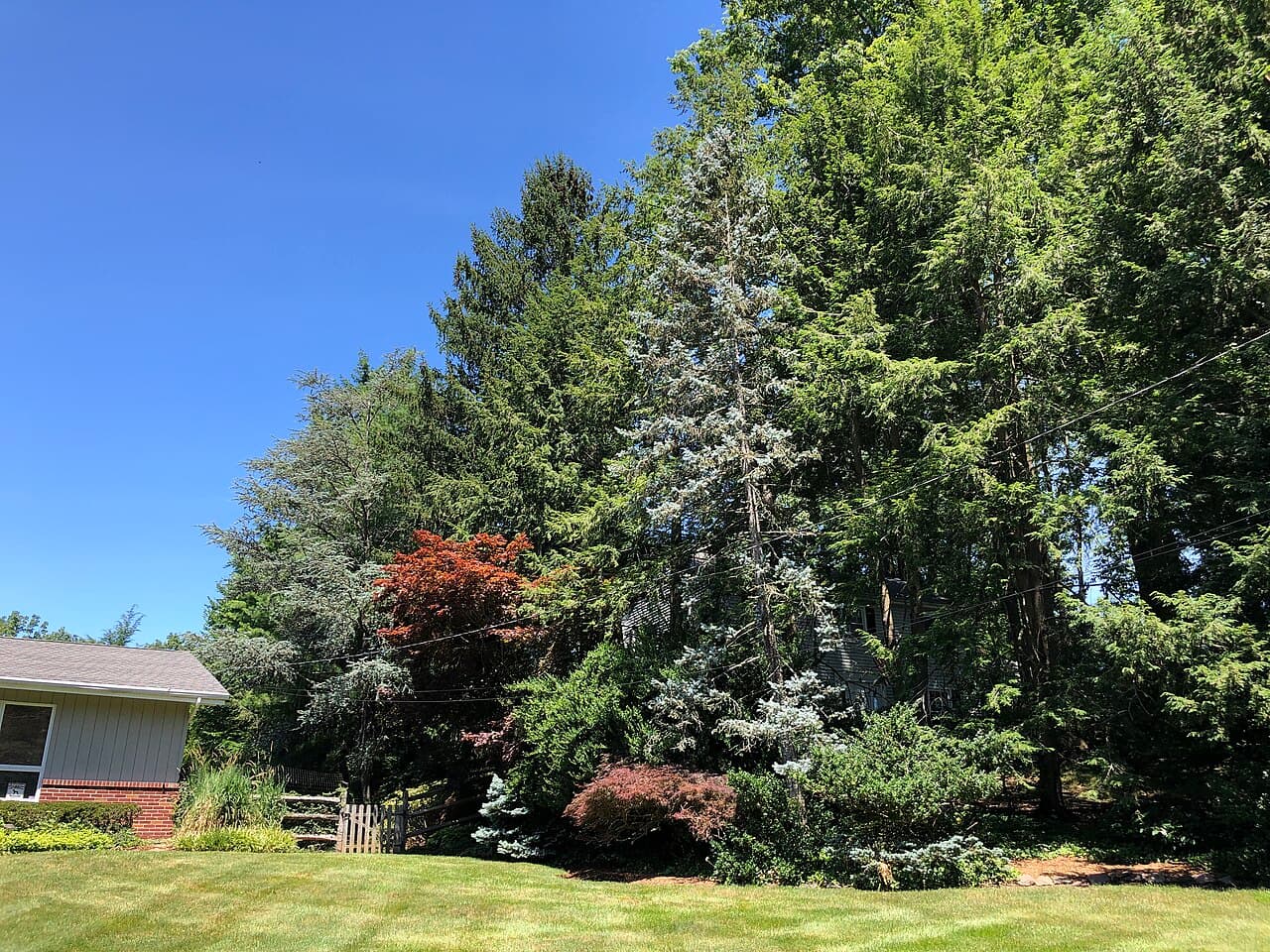
Start with what the yard is for
Make a list of your goals, wants and needs, and be honest about the time and resources you have.[1] Do you want privacy from the street, shade on the west side of the house, a place for children or dogs, a vegetable patch, flowers for pollinators, or less lawn to mow? Who will use each space, and when?
Write down how much weekend time you will really spend on upkeep. Also plan for long-term maintenance, because new plantings need more care until they are established.[1] A low-maintenance goal changes the whole plan: fewer clipped hedges, more shrubs left at their natural size, and mulched beds in place of hard-to-mow corners.
Map what the site gives you
You need a base map. The plot map you received when you bought the house works, or you can measure the boundary lines and the house onto graph paper.[1] Make several copies so you can sketch freely. Then walk the yard at different times of day and record:
- Sun and shade. "Full sun" means six or more hours of light a day.[1] Note whether a bed gets morning or afternoon sun, and remember that the shadow your house casts is longer in winter than in summer.[1]
- Water. Mark where runoff comes from, such as a neighbor's yard, the roof or the street, and where it collects. If water stands for more than two days, plan to improve how it soaks in.[1] In most yards it is usually easier and cheaper to work with the path water already takes than to change it.[1] For planting spots, dig a test hole and fill it with water. Virginia Tech's rule is blunt: "If the water doesn't drain in 24 hours, plant elsewhere."[3]
- Soil. Take a soil sample a few months before any new landscaping[6] so lime or fertilizer has time to change the pH before you plant. Note heavy clay, rocky fill and compacted spots too.
- Slopes, existing plants and structures. Mark slopes, low wet spots, healthy trees worth keeping, sheds, fences, views you want to frame or hide, and any future patio or addition.[1]
- Utilities. Before any digging, contact Virginia 811 at least 3 working days in advance.[7] There is no safe depth: many utilities are buried just a few inches below the surface.[7] Note the septic field or well on your map too.
Lay out the spaces before the plants
On a copy of the map, draw rough bubbles for lawn, beds, paths, play space and a sitting area. Think about how people move from the driveway to the door and from the back door to the yard.
Then assign each area a job. Foundation plantings anchor the house and soften the hard angle where wall meets ground.[3] Choose them by mature size so they stay below windows without constant pruning. For privacy, a shrub border is usually cheaper and better looking than a fence but needs more upkeep.[3] Accent shrubs frame a door or path, and one showy specimen tree can become the focal point you see from the street.
Place shade trees with care. Properly placed deciduous trees shade the house in summer, letting air conditioners run 2 to 4 percent more efficiently, and let winter sun through.[5] Never plant a tree where its mature height will reach a power line,[4] and keep trees back from buildings, driveways and sidewalks, which their roots and limbs can damage or block.[4]
Choose plants that fit each spot
The rule designers repeat is "Put the right plant in the right place."[1] For each area on the map, list plants that suit its light, moisture and soil, with a second choice in case the nursery is out. Native plants are a strong starting point: a landscape does the most for wildlife when at least 70% of its plants are native,[1] and even a few help. If you want to water less, choose plants defined as low water use or drought tolerant for your area.[9]
Space every plant for its mature size, not its pot size. If a shrub will grow 3 feet wide, set it 3 feet, center to center, from its neighbors.[2] Group taller plants at the back or center of a bed and shorter ones along the edges.[2] Use several species instead of one or two, so a single pest cannot wipe out the planting.[3]
Phase it and time it
Spacing is also a budget decision. Closer spacing fills in sooner but means buying more plants,[3] while wider spacing costs less and takes longer to fill. A large yard does not have to be planted at once: split it into sections, or follow a multi-year plan such as trees in year one, shrubs in year two and perennials in year three.[1] Trees go first because they take longest to grow.
In Virginia, the best time to plant container-grown shrubs is spring and fall.[3] Order plants for the season you plan to plant, and see what landscaping costs in Virginia before you finalize the plan.
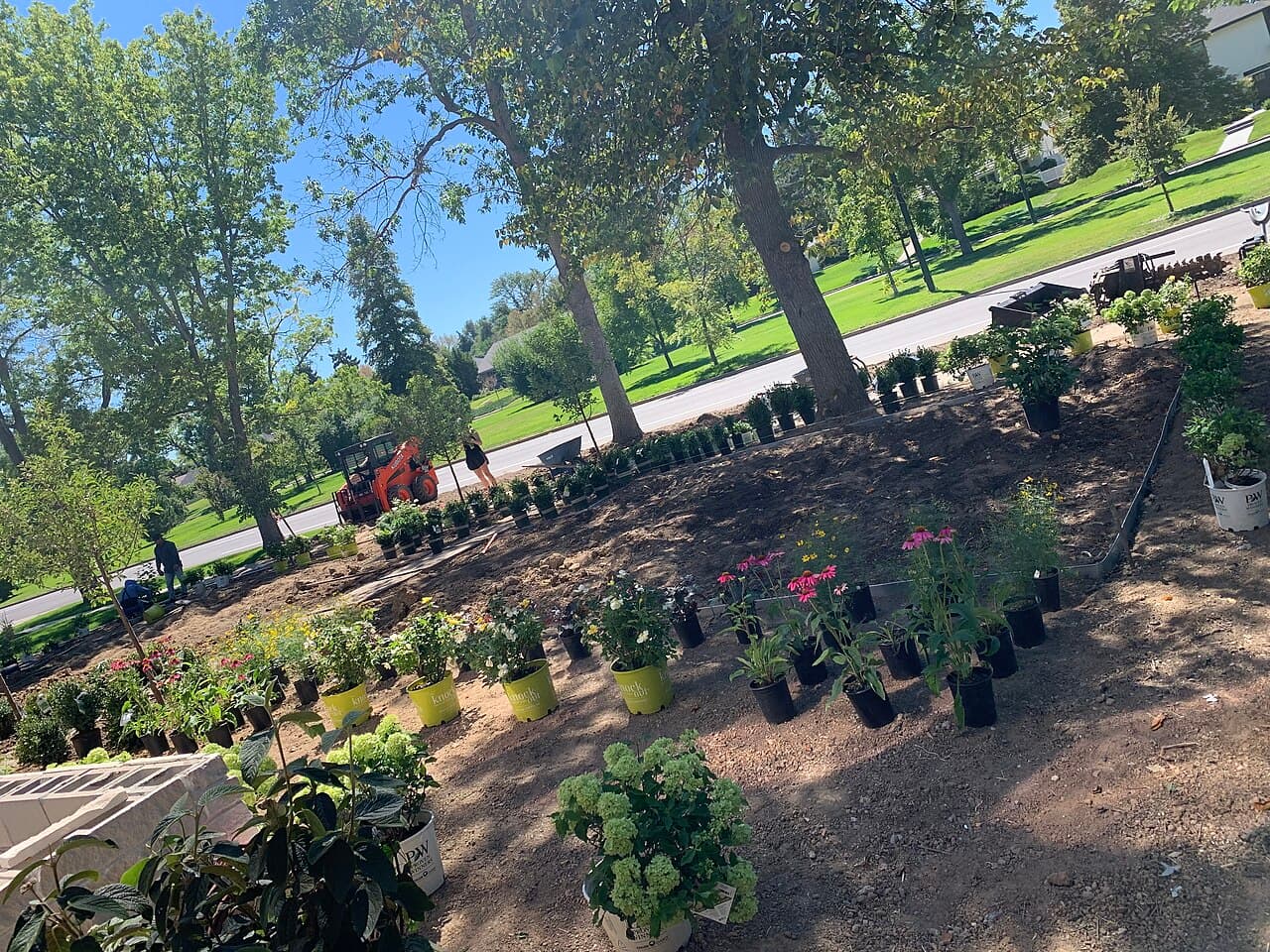
Before planting day, set the potted plants out on the bed in their planned spots, as in the photo above, and walk around them. Moving a pot is easier than moving a shrub. Once they are in, follow a plan for caring for new landscaping in its first year.
Stop and call a pro if
- The plan needs regrading, a retaining wall or drainage changes. In Virginia, grading, retaining walls for landscaping and landscaping timbers fall under the Board for Contractors' landscape service contracting specialty,[8] and moving water toward a neighbor creates new problems.
- You want an irrigation system: installing or repairing irrigation and outdoor sprinkler systems is a separate contracting specialty.[8]
- A slope is eroding, or water runs toward the foundation.
- Large trees need removing or pruning near the house or lines.
- The design covers the whole property and you want a scaled plan with plant lists; see how to choose a landscape designer.
Browse more lawn and landscaping answers, see landscape design and installation services, or look up lawn and landscaping businesses around Blacksburg. To have a plan drawn or installed, describe the job once and local businesses quote it.
Common questions
- Do I need a professional to design my yard?
- No. Many homeowners plan their own yards with a base map, a soil test and good plant lists. A designer earns their fee on a whole-yard plan, a sloped or wet site, or when you want hardscape, grading or lighting worked into one plan. You can also ask your local Extension Master Gardeners for advice on plant choices.
- What scale should I draw my landscape plan at?
- Any scale you can measure from consistently works. On graph paper, one square to a foot or to two feet is common for a typical lot. What matters is that the house, property lines, driveway and existing trees are in the right places, so plant spacing on paper matches the ground.
- When is the best time to plant a new landscape in Virginia?
- Spring and fall are the preferred seasons for container-grown shrubs. Fall planting gives roots time to grow before summer heat. Plants set out in spring need close watching through their first summer, since their roots may still be confined to the root ball.
- How do I keep a new landscape affordable?
- Plant in phases, put trees in first because they take longest to grow, and choose smaller plants spaced for their mature size rather than crowding large ones. Keep healthy existing plants that fit the plan, and test the soil so you only buy the amendments it needs.
Sources
- [1] Native Plants in the Landscape: Incorporating Native Plants (SPES-798), Virginia Cooperative Extension, Virginia Tech. Checked October 27, 2026.
- [2] Native Plants in the Landscape: Maintaining Native Plants (SPES-799), Virginia Cooperative Extension, Virginia Tech. Checked October 27, 2026.
- [3] Shrubs: Functions, Planting, and Maintenance (426-701), Virginia Cooperative Extension, Virginia Tech. Checked October 27, 2026.
- [4] Planting Trees (426-702), Virginia Cooperative Extension, Virginia Tech. Checked October 27, 2026.
- [5] The Value of Landscaping (426-721), Virginia Cooperative Extension, Virginia Tech. Checked October 27, 2026.
- [6] Soil Sampling for Residential Areas (452-129), Virginia Cooperative Extension, Virginia Tech. Checked October 27, 2026.
- [7] Homeowners, Virginia 811. Checked October 27, 2026.
- [8] 18VAC50-22-30. Definitions of specialty services, Virginia Administrative Code, Board for Contractors. Checked October 27, 2026.
- [9] What to Plant, U.S. Environmental Protection Agency, WaterSense. Checked October 27, 2026.
Want a pro to handle it?
Describe the job once. Licensed local businesses send quotes, and you pay only when you book one.
Get a quote from a local pro