How much does septic drain field repair cost in Virginia?
No Virginia agency publishes a going rate, so the real number is a written quote after a licensed evaluator has looked at the site. The state charges no application fee for a permit to repair a failing system. What moves the bill is the private design work, how much of the field must be rebuilt, the soil and space available, and whether an alternative system is needed.
Free to ask. Local shops send quotes, and you pay only when you book one.
By Kasra Taheri, Founder, LoclisPublished
Researched and drafted with AI, then checked claim by claim against the sources listed below before it was published. Prices and rules change; the dates beside each source say when it was last checked.
This is a job for a licensed pro in Virginia
This page explains what the work involves, the permits, what a licensed pro does and what drives the cost. It does not give step-by-step instructions, because this work needs a licence, a permit or both, and doing it wrong can injure someone. Before you hire, check the licence on Virginia's DPOR record.
The short version
There is no published Virginia price for drain field repair, and a number given over the phone before anyone has tested the soil is a guess. The bill depends on what failed and what the site allows: replacing a damaged section of pipe, building a new field in a fresh spot and putting in an alternative system are very different jobs, priced very differently. The state's own permit fee is usually zero. What follows is what you are paying for, and what to ask for in writing.
What the state charges
Virginia does not charge to apply for a repair permit. The fee regulations say: "Any person applying for a permit to repair an onsite sewage disposal system or alternative discharging system shall not be charged a fee for filing the application."[1] Separately, an owner with family income at or below the federal poverty guidelines pays no fee under the same regulation.[1]
Under Va. Code § 32.1-164, other onsite sewage permit applications do carry a filing fee, and the Board of Health is directed to waive fees for the repair of a failing system and for applicants whose incomes are below the federal poverty guidelines.[2] If your project is classed as a voluntary upgrade or new construction rather than a repair, ask the local health department which fee applies and how much it is.
What you pay the private sector for
Evaluation and design. Since August 11, 2019, every application for an onsite sewage system or private well has to come with supporting work from a private sector consultant licensed through the Department of Professional and Occupational Regulation (DPOR).[5] The health department does this work itself only for owners who petition and meet its means test, where household income is no more than 100% of the federal poverty guidelines,[5] or its hardship guidelines. Expect a separate fee for the soil evaluation and design, and ask whether the final inspection after installation is included.
Installation. Virginia's licensing rules bar anyone from installing a conventional or alternative onsite sewage system without an installer licence from the board in the right class.[11] Excavation, materials, hauling and restoring the yard all sit in the installer's price, so ask for each as its own line.
Finding the system. Some septic services charge extra to find and uncover the tank.[4] If you do not know where your system is, the local health department may be able to find it on the construction permits,[4] which can save time on the first visit.
Pumping while you wait. Until the repair is built, licensed professionals may be able to pump the effluent out and haul it away on a schedule ("pump and haul"),[3] and each load is billed.
What makes the job bigger or smaller
What actually failed. Virginia Cooperative Extension puts it plainly: "These failures can require relatively simple and easy fixes or costly system relocations."[3] A repair can mean replacing one component or the whole system.[3] A diagnosis that separates a broken baffle or crushed pipe from a field that no longer drains is worth paying for.
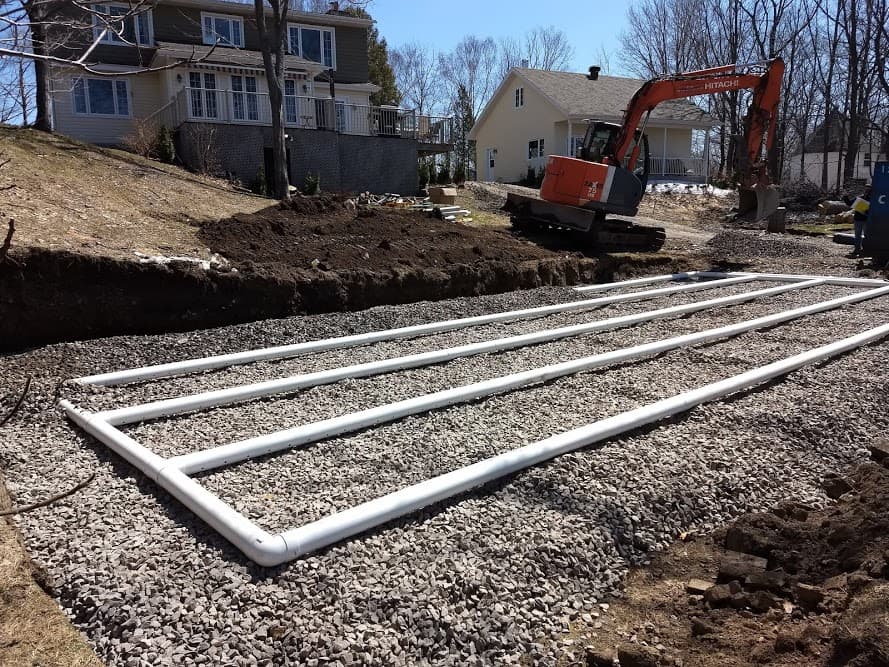
Where the new field can go. Sometimes the system can be moved to a reserve field.[3] Without one, the soil between the existing trenches, a new area on the property, or an adjacent property may be considered.[3] Ask each quote how slope, rock and wet ground affect the price, and what legal paperwork using a neighbour's land would need.
Conventional or alternative. On a tight or poorly drained lot, the answer may be an alternative system that treats the effluent and disperses it in a smaller area.[3] Ask for its build price and its running costs side by side, because an alternative system has to be inspected by a licensed operator at least once a year.[7]
The repair waiver. Under Va. Code § 32.1-164.1:1, the owner of a failing system serving one to four dwelling units may request a waiver from a requirement for treatment beyond what the existing system provided when working properly, or from a new requirement for pressure dosing.[6] That can keep the repair closer to the original design. The waiver is recorded in the land records and becomes void when the property is sold, except for transfers the law specifically allows, such as court-ordered and foreclosure transfers, transfers in settling an estate, and transfers between spouses in a divorce.[6] After an ordinary sale, the added treatment or pressure dosing requirements apply,[6] so weigh the waiver against any plan to sell. Our guide to what a drain field repair involves explains the options in more detail.
Help with the cost
Assistance is limited and mostly for lower-income households. VDH's Septic and Well Assistance Program is for homeowners whose income is at or below 200% of the federal poverty guidelines,[8] but SWAP no longer takes funding applications directly;[8] owners are screened through a homeowner interest form.[8]
VDH's Indemnification Fund helps pay to repair or replace a system, or parts of one, that failed within 3 years of being installed because of VDH's negligence.[9] It pays up to $30,000, reimbursed after the work is done.[9] Some planning district commissions, the New River Valley Regional Commission among them, may offer local help to repair, replace or pump out a septic system.[9] DHCD's Indoor Plumbing Rehabilitation program offers "zero percent interest, subsidized loans in eligible localities" to owners of substandard housing whose wastewater system has failed or who have no indoor plumbing.[9]
What to put in the written quote
Virginia's Board for Contractors advises: "Get at least three written bids."[10] For a septic repair, compare quotes built on the same approved design. A useful quote lists:
- the design it is built to, and the permit number once issued
- trench length or system type, and the main materials
- excavation, hauling, fill and restoring the lawn
- whether pumping the tank and any pump and haul are included
- the final inspection by the designer, and who files the paperwork
- the warranty, and the installer's DPOR licence number and class
A bid far below the others probably means a mistake or missing work.[10] Read before you sign, because "any bid or estimate you sign may become the contract".[10] A good rule of thumb is a first deposit of at most 10% of the total price or $1,000, whichever is less,[10] and expect a written contract: Virginia law requires licensed contractors to provide one for residential work.[10]
When to call a licensed pro
Call promptly when sewage surfaces in the yard, the field smells, or backups return soon after pumping. Wastewater needs enough soil between the trench bottoms and the water table to keep it out of groundwater, and many homes on septic also drink from a private well, which contaminated groundwater can quickly reach.[12] Check each installer and evaluator on DPOR, and read whether you need a permit before work is scheduled.
Get quotes from licensed pros
Loclis lists licensed businesses from Virginia's DPOR register. Browse septic system services, find excavation contractors in Blacksburg, or read more plumbing repair answers. When you are ready, describe the job once and licensed local businesses quote it.
Common questions
- Is there a standard price for drain field repair in Virginia?
- No. No state agency publishes one, and the job ranges from replacing a single component to building a new field or an alternative system. Get written quotes after a licensed onsite soil evaluator or engineer has looked at the site and designed the repair.
- Does the health department charge for a septic repair permit?
- Not for the application. Virginia's fee regulations say that filing an application for a permit to repair an onsite sewage disposal system costs nothing. The private evaluation and design that must come with it are paid to the consultant.
- What does an alternative system add to the cost?
- Ask the designer and installer to price it in full, including the running costs. An alternative system brings an ongoing one: Virginia requires it to be inspected by a licensed operator at least once a year. Ask whether the waiver in Va. Code § 32.1-164.1:1 could let you avoid added treatment requirements.
- Is there help paying for a failed septic system?
- Sometimes, and mostly for lower-income households. VDH's Septic and Well Assistance Program screens homeowners through an interest form, VDH's Indemnification Fund covers some failures within three years of installation caused by VDH negligence, and local programs exist in some regions. Funding is limited, so apply early.
- Should I pay to pump the tank while I wait for the repair?
- You may have to. Pump and haul by licensed haulers is allowed for a limited time while a failed system is repaired or replaced, and each load is a charge. Using less water in the house stretches the time between loads.
Sources
- [1] 12VAC5-620-80, Regulations Governing Fees for Onsite Sewage Disposal Systems: Waiver of fees, Virginia Administrative Code, Legislative Information System. Checked October 26, 2026.
- [2] Code of Virginia § 32.1-164, Powers and duties of Board; regulations; fees, Code of Virginia, Legislative Information System. Checked October 26, 2026.
- [3] What Happens if My Septic System Fails? (SPES-379), Virginia Cooperative Extension, Virginia Tech. Checked October 26, 2026.
- [4] What to Expect When Getting Your Septic Tank Pumped (SPES-574), Virginia Cooperative Extension, Virginia Tech. Checked October 26, 2026.
- [5] Septic, Sewage, and Well Applications: Have You Considered Using the Private Sector?, Virginia Department of Health. Checked October 26, 2026.
- [6] Code of Virginia § 32.1-164.1:1, Validity of certain septic tank permits, Code of Virginia, Legislative Information System. Checked October 26, 2026.
- [7] Onsite Sewage System Owner Responsibilities, Virginia Department of Health. Checked October 26, 2026.
- [8] SWAP Grant Program (Septic and Well Assistance Program), Virginia Department of Health. Checked October 26, 2026.
- [9] Funding Opportunities (Water and Wastewater Services), Virginia Department of Health. Checked October 26, 2026.
- [10] What You Should Know Before You Hire a Contractor, Virginia Board for Contractors, DPOR. Checked October 26, 2026.
- [11] 18VAC160-40-110, Onsite Sewage System Professionals Licensing Regulations: License required (installers), Virginia Administrative Code, Legislative Information System. Checked October 26, 2026.
- [12] How Systems Work, Virginia Department of Health. Checked October 26, 2026.
Want a pro to handle it?
Describe the job once. Licensed local businesses send quotes, and you pay only when you book one.
Get a quote for Plumbing Repair