How much does stereo amplifier repair cost in Virginia?
There is no Virginia price list for stereo amplifier repair, and a number quoted before the unit is on the bench is a guess. The bill depends on what failed, the amplifier's age and design, whether parts are still available and whether a warranty applies. Ask for the diagnosis, the part, the labor and any bench fee in writing before you agree to the work.
Free to ask. Local shops send quotes, and you pay only when you book one.
By Kasra Taheri, Founder, LoclisPublished
Researched and drafted with AI, then checked claim by claim against the sources listed below before it was published. Prices and rules change; the dates beside each source say when it was last checked.
Step by step
Read when to stop and call a pro, further down this page, before you start.
Step 1: Unplug it and note the symptom
Unplug the amplifier and write down what it does: no power, no sound from one side, crackling, a protection light or a hot smell. A specific symptom gets a better quote.
Step 2: Rule out the cheap causes
Swap the speaker cables and the source cables to see whether the fault follows the cable, and try a different input and a different outlet. Do not open the case.
Step 3: Find the model and serial number
Read them off the rear panel and photograph the label, along with any protection or error light.
Step 4: Check the warranty and receipt
A unit still under warranty may be fixed for free. Federal law says a warrantor may not tie its warranty to a brand-name service unless that service is free under the warranty.[1]
Step 5: Call two or three repair shops
Describe the symptom and the model and ask whether they service that brand, what a bench or diagnosis fee is and whether it is credited if you go ahead.
Step 6: Get the quote in writing
Ask for the diagnosis, the part, the labor and any fee on separate lines, plus the warranty on the repair and the turnaround time.
Step 7: Compare repair against replacing
Set the written quote beside the price of a comparable new or used amplifier before you say yes.
Step 8: Keep the paperwork
Keep the quote and the final invoice, and ask for the replaced part back if you want to see what failed.[2]
What decides the price
What failed. Cleaning a noisy input selector, replacing a worn speaker relay, re-capping a power supply and replacing failed output transistors are repairs of very different scale. Ask the shop to name the part, not only the symptom.
Age and design. Older analog amplifiers were built to be serviced, with common parts and published schematics. A modern receiver with networking, HDMI and a lot of surface-mount electronics is harder to work on, and a failed digital board may not be repairable at all.
Parts availability. A part can come from the maker, a parts distributor or a donor unit. Ask for the part price, the labor and any shipping separately, because a part on order adds days or weeks.
Labor and diagnosis. Many shops charge a bench fee to find the fault, and some credit it against the repair. Ask before you hand the unit over.
Brand and service access. Some makers service their own equipment through authorized shops, and some independent shops specialize in particular brands. Call a shop that says it works on yours.
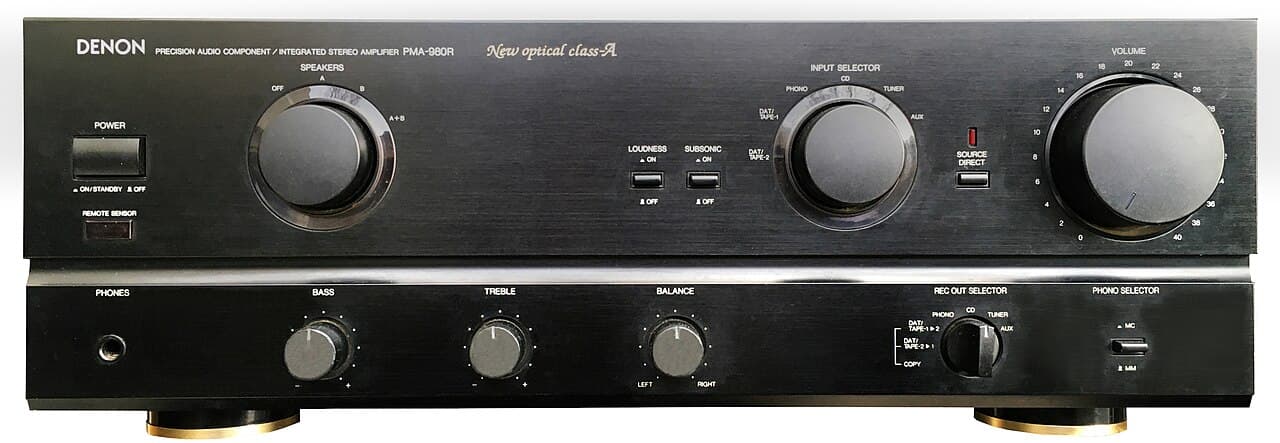
Before you call a shop
Rule out the cheap causes first. Unplug the amplifier, swap in different speaker cables and source cables, and try another input and outlet. A fault that moves with the cable was never the amplifier. Note exactly what happens: no power, one dead channel, crackle when you turn the volume knob, a protection light that comes on. A specific symptom lets a shop give a better first answer on the phone.
Then check the warranty. A unit still covered may be fixed for nothing, so find the receipt, the model number and the serial number. If it is out of warranty, an independent shop is a fair option. On whether using one voids a warranty, federal law says a warrantor may not condition its written or implied warranty on the consumer's using any article or service identified by brand, trade or corporate name, unless the service is provided free under the warranty.[1] A warranty can still exclude damage that a repair caused, so ask the maker if you are unsure.
Get a quote you can compare
Before you agree to work, ask for these in writing:
- the diagnosis, naming the part that failed
- the part, the labor and any bench fee on separate lines
- the warranty on the repair, and whether it covers the part, the labor or both
- the turnaround time and what happens if the part does not arrive
- what you owe if you decline the repair and collect the amplifier
Virginia's Consumer Protection Act lists, among its prohibited practices, misrepresenting that repairs, alterations, modifications, or services have been performed or parts installed.[2] Keep the written quote and the final invoice, and ask for the replaced part back if you want to see it.
Weigh the quote against the price of a comparable amplifier. A repair usually makes sense when the fault is a common part in a unit you like, and less so when the quote nears the cost of a replacement. For the same decision on a related device, see is it worth repairing a TV.
If you decide not to repair
Many amplifiers, receivers and remotes contain batteries. The EPA says lithium-ion batteries, and devices containing them, should not go in household garbage or recycling bins.[3] Look at the EPA's guidance on donating or recycling electronics, or sell the unit for parts, before it goes to the curb.
Stop and call a pro if
Leave the case closed. Repair means bench work on the amplifier's circuit boards and power supply, which is a job for an experienced electronics technician. Take the unit to a repair shop if it smells of burning, trips a breaker, shows a protection light that returns, or hums or crackles after you have changed cables.
Call a licensed electrician if the problem is the wall outlet, a dead circuit or wiring for in-wall speakers or a new power connection. Virginia's licensing law defines a tradesman as "any individual who engages in, or offers to engage in, work for the general public for compensation in the trades of electrical, plumbing and heating, ventilation and air conditioning."[4] A repair shop is not the right call for that work.
Read more electronics repair answers, including how much TV repair costs in Virginia and how much game console repair costs in Virginia.
Loclis lists local repair businesses. Browse electronics repair services, then describe the amplifier problem once and repair shops can quote it.
Common questions
- Is a bench fee normal for an amplifier?
- Many shops charge one to open the unit and find the fault, and some credit it against the repair if you go ahead. Ask before you drop the amplifier off and get the fee in writing.
- Does using an independent shop void my amplifier warranty?
- Federal law says a warrantor may not condition its written or implied warranty on the consumer's using any article or service identified by brand, trade or corporate name, unless the service is provided free under the warranty. A warranty can still exclude damage a repair caused, so ask the maker first if the unit is covered.
- Why do two shops quote different prices for the same amplifier?
- Usually the quotes are not for the same work. One may price a quick fix, another a full service with new parts. Ask each shop to name the failed part and list the parts, labor and warranty separately.
- Is it worth repairing an old amplifier?
- Often, when the fault is a common part and the model has a following, because older amplifiers were built to be serviced. It is less likely to pay when the part is scarce or the quote nears the price of a comparable replacement.
- Can I open the amplifier and look inside myself?
- Leave the case closed. The inside is for an experienced bench technician, and opening it can also complicate a warranty claim. Checking cables, inputs and the outlet from outside is safe.
Sources
- [1] 15 U.S. Code § 2302, Rules governing contents of warranties, Consumer Product Warranties, U.S. Code (Government Publishing Office). Checked October 27, 2026.
- [2] Va. Code § 59.1-200, Prohibited practices, Code of Virginia, Virginia General Assembly. Checked October 27, 2026.
- [3] Electronics Donation and Recycling, U.S. Environmental Protection Agency. Checked October 27, 2026.
- [4] Va. Code § 54.1-1128, Definitions, Code of Virginia, Virginia General Assembly. Checked October 27, 2026.
Want a pro to handle it?
Describe the job once. Licensed local businesses send quotes, and you pay only when you book one.
Get a quote for Electronics