How often should I test GFCI outlets?
Test every GFCI once a month, according to the manufacturer's instructions, as the U.S. Consumer Product Safety Commission recommends. Press the test button and the outlet should cut power; press reset and it should come back. A GFCI can fail without any visible sign, so a unit that fails either step needs an electrician.
Free to ask. Local shops send quotes, and you pay only when you book one.
By Kasra Taheri, Founder, LoclisPublished
Researched and drafted with AI, then checked claim by claim against the sources listed below before it was published. Prices and rules change; the dates beside each source say when it was last checked.
This is a job for a licensed pro in Virginia
This page explains what the work involves, the permits, what a licensed pro does and what drives the cost. It does not give step-by-step instructions, because this work needs a licence, a permit or both, and doing it wrong can injure someone. Before you hire, check the licence on Virginia's DPOR record.
Once a month
Test every GFCI once a month. That is the CPSC's advice: test every GFCI once a month according to the manufacturer's instructions.[1] The reason is blunt. A GFCI can fail without showing any sign of failure, so regular testing may save your life.[1] An outlet that looks fine and powers a lamp may no longer cut power when current leaks, and the test button is the only way an ordinary person finds out.
Leviton's instruction sheet says the same thing in the manufacturer's own words: Press the TEST button (then RESET button) every month to assure proper operation.[2] The device is even printed with "TEST MONTHLY".
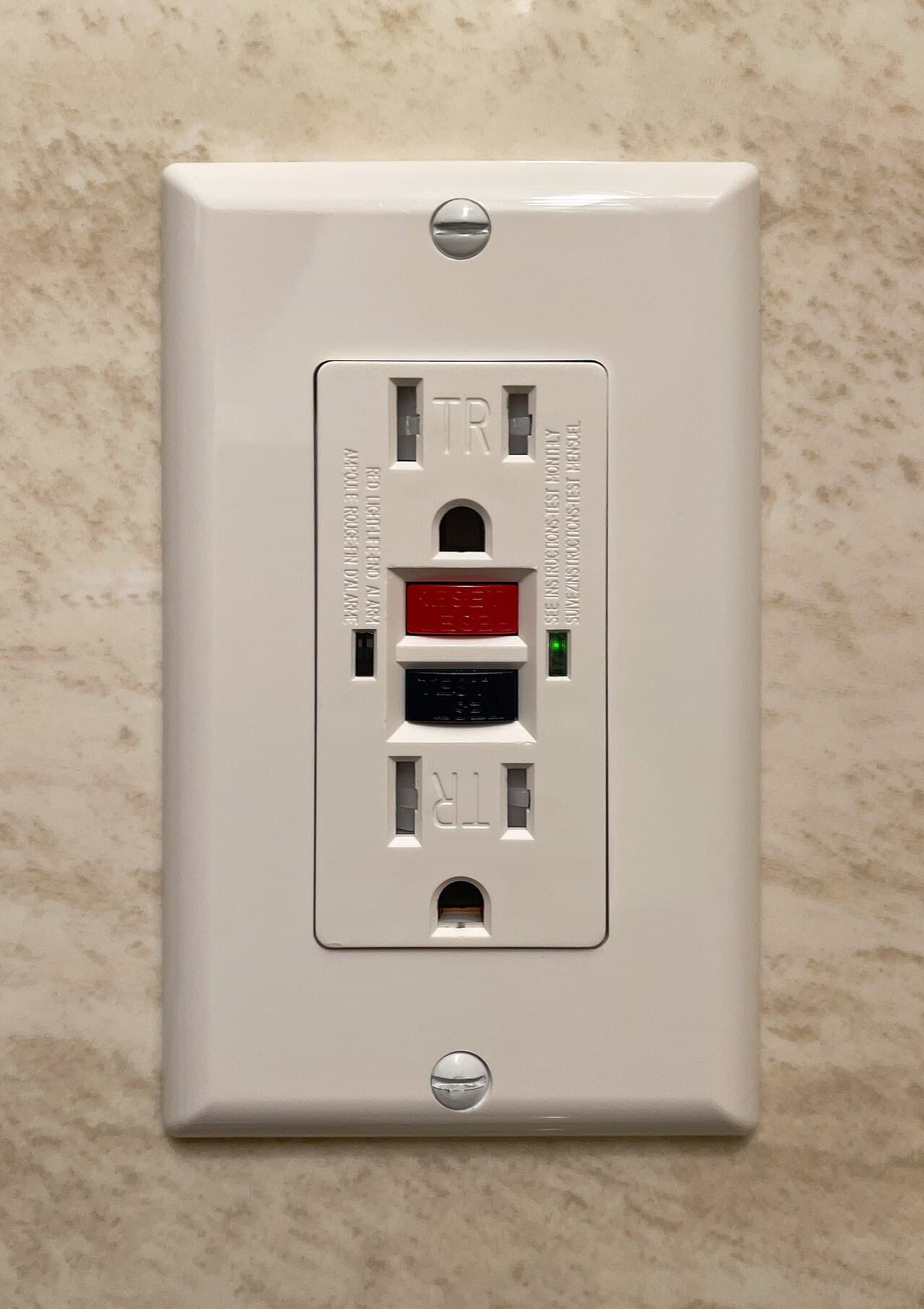
What a test looks like
Pressing test and reset is a button-press, not electrical work, and nothing needs to be opened or removed. Check the instructions that came with the device first, since models differ. If you do not have them, the CPSC gives a simple fallback: plug a light into the outlet and turn it on.[1] Press the test button, and the light should go out. Press the reset button, and the light should come back on. The CPSC says to replace the GFCI if either does not happen.[1]
Do the test with nothing important plugged in. A GFCI can feed other outlets, and Leviton's instructions describe finding which one(s), in addition to the GFCI, lose power when you press the GFCI TEST button.[2] A freezer, a medical device, a sump pump or a computer on a downstream outlet will lose power when you test. Unplug it first, or pick a moment when losing power does no harm.
Which ones to test
Test every one in the house: outlets and breaker-type units alike. Start with the locations where you rely on them most. The CPSC lists kitchens, bathrooms, garages, unfinished basements and the area near laundry tubs or wet bar sinks as locations where the National Electrical Code calls for GFCIs.[1] Walk through the house once, press test on each GFCI outlet, and check that other outlets nearby did not go dead in a way you did not expect. For where Virginia's code requires them, see where Virginia code requires GFCI outlets.
Make it routine. The first day of the month, or the day you change a smoke alarm battery, works for most people. Outdoor outlets, which see rain and temperature swings, are worth an extra check after a storm.
When the test fails
Three results matter. If the test button does nothing and power stays on, the device is no longer protecting you. If the outlet will not reset after the test, the problem may be the device, the supply or the wiring; why a GFCI outlet will not reset explains the difference. If the outlet trips on its own with nothing plugged in, the unit or the circuit has a fault.
In all three, stop relying on the outlet and call an electrician. Plug-in GFCI adapters exist as a stopgap, but they are not a repair.
When to call a licensed pro
Testing is for you. Replacing a failed GFCI is for an electrician, because it means working on wiring that may be live and on a circuit that can feed other outlets. The Code of Virginia defines a tradesman as any individual who engages in, or offers to engage in, work for the general public for compensation in the trades of electrical, plumbing and heating, ventilation and air conditioning,[3] and says no individual shall engage in, or offer to engage in, work as a tradesman unless licensed under that article, apart from individuals working under the supervision of a licensed tradesman in that specialty.[4] Check the licence first with how to check if a contractor is licensed in Virginia.
For the price range and what drives it, see how much it costs to replace a GFCI outlet in Virginia. If you have several GFCIs of the same age, ask the electrician to test them all on the same visit.
GFCIs can prevent electrocutions,[1] but only while they work. What a GFCI outlet does is a good primer if you are not sure how yours is set up.
Next steps
Browse more electrical repair answers or electrical services.
If a GFCI fails its monthly test, describe the problem once and licensed local electricians quote the repair.
Common questions
- How do I test a GFCI outlet?
- Follow the instructions that came with it. The CPSC's fallback is to plug a light into the outlet and turn it on, press the test button and see whether the light goes out, then press reset and see whether it comes back on. If either does not happen, the CPSC says to replace the GFCI.
- Do I need to test GFCI breakers in the panel too?
- Yes. The CPSC's advice covers every GFCI, whether in an outlet or elsewhere, and says to follow the manufacturer's instructions. Breaker-type GFCIs have their own test button, usually labeled on the breaker. If you cannot find the instructions, an electrician can show you.
- What if the test button works but other outlets stay powered?
- That can be normal. A GFCI protects only the outlets wired through it, and a lamp plugged into an ordinary outlet elsewhere will stay lit. If you want to know which outlets a GFCI feeds, test with a lamp and check which ones lose power, or ask an electrician to label them.
- Should I test outdoor GFCIs more often?
- The CPSC recommendation is monthly for every GFCI. Outdoor outlets are exposed to rain and temperature swings, so it is sensible to also test them after a storm or a trip, and to replace one that is cracked, corroded or holds water.
- What does it mean if a GFCI fails the test?
- Either the device has stopped working or something about the circuit is wrong. Stop using the outlet for anything that matters and read why a GFCI will not reset; the fix usually needs an electrician.
Sources
- [1] Home Electrical Safety Checklist (Publication 513), U.S. Consumer Product Safety Commission. Checked October 28, 2026.
- [2] Installing and Testing a GFCI Receptacle (GFNT1 instruction sheet), Leviton Manufacturing Co.. Checked October 28, 2026.
- [3] Va. Code § 54.1-1128, Definitions (tradesmen), Code of Virginia, Virginia General Assembly. Checked October 28, 2026.
- [4] Va. Code § 54.1-1129, Necessity for licensure (tradesmen), Code of Virginia, Virginia General Assembly. Checked October 28, 2026.
Want a pro to handle it?
Describe the job once. Licensed local businesses send quotes, and you pay only when you book one.
Get a quote for Electrical Repair