How do I calibrate a lawn spreader?
For a home lawn, measure the product instead of timing the machine. Work out the lawn's square footage, put the amount of product the bag calls for into the spreader on a low setting, and cover the whole lawn. If it empties before you finish two to four passes, raise the setting slightly and repeat.
Free to ask. Local shops send quotes, and you pay only when you book one.
By Kasra Taheri, Founder, LoclisPublished
Researched and drafted with AI, then checked claim by claim against the sources listed below before it was published. Prices and rules change; the dates beside each source say when it was last checked.
Step by step
Read when to stop and call a pro, further down this page, before you start.
Step 1: Read the bag
Find the area one bag covers and the rate on the label; bags often state that they cover a set number of square feet.[1]
Step 2: Measure the lawn
Divide the lawn into rectangles, multiply length by width for each, and add them up.[1]
Step 3: Measure out the product
Work out how much of the bag your lawn needs, using half the bag for half the area, and measure it the same way each time.[1]
Step 4: Start low
Pour the measured product into the spreader, set it on a low setting and cover the whole lawn.[1]
Step 5: Check what is left
See how much product you used and how much remains in the hopper.[1]
Step 6: Raise the setting if needed
If more than four passes would be needed, raise the setting slightly and repeat.[1]
Step 7: Make two to four passes
Cover the lawn two to four times, changing your walking pattern each time.[1]
Step 8: Keep it on the grass
Sweep or blow any granules on a driveway or sidewalk back onto the lawn.[1]
Measure the product, not the machine
The most reliable way to calibrate a lawn spreader at home is to measure what goes in and make sure all of it lands on a lawn of known size. Virginia Cooperative Extension describes two ways to calibrate the application of granular products: measure the amount of product and apply all of it uniformly to a given area of turf, or calibrate the delivery rate of the machine and run it until the area is covered.[1] It says the first method is the best one for home lawn application.[1]
Bags make this easy. Product bags often state the area one bag covers, such as "covers 5000 square feet", and the product is typically well blended, so half the bag's contents covers half the stated area.[1]
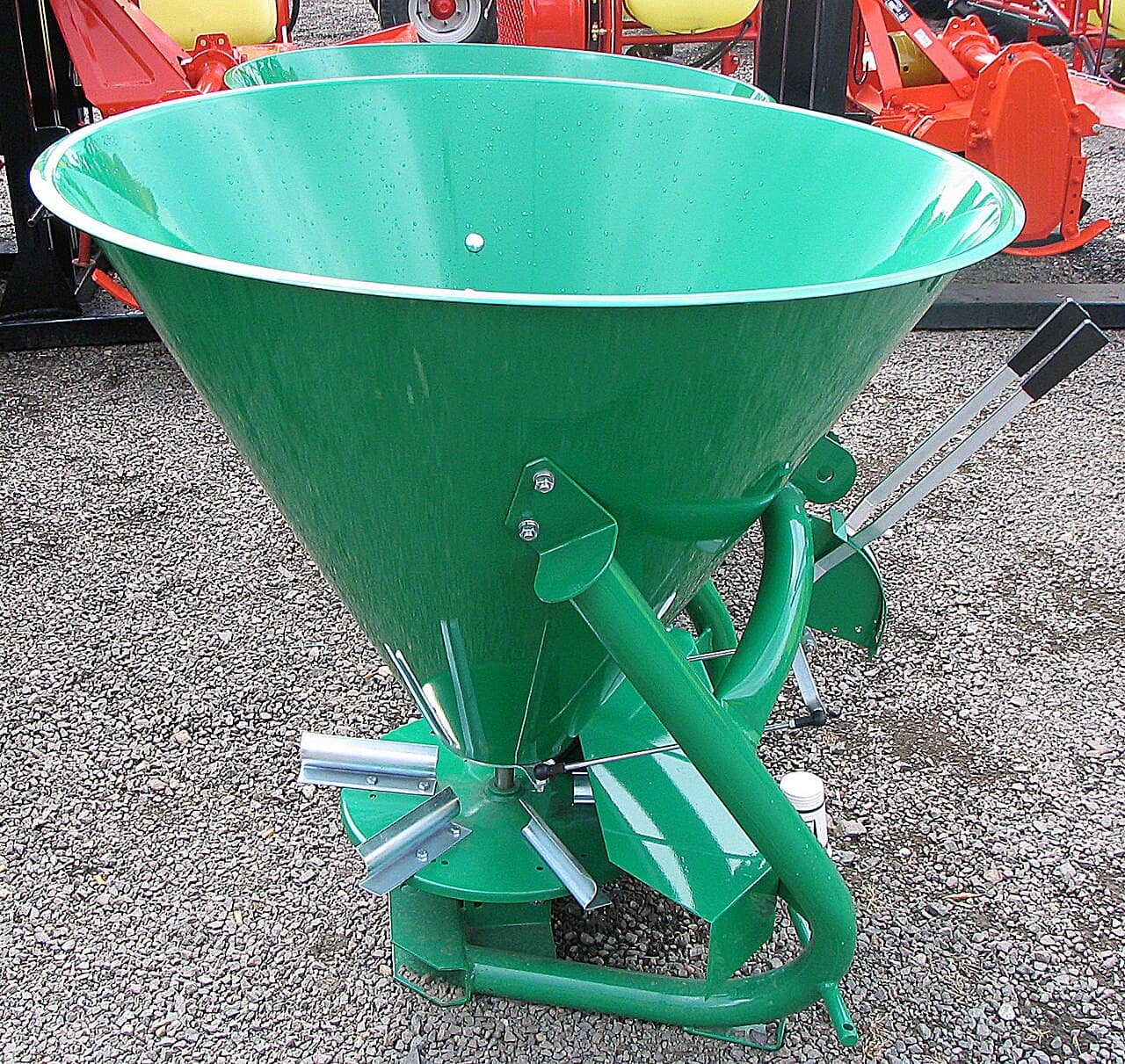
Step one: measure the lawn
Divide the lawn into rectangles and squares, multiply length by width for each, and add the totals. An area 15 feet by 25 feet contains 375 square feet.[1] Leave out house, driveway and beds. Do this once and write the number on the spreader's hopper or in your phone.
Step two: measure the product
Work out what fraction of a bag your lawn needs, then measure out that amount. The scientific way to divide product is by weight, but it is easier for homeowners to divide it by volume, as long as cups or cans are filled the same way each time.[1] Check the label for the rate and for any limit on how much to apply.
On fertilizer, the three numbers on the bag, such as 12-4-8, are the percent by weight of nitrogen, phosphate and potash.[2] Use them with your soil test, not the bag headline, to pick how much to put down.
Step three: find the setting by trial
Place the product in the spreader, set it on a low level, cover the entire lawn, then check how much product was used.[1] If more than four passes are needed, adjust the spreader to a slightly higher level and repeat.[1]
The target is to apply the product evenly in two to four passes, which spreads it uniformly and leaves no pattern from walking; change your walking pattern each time.[1] Once you find a setting that empties the measured amount in that many passes, mark it on the spreader, and keep your walking speed the same on later jobs.
Make the passes even
Drop-type or rotary spreaders should be used for nitrogen fertilizer, because applying it by hand is difficult even for a trained professional.[2] With a drop-type spreader, overlap the wheel tracks, because all of the fertilizer falls between the wheels.[2] Rotary spreaders usually give better distribution where sharp turns are encountered because they cover a broader swath and fan the fertilizer out at the edges.[2]
Until you are experienced with a spreader, apply half the fertilizer in one direction and the other half in a perpendicular direction to minimize streaking.[2]
Keep it off hard surfaces
Avoid applying fertilizer to driveways, roads or bare soil, where it is prone to run off into drainage ways and reach waterways.[2] Many granular spreaders have deflector shields to minimize product delivery onto hardscapes, and granules that land on sidewalks or pavement should be swept up or blown back onto the lawn.[1] Never discard granules or liquids into any drain.[1] Shut the hopper gate before turning at the edges and before you stop.
Stop and call a pro if
- The spreader will not meter evenly even after cleaning. A bent agitator, a worn or sticking gate, or a warped spinner plate is a repair, and a lawn-equipment shop can fix it or tell you it is cheaper to replace.
- The wheels, gearbox or spinner will not turn. Corroded fertilizer can seize the parts, and forcing them breaks the drive.
- The product is a pesticide you are unsure how to apply. Follow the label, or ask a professional lawn-care company rather than guessing at a setting.
- A powered or tractor-mounted spreader needs work. Have the shop service the engine, hitch or drive.
Getting help in Virginia
If your spreader is not the only equipment giving trouble, see how to change the oil in a riding mower, what riding mower repair costs in Virginia and when to fertilize a lawn in Virginia. Browse lawn mowing pros or more lawn equipment repair answers.
When a spreader or mower needs a shop, describe the problem once and local pros quote it.
Common questions
- Why not just use the setting printed on the bag?
- The bag's setting is a starting point for the spreader the manufacturer tested, and your machine, walking speed and the product's granule size all change what comes out. Measuring the product you spread over a measured lawn tells you what actually landed, so use the printed setting only as the place to begin.
- Which calibration method does Virginia Cooperative Extension recommend?
- For a home lawn it says to measure the product and apply all of it uniformly to a known area, rather than calibrating the machine's delivery rate and running it until the area is covered. Machine calibration suits larger or repeated jobs, but it takes more setup.
- How do I stop stripes in my lawn after fertilizing?
- Streaks come from uneven overlap and uneven rates. Until you are practiced, put half the product down in one direction and half at right angles to it. With a drop-type spreader, overlap the wheel tracks, because the fertilizer falls only between the wheels.
- Do I need a different method for a drop spreader and a rotary spreader?
- The measuring is the same. The difference is in how you walk the lawn: a drop spreader spreads only between its wheels, so tracks must overlap, while a rotary spreader throws a broader swath and copes better with turns.
- What if the spreader runs out before I finish the lawn?
- That means the setting is too high. Lower it, refill with the measured amount and start again. If you finish with product left over after several passes, the setting is too low, and you can add passes or raise it a notch.
Sources
- [1] 2026 Pest Management Guide: Home Grounds and Animals, Chapter 5: Lawn (456-018, ENTO-634-E), Virginia Cooperative Extension, Virginia Tech. Checked October 27, 2026.
- [2] Lawn Fertilization in Virginia (430-011), Virginia Cooperative Extension, Virginia Tech. Checked October 27, 2026.
Want a pro to handle it?
Describe the job once. Licensed local businesses send quotes, and you pay only when you book one.
Get a quote for Lawn Equipment