How do I clean gas grill burners?
Shut off the gas at the cylinder valve, let the grill cool, lift the burners out, brush the outside and poke each port clear with a paperclip, wire or 3/32 inch drill bit, then tap out the residue and check the inlet. Put the burners back seated, check the connections with soapy water outdoors and light the grill. Stop if you smell gas or a joint keeps bubbling.
Free to ask. Local shops send quotes, and you pay only when you book one.
By Kasra Taheri, Founder, LoclisPublished
Researched and drafted with AI, then checked claim by claim against the sources listed below before it was published. Prices and rules change; the dates beside each source say when it was last checked.
Step by step
Read when to stop and call a pro, further down this page, before you start.
Step 1: Let it cool and shut the gas off
Turn every control knob to off, close the cylinder valve (or the shut-off valve on a natural gas line) and make sure the grill is completely cool.[2] Leave every gas connection as it is.
Step 2: Take out the grates and heat shields
Lift out the cooking grates and the briquette or flavorizer trays so the burners are in plain view, and set the burners' hardware aside.
Step 3: Lift each burner out
Follow your manual to lift each burner clear of its orifice at the front and of the frame, taking care not to bend it or knock the igniter.
Step 4: Brush the outside
Clean the outside of each burner with a nylon brush once it is cool.[2]
Step 5: Clear the ports
Poke out each burner hole with a paperclip or wire, never a toothpick, or a 3/32 inch drill bit.[1]
Step 7: Check the inlet
Shine a flashlight into the burner inlet and, if you can see an obstruction, clean it with a paperclip or pipe cleaner.[2]
Step 8: Clean the drip tray
Empty and wipe the drip tray, because grease on it blocks airflow and can start a grease fire.[1]
Step 9: Seat the burners
Put each burner back so it sits on its hangers and is pulled all the way to the front panel.[1]
Step 10: Check the connections for leaks
With all knobs off, open the cylinder valve and brush or spray soapy water on the connections outdoors, watching for growing bubbles.[2]
Step 11: Light it and watch the flames
Light the grill with the lid open and check for steady blue flames with slight yellow tips.[2]
To clean gas grill burners, shut off the gas, let the grill cool, lift the burners out, brush the outside with a nylon brush, poke every port clear with a paperclip, wire or small drill bit, and empty the burner. Then put everything back, check the connections with soapy water and light it. It is the usual first fix for weak, uneven or yellow flames.
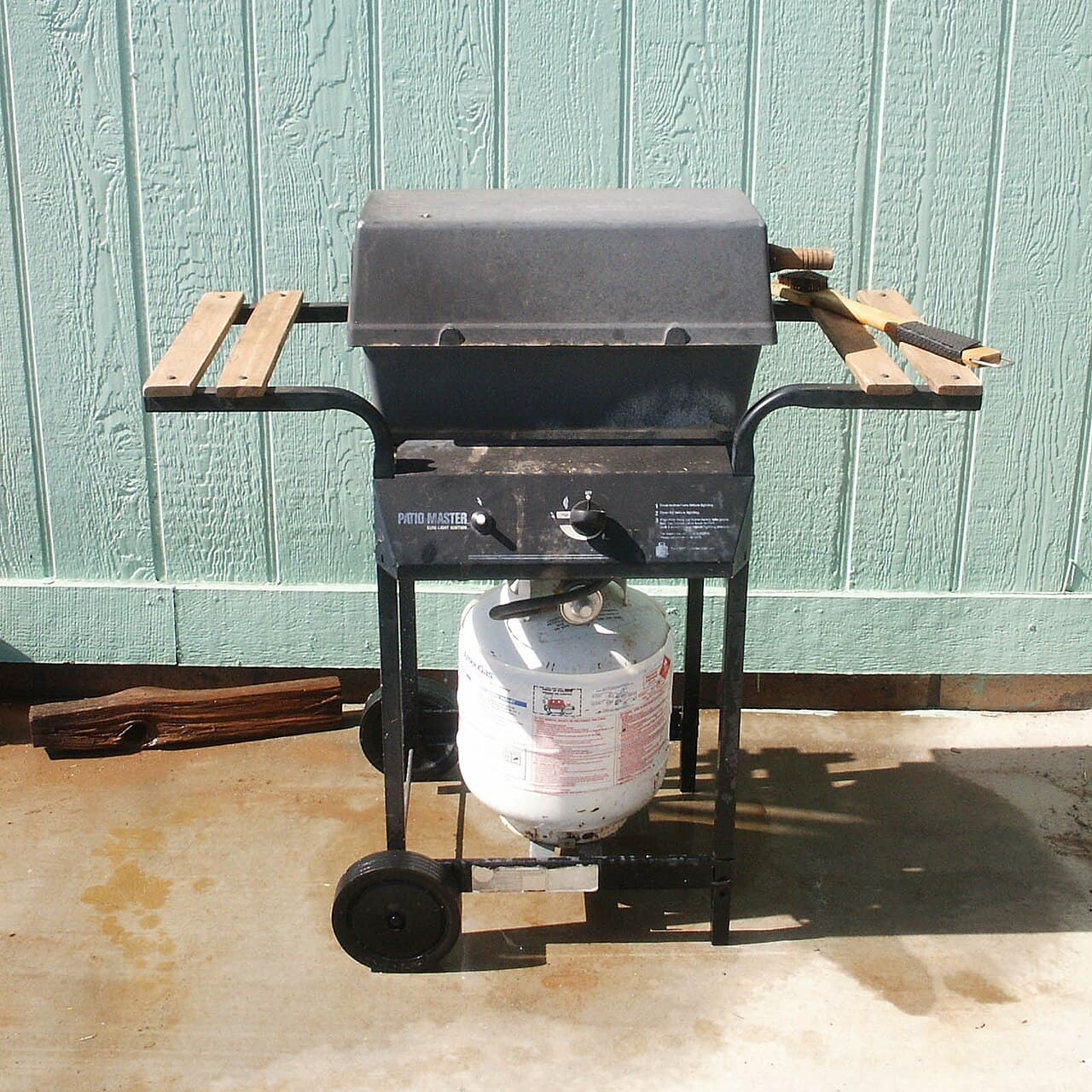
Why burner cleaning matters
A burner is a tube with a row of small ports. Gas flows through the tube and burns at the ports, and anything that blocks them, such as grease, ash, rust or a spider nest, changes the flame. Lynx's troubleshooting page puts it this way: "Burners must be clean in order for proper gas supply to ignite."[1]
Spiders are a real hazard, not a nuisance. Lynx's manual says they "like to nest in the burners, venturis, valves and orifices of a grill, disrupting the gas flow."[2] It advises that at the start of each new grilling season you remove the grilling racks and check the burners, venturis, orifices and valves for obstructions.[2] The same applies if the grill has sat unused for a long time.
This guide covers cleaning with the gas supply closed at the cylinder valve (or the shut-off valve on a natural gas line). You never disconnect, open or alter a gas line to clean a burner.
Before you start
Gather a nylon brush, a paperclip or stiff wire, a flashlight and a small bottle of soapy water for the check at the end. Wear gloves. Lynx's manual says to make sure the grill is completely cool before proceeding.[2]
Burner designs differ, so open your own manual and look at how the burners release. Most lift out after you take off the grates and heat shields, but the fasteners and the way they hook onto the orifice vary. If your manual does not tell you how to remove a part, do not force it. The wording below follows Lynx's published instructions, so check your own maker's guidance where it differs.
How to clean the burners
- Close the gas and let the grill cool. Turn every knob to off, close the cylinder valve and make sure the grill is completely cool.[2] Leave the hose and regulator connected.
- Take out the grates and heat shields so the burners are in view.
- Lift each burner out the way the manual describes, taking care not to bend it.
- Brush the outside clean. Lynx says to clean the exterior of the burner with a nylon brush once it has cooled.[2]
- Clear the ports. Poke out the burner holes with a paperclip or wire, never a toothpick, or with a 3/32 inch drill bit.[1] A toothpick can snap off and leave a plug in the hole.
- Empty the burner. After poking out all holes, gently tap the burner on its end outside the grill to empty the residue out.[1] Shake out any debris through the venturi or burner cap opening.[2]
- Look into the inlet. Use a flashlight to check that the burner inlet is not blocked, and if you can see an obstruction, clean it with a paper clip or a pipe cleaner.[2]
- Wash the drip tray and grates. Lynx warns that grease build-up on the drip tray obstructs the air flow and can cause a grease fire.[1] The U.S. Fire Administration advises cleaning your grill after each use to remove grease that can start a fire.[3]
- Put the burners back. They must sit on the hangers and be pulled all the way to the front panel.[1] A burner that sits crooked or off its orifice gives an uneven flame.
- Check for leaks before lighting. With all knobs off, open the cylinder valve and test the connections as described in the next section.
- Light and watch. Light the grill with the lid open. Lynx describes the right flame as blue and stable with slight yellow tips, burning quietly.[2]
Checking the connections for leaks
Do this outdoors. Lynx's manual says: "Leak tests should be conducted outdoors only."[2] It adds: "Never conduct a leak test using fire or flame."[2] It also says to always leak-test the connection after refilling or exchanging LP cylinders, which is when the connection gets disturbed.[2] Cleaning burners with the hose left connected does not disturb it, but a quick check before you light costs nothing.
Mix a soapy solution of 1 part soap and 3 parts water,[2] make sure every knob is off, open the cylinder valve and brush or spray the solution on each connection and fitting. Bubbles that keep growing mean a leak. Close the cylinder valve at once and do not use the grill.
If the flames still look wrong
Yellow, lazy or uneven flames after cleaning usually mean a port or the inlet is still partly blocked, or a burner is not seated. For flames that do not look right, Lynx's manual says to ensure the burner ports are free and clear of dirt, debris or spider webs.[2] If the problem is low heat across the whole grill, the cause may be the regulator or the gas supply rather than the burners. For the price of a visit, see what gas grill repair costs in Virginia.
Stop and call a pro if
- You smell gas or hear hissing. Columbia Gas of Virginia says to listen for a hissing or blowing sound and to watch for a rotten-egg smell.[4] Propane is heavier than air, so a leak can collect in low spaces near the floor.[4] Turn the knobs off, close the cylinder valve, keep away from anything that could spark and go outside and call 911.[4]
- The leak test shows bubbles. Close the cylinder valve and do not use the grill. A leak from a hose, regulator or fitting means a replacement part and a gas fitter's attention, not a home repair.
- Your grill is hard-piped to a natural gas line. Do not open or alter the line. In Virginia no individual may engage in work as a liquefied petroleum gas fitter or natural gas fitter provider without a licence,[5] so call a licensed gas fitter.
- A burner is cracked, rusted through or burned out. Replace it with the manufacturer's part. Lynx's manual says: "Do not repair or replace any part of the grill unless specifically recommended in this manual."[2]
- There is grease or fire damage behind the control panel. That means a fire hazard inside the cabinet.
Getting help in Virginia
For a one-time cleaning visit or a replacement burner, read how much gas grill repair costs in Virginia, then browse grill repair or see more other repair answers.
If a part or a gas connection needs a pro, describe the problem and local repair pros will quote it.
Common questions
- Can I clean gas grill burners with water?
- Brush the outside with a nylon brush instead, as Lynx's manual describes, and clear the ports with a paperclip or wire.[^lynx-man] Lynx does not call for water on the burner, so check your own manual before using any liquid and make sure everything is dry before it goes back.
- How often should I clean the burners?
- At the start of every grilling season and whenever the flames look yellow, weak or uneven. Lynx's manual says to check the burners, venturis, orifices and valves for obstructions at the start of each season.[^lynx-man]
- Why can't I use a toothpick on the ports?
- Because it can snap off and leave a plug in the hole. Lynx specifies a paperclip, wire or a 3/32 inch drill bit, never a toothpick.[^lynx-ts]
- Do I need to remove the propane tank to clean the burners?
- No. Close the cylinder valve and leave the hose and regulator connected, so you never open a gas connection. Lynx's manual says to leak-test the connection after refilling or exchanging cylinders, which is when it is disturbed.[^lynx-man]
Sources
- [1] Troubleshooting, Lynx Professional Grills. Checked October 27, 2026.
- [2] Lynx Professional Grills (Pro Models) Care & Use / Installation Manual, Lynx Grills. Checked October 27, 2026.
- [3] Outdoor fires, U.S. Fire Administration, FEMA. Checked October 27, 2026.
- [4] Propane safety, Columbia Gas of Virginia. Checked October 27, 2026.
- [5] Va. Code § 54.1-1129, Necessity for licensure, Code of Virginia, Virginia General Assembly. Checked October 27, 2026.
Want a pro to handle it?
Describe the job once. Licensed local businesses send quotes, and you pay only when you book one.
Get a quote for Other Repairs