Why won't my gas grill get hot enough?
The usual causes are a nearly empty cylinder, a valve opened too fast so the regulator tripped, clogged burner ports, a dirty drip tray, wind, or skipping the 15-minute preheat with the lid down. Check those first. If the grill is on natural gas or a hard-piped line, low heat often means low gas pressure, which needs a licensed gas fitter.
Free to ask. Local shops send quotes, and you pay only when you book one.
By Kasra Taheri, Founder, LoclisPublished
Researched and drafted with AI, then checked claim by claim against the sources listed below before it was published. Prices and rules change; the dates beside each source say when it was last checked.
Step by step
Read when to stop and call a pro, further down this page, before you start.
Step 1: Check the fuel and the valve
With a propane grill, make sure there is gas in the cylinder and that the valve on the cylinder is turned on.[1] On a natural gas grill, check that the shut-off valve is open.
Step 2: Open the cylinder valve slowly
Turn every grill knob off and close the cylinder valve, then open the cylinder valve slowly, because opening it fast can trip the regulator.[1] Leave all hose and regulator connections as they are.
Step 4: Look at the flames
Lift the grates with the grill cool and then lit, and watch each burner. Lynx describes the right flame as blue with yellow tips and stable.[1] Weak, yellow or uneven flames point to clogged ports.
Step 5: Clear the burners
With the gas off and the grill cool, brush the burners and poke each port clear with a paperclip, wire or 3/32 inch drill bit, never a toothpick.[1] The full routine is in the burner cleaning guide linked below.
Step 6: Clean the drip tray
Pull the drip tray open and scrape out the grease.[1] Do not line the tray or grates with foil.
Step 7: Reseat the burners
Make sure each burner sits on its hangers and is pulled all the way to the front panel so the gas orifice points into the centre of the burner opening.[1]
Step 8: Block the wind
If the breeze hits the back of the grill, turn it so the wind comes from the side or front, and lift the lid for a couple of minutes if the knobs get hot.[1]
Step 9: Test again
Preheat for 15 minutes with the lid closed and read the thermometer. If it still will not climb, stop and see the list of reasons to call a pro below.
A gas grill that will not get hot enough is usually short of gas, short of air or both. Start with the cheap checks: gas in the cylinder, the valve opened slowly, a full 15-minute preheat with the lid down. Then look at the burner ports and the drip tray. If all of that is fine and the grill runs on natural gas or a fixed gas line, the cause is probably gas pressure, and that is a job for a licensed gas fitter.
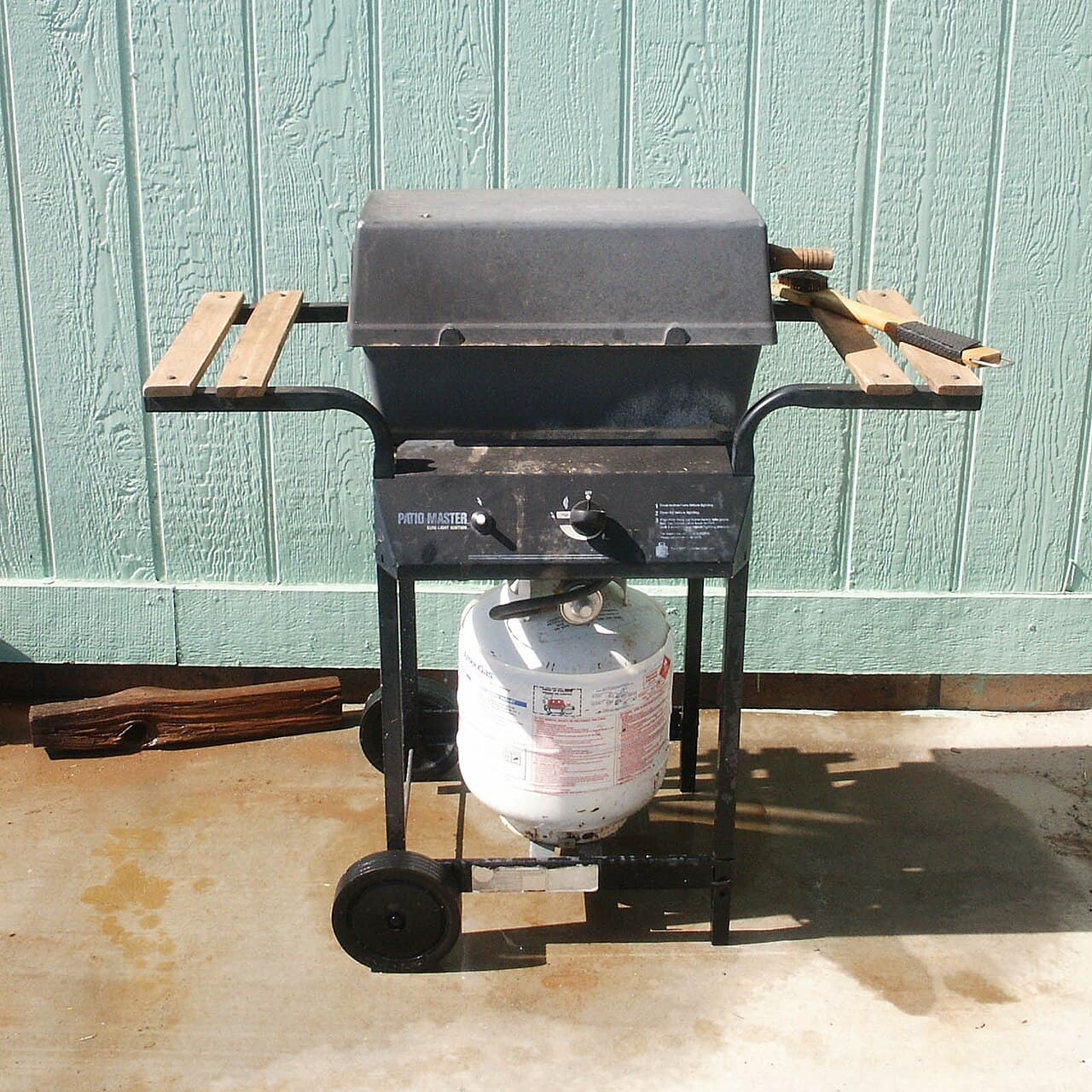
The usual suspects, in order
Most heat complaints come from one of five things.
- Not enough fuel. Lynx's troubleshooting page says: "If using a propane bottle, be sure there is gas in the bottle and the valve on the bottle is turned on."[1] A cylinder that feels light, or a gauge near empty, explains a lot of weak grills.
- A tripped regulator. The same page notes: "When you hook up gas for the first time, the valve has to be opened slowly in order to not trip the regulator."[1] Opening the valve fast is the classic way to get a flame that never rises above a low blue line.
- Clogged burner ports. The same page says "Burners must be clean in order for proper gas supply to ignite."[1] Grease, ash and spider webs block the ports one at a time, so the grill loses heat gradually. See how to clean gas grill burners.
- A dirty drip tray. Lynx warns: "Grease build-up on the drip tray obstructs the air flow and can cause a grease fire."[1] It also says not to use foil or other items on the tray or grates to collect grease, because that may affect the grill's performance.[1]
- Skipping the preheat or grilling in the wind. Lynx says to preheat with all burners on high and the lid closed for 15 minutes, and that the lid thermometer should reach about 400 degrees in that time.[1] On wind it says: "Windy conditions can divert the heat causing a delay in heating temperatures."[1]
What to do, step by step
The short version of the checks follows. Do them with the grill cool and the gas off, except where a step says to light it. Never open or loosen a gas connection.
Check that the cylinder has fuel and that its valve is fully open. Close the valve, turn every knob off, then open the valve slowly. Light the grill with the lid open, confirm that every burner lights, then close the lid and run all burners on high for 15 minutes.
Look at the flames before you close the lid. Lynx describes the right flame as blue with yellow tips and stable at the lowest setting.[1] A flame that is mostly yellow, lazy, or missing along part of the burner means blocked ports or a burner that is not seated. Clear the ports with a paperclip, wire or a 3/32 inch drill bit, never a toothpick,[1] and make sure each burner sits on its hangers and is pulled all the way forward.[1]
Last, look at the position of the grill. If the wind blows into the back, the heat is pushed toward the knobs and the cooking area suffers. Turn the grill so the breeze hits the side or front.
When the problem is gas pressure
If the cylinder is full, the burners are clean and the flames still look weak, the supply may be the issue. This is most common on natural gas grills and on propane grills fed by a fixed line.
Lynx says natural gas or hard-piped propane units may have improper incoming gas pressure, and that lines may be too long or undersized.[1] It adds that "Longer distances and turns or tees in the line can reduce gas pressure at the grill."[1] Two more mistakes show up on its checklist: a grill that was converted between propane and natural gas without changing both the regulator and the orifices, and a bottle-type regulator fitted to a hard-piped propane grill, which does not pass enough gas.[1] A second gas appliance on the same line, such as a side burner, can double-regulate the supply too.[1]
None of those can be fixed by looking at the grill. A manometer reading at the grill manifold and the inlet is what tells the story, and Lynx notes that a reading at the inlet alone is sometimes not enough to tell what is happening.[1] That is work for an authorized servicer or a certified gas plumber.
A word on regulators
Do not remove or bypass the regulator to get more heat. Lynx's manual warns that a pressure regulator must be installed on all gas equipment and that removing it or failing to install it can result in fire and serious personal injury.[2] If you suspect the regulator itself, replace it with the manufacturer's part.
Stop and call a pro if
- You smell gas or hear hissing. Columbia Gas of Virginia says to listen for a hissing or blowing sound and watch for a rotten-egg smell, and that propane is heavier than air, so a leak can collect in low spaces near the floor.[3] Turn the knobs off, close the cylinder valve, keep away from anything that could spark, go outside and call 911.[3]
- The grill runs on natural gas or a fixed propane line and is weak on every burner. That points to pressure or pipe size. In Virginia no individual may engage in work as a liquefied petroleum gas fitter or natural gas fitter provider without a licence,[4] so hire a licensed gas fitter.
- The grill was recently converted between fuels. The regulator and the orifices both need to be right for the fuel.
- Flames are still yellow or uneven after cleaning, or a burner is cracked or rusted through. Replace burners with the manufacturer's part.
- Grease or fire damage sits behind the control panel.
Getting help in Virginia
For prices, read what gas grill repair costs in Virginia. Browse other repair pros or see more other repair answers.
If the grill still will not get hot, describe the problem and local repair pros will quote it.
Common questions
- How long should a gas grill preheat?
- Lynx says to preheat with all burners on high and the lid closed for 15 minutes on most models, and about 4 to 8 minutes on its All Sear models.[^lynx-ts] Check your own manual, because the time and the target temperature differ by grill.
- Why is my propane grill flame so low even though the tank is full?
- A tripped regulator is a common reason. Lynx notes that the cylinder valve has to be opened slowly so it does not trip the regulator.[^lynx-ts] Close the valve, turn the knobs off and reopen the valve slowly. If the flame stays weak, clear the burner ports.
- Can wind keep a gas grill from heating?
- Yes. Lynx says wind can divert the heat and delay the rise in temperature, and that a breeze at the back of the grill can push heat to the knobs.[^lynx-ts] Turn the grill so the wind hits the side or front, or add a windscreen.
- Does a natural gas grill heat differently from a propane one?
- It depends on the gas line. Lynx says natural gas or hard-piped propane units may have the wrong incoming pressure, or a line that is too long or undersized, and recommends an authorized servicer check pressure with a manometer.[^lynx-ts] That is gas work, not a home repair.
Sources
- [1] Troubleshooting, Lynx Professional Grills. Checked October 27, 2026.
- [2] Lynx Professional Grills (Pro Models) Care & Use / Installation Manual, Lynx Grills. Checked October 27, 2026.
- [3] Propane safety, Columbia Gas of Virginia. Checked October 27, 2026.
- [4] Va. Code § 54.1-1129, Necessity for licensure, Code of Virginia, Virginia General Assembly. Checked October 27, 2026.
Want a pro to handle it?
Describe the job once. Licensed local businesses send quotes, and you pay only when you book one.
Get a quote for Other Repairs