How do I find a trustworthy dog walker?
Trust has to come from what you check yourself. Meet the walker with your dog, ask for references and for proof of insurance, ask whether they are registered with your locality, put the schedule, fees and emergency plan in writing, and start with a trial week. Confirm your own dog is licensed first.
Free to ask. Local shops send quotes, and you pay only when you book one.
By Kasra Taheri, Founder, LoclisPublished
Researched and drafted with AI, then checked claim by claim against the sources listed below before it was published. Prices and rules change; the dates beside each source say when it was last checked.
Step by step
Read when to stop and call a pro, further down this page, before you start.
Step 1: Check your own dog first
Confirm your dog's licence is current.[3] Gather its vaccination dates and microchip details too.
Step 2: Collect a few candidates
Ask neighbours, your vet and local groups for walkers, and shortlist two or three.
Step 3: Ask the business questions
Ask whether the walker is registered for a local business licence, carries insurance and works alone or with staff.[2]
Step 4: Ask for references
Ask for two or three current clients you can phone and call them.
Step 5: Meet with your dog
Have the walker meet you and your dog at home and watch how the dog responds and how the walker handles the leash.
Step 6: Ask how they keep dogs under control
Ask where they walk, how many dogs they take at once and what they do if a dog slips its collar.[1]
Step 7: Agree the details in writing
Put the schedule, price, cancellation terms, key handling, vet contact and emergency plan in a short written agreement.
Step 8: Run a trial week
Start with a short trial and ask for a photo or note after each walk.
Finding a good dog walker is mostly about what you check before the first walk. Look for a walker who is registered with your locality, carries insurance, can give you references and will put the arrangement in writing. Then meet in person and run a short trial.
Start with your own dog
Before you hire anyone, make sure your side is in order. Virginia law makes it unlawful to own a dog four months old or older unless it is licensed,[3] so check yours is current. Write down your dog's vaccination dates, any health conditions and medications, and what makes your dog nervous.
Where to look, and what to ask
Neighbours, your vet's office and local community groups are good places to start, and a walker who already walks several dogs on your street tells you something. A directory or marketplace listing is a starting point, not proof of anything, so ask the same questions of everyone.
Ask each candidate:
- How long have you walked dogs, and can I speak to two or three current clients?
- Do you carry liability insurance, and can you show me the policy?
- Are you registered with this county or city as a business? Virginia counties, cities and towns may impose local license taxes and fees,[2] so the answer depends on where you live.
- Do you walk alone or with staff, and who covers when you are sick?
- How many dogs do you take out at once, and where do you walk?
- Do you have training in pet first aid?
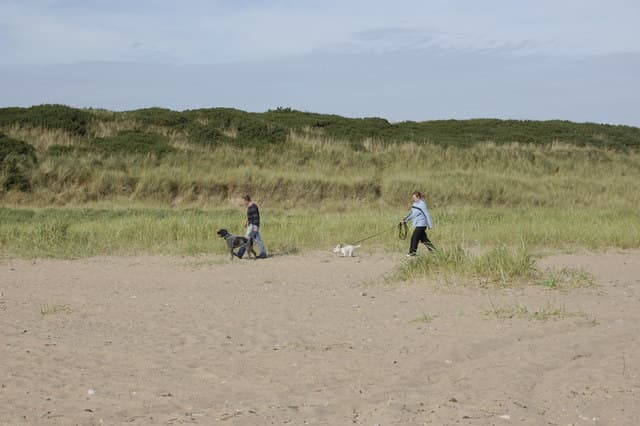
Meet at home, with your dog
A good walker will insist on a meeting. Watch how the dog reacts, and how the walker greets it, handles the leash and asks about your dog's habits. A walker who does not ask about triggers, health or what to do in an emergency has not thought it through.
How a trustworthy walker keeps your dog safe
Control is the big one. Virginia law says a dog runs at large while it is roaming or running off the property of its owner or custodian and not under its owner's or custodian's immediate control.[1] A locality can set a civil penalty of up to $100 per dog for a dog found running at large in a pack.[1] Ask how the walker prevents escapes: a secure harness or collar, a leash at all times unless a fenced area is allowed, and a plan for a dog that slips out.
Ask about waste as well. Bagging, then placing pet wastes in the trash is the best disposal method,[4] so the walker should carry bags and use them on every walk.
Put it in writing
A short written agreement is worth the effort. It should cover the schedule and length of each walk, the price and when you pay, cancellation and holiday terms, how the walker gets in and what happens to the key, your vet's details and who can approve treatment, and what the walker does in an emergency. Ask for a photo or short note after each walk so you know it happened.
For what a walk should cost and how to compare quotes, see how much dog walking costs in Virginia.
Start small and watch for signs
Begin with a trial week. Good signs are a dog that is happy to see the walker, a house that is left as it was found, and prompt updates. Be wary of a walker who is vague about insurance, refuses a meeting, takes many dogs at once, or pushes you to prepay for a long package.
Stop and call a pro if
Do not wait for a trial to tell you something is wrong. Contact your vet or a certified behaviour professional first if your dog has bitten or nipped, reacts strongly to other dogs or people, is very strong on the leash, or has a medical condition. Stop using a walker, and call animal control or your vet as needed, if the dog comes home injured, the walker cannot account for the time, or the dog got loose and you were not told.
See pet services answers and pet services on Loclis, or compare what a poop scooping service costs for the yard.
When you are ready, describe what you need and local walkers will respond.
Common questions
- Does a dog walker need a state licence in Virginia?
- Ask the walker whether they hold any licence or registration. Virginia counties, cities and towns may impose local license taxes and fees, so ask the walker whether they are registered with your locality and check your locality's rules.
- Should I hire an individual or a company?
- Either can be good. A company may offer backup when a walker is sick and usually has staff you can ask about, while an individual gives you one consistent person. Ask both the same questions about insurance, references and emergencies.
- What if my dog gets loose on a walk?
- Settle this before the first walk. Virginia law treats a dog as running at large when it is off its owner's or custodian's property and not under immediate control, and localities can penalise it, so ask how the walker prevents escapes and what they do if one happens.
- What should I give the walker?
- A written sheet with your phone number, a second contact, your vet's details, medications, feeding notes, and what your dog is afraid of or reacts to. Also show how the leash, harness and lock work.
- Should I put a camera in the house?
- Many owners do for their own peace of mind. Tell the walker about any camera in advance, and keep it out of private rooms.
Sources
- [1] Va. Code § 3.2-6538, Governing body of any locality may prohibit dogs from running at large; civil penalty, Code of Virginia, Virginia General Assembly. Checked October 27, 2026.
- [2] Va. Code § 58.1-3703, Counties, cities and towns may impose local license taxes and fees; limitation of authority, Code of Virginia, Virginia General Assembly. Checked October 27, 2026.
- [3] Va. Code § 3.2-6524, Unlicensed dogs prohibited; ordinances for licensing cats, Code of Virginia, Virginia General Assembly. Checked October 27, 2026.
- [4] Stormwater Pollution Reduction, Prince William County, Department of Environmental Services. Checked October 27, 2026.
Want a pro to handle it?
Describe the job once. Licensed local businesses send quotes, and you pay only when you book one.
Get a quote from a local pro