How do I keep a wood porch from rotting?
Keep the wood dry. Decay needs wood above about 30% moisture, so sweep debris out of gaps, keep soil, mulch and plants off the wood, send roof runoff away, and renew a water-repellent finish about once a year. Probe the floor and the post bases each season, and call a pro if a post, beam or joist is soft.
Free to ask. Local shops send quotes, and you pay only when you book one.
By Kasra Taheri, Founder, LoclisPublished
Researched and drafted with AI, then checked claim by claim against the sources listed below before it was published. Prices and rules change; the dates beside each source say when it was last checked.
Step by step
Read when to stop and call a pro, further down this page, before you start.
Step 1: Probe the wood each spring
Press a screwdriver tip into the floor boards, the stair treads, the railing bases and the post bottoms. Mark any spot where the tip sinks in or the wood feels spongy.[3]
Step 2: Sweep out the gaps
Clear leaves, dirt and pine needles from between boards, from the corners against the house and from the stair treads, because debris holds water against the wood.
Step 3: Pull soil and plants back
Keep mulch, soil and plantings away from posts, lattice and stair stringers. Wood in contact with the ground stays wet.[1]
Step 4: Check where the roof water goes
Make sure gutters and downspouts discharge away from the porch, and that the ground near it slopes away rather than toward it.[1]
Step 6: Let the porch dry
If you are going to refinish after cleaning, wait at least 2 warm, windy days for the wood to dry.[2]
Step 7: Renew a water-repellent finish
Brush a penetrating water-repellent preservative onto the floor, paying attention to ends and edges. It is not pigmented and is the easiest finish to reapply.[2]
Step 8: Look at the metal
Check hangers, bolts and screws for rust and loose heads, and look at the places where the porch meets the house for gaps or staining.[3] Note anything that has moved and call a pro rather than tightening framing connections yourself.
Step 9: Clear snow and water
Shovel heavy snow off the porch in winter and sweep standing water toward the edge.[3]
The short version
Rot needs water. The Forest Products Laboratory says "Serious decay occurs only when the moisture content of the wood is above the fiber saturation point (average 30%)."[1] The same source adds that "wood will not decay if it is kept air dry."[1] So keeping a wood porch from rotting comes down to three habits: shed water quickly, keep wood away from wet ground, and renew the finish before it fails.
Keep wood away from the ground and plants
Posts, lattice and stair stringers that touch soil, mulch or damp planting beds stay wet for days after rain. The laboratory's guidance is plain: "Untreated wooden parts of substructures should not be permitted to contact the soil."[1] The laboratory adds: "If contact with soil is unavoidable, the wood should be pressure treated."[1] Even then, Fairfax County's deck details caution: "Not all treated lumber is rated for ground contact."[4]
Pull mulch back from post bases, trim shrubs so air moves through, and cut back vines that grow up railings.
Send water away
Water that runs toward the porch ends up under it. The laboratory notes that "Grading around the building is an important consideration, as is adequate planning for management of roof runoff."[1] In practice, check that gutters are not overflowing onto the porch, downspouts discharge well away from it, and the soil beside it slopes away from the house.
Sweep leaves and dirt out of the gaps between boards and out of the corners against the house. A mat of damp debris holds water against the wood long after the sun has dried everything else.
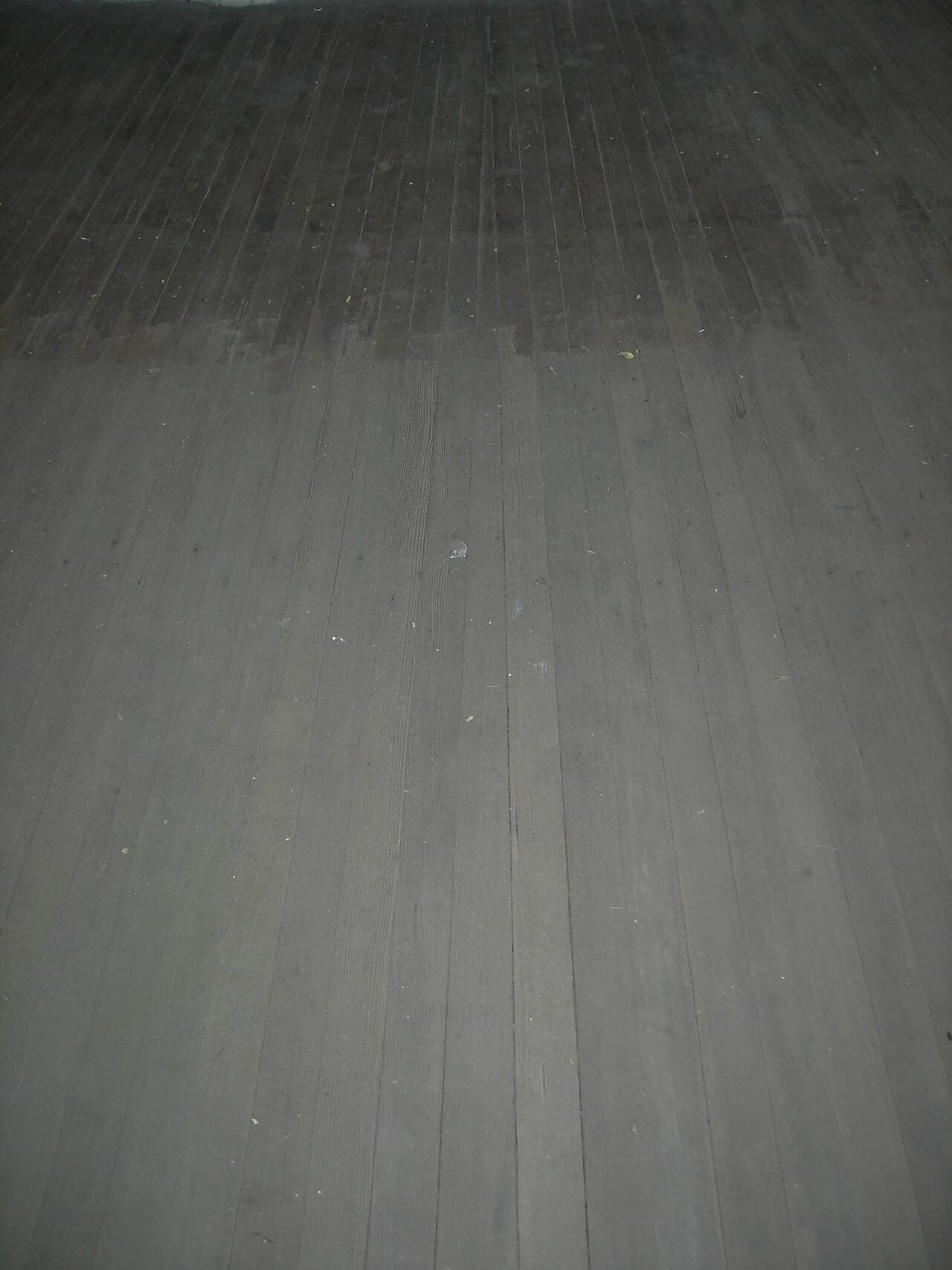
Use the right finish
For floors that people walk on, the laboratory recommends that "penetrating finishes, not film-forming finishes, should be used on wood decks."[2] Film-forming coatings can look good at first, but "Film-forming finishes, such as paints and solid-color stains, are prone to trap moisture and fail by peeling."[2] Railings are an exception: "Paints and solid-color stains may perform quite well on the railings."[2]
A water-repellent preservative is the easiest to look after. "The service life of a WRP finish is about 1 year on the exposed surfaces of wood decks,"[2] but "It absorbs readily into the end grain of lumber,"[2] where water gets in first. If your floor is painted, keep it painted: touch up chips and peeling before bare wood is exposed.
Clean before you refinish
Mildew holds moisture and spoils a finish, so clean it off first. The laboratory's method is a bleach solution: "Dilute the bleach with 3 parts water and add some detergent."[2] Do not use a detergent that contains ammonia, because "Ammonia reacts with bleach to form a toxic gas."[2] Rinse well, and let the wood dry for "at least 2 warm, windy days" before you finish it.[2] Go gently with a pressure washer: "Aggressive scrubbing with a caustic cleaner or power washing can remove wood from the surface."[2]
A yearly check
Fairfax County says "You should evaluate your deck annually."[3] Look at the floor, the stairs, the railing bases and the post bottoms with a screwdriver, and look at the metal. The county asks: "Is there rust or corrosion on any of the fasteners used to connect your decks, rails, beams and joists together?"[3] In winter, "shovel the snow off your deck after a heavy snow fall,"[3] since piled snow adds both load and moisture.
Stop and call a pro if
- A post, beam or joist is soft when you probe it. That is structural work, not maintenance. See why a porch sags.
- The porch is pulling away from the house or the ledger area is stained or damp.
- Fasteners or hangers are rusted through or connections have loosened. Fairfax County says that if you see issues with connection points or wood quality, "consider staying off your deck until a professional inspects it, repairs it or replaces it."[3]
- Boards are soft over a wide area, which usually means the framing under them has been wet too. For a few boards, see how to replace a rotted porch floorboard.
Getting help in Virginia
For an older porch, how much porch repair costs in Virginia and whether to repair or rebuild your porch help you plan. Browse porch repair, deck repair businesses, or more home repair answers.
When the framing needs attention, describe the porch once and licensed local contractors quote it.
Common questions
- What makes a wood porch rot?
- Wood that stays wet. The Forest Products Laboratory says serious decay occurs only when the moisture content of the wood is above the fiber saturation point, which averages 30%. Rain, leaks, standing water and ground contact are what bring wood to that level on a porch.
- Should I paint or stain my porch floor?
- For decking, the Forest Products Laboratory recommends penetrating finishes such as water-repellent preservatives and semitransparent stains, not film-forming ones. Paints and solid-color stains are prone to trap moisture and fail by peeling. Many porch floors are painted anyway, and a painted floor needs its coating kept intact, with no peeling patches where water can get in. Railings are more forgiving: the laboratory says paints and solid-color stains may perform quite well on them.
- How often should I treat a wood porch?
- The Forest Products Laboratory puts the service life of a water-repellent preservative at about one year on the exposed surfaces of a wood deck, so an annual check and reapplication where the wood has stopped beading water is a sensible rhythm. Fairfax County likewise advises evaluating your deck annually.
- Can I pressure wash my porch to clean it?
- Be careful. The Forest Products Laboratory warns that aggressive scrubbing with a caustic cleaner or power washing can remove wood from the surface, particularly on softer wood. A deck cleaner, or a diluted bleach solution rinsed with water, is gentler. Never mix bleach with a product containing ammonia, which makes a toxic gas.
- Does pressure-treated wood still rot?
- It resists decay much better than untreated wood, but it is not immune, and not all treated lumber is rated for ground contact. Fairfax County's deck details say so, and the Forest Products Laboratory recommends pressure-treated wood where contact with soil cannot be avoided. Keeping treated wood dry still helps.
- What do I do if I find soft wood?
- If it is a floor board, see how to replace a rotted porch floorboard. If it is a post, beam, joist or the ledger against the house, stay off that part of the porch and have a licensed contractor look at it, because that is structural work.
Sources
- [1] Wood Handbook, Chapter 14: Biodeterioration of Wood (FPL-GTR-282), U.S. Forest Service, Forest Products Laboratory. Checked October 28, 2026.
- [2] Finishes for Wood Decks, U.S. Forest Service, Forest Products Laboratory. Checked October 28, 2026.
- [3] How to Ensure the Safety of Your Decks, Fairfax County, Virginia. Checked October 28, 2026.
- [4] Typical Deck Details (based on the 2021 Virginia Residential Code), Fairfax County, Virginia. Checked October 28, 2026.
Want a pro to handle it?
Describe the job once. Licensed local businesses send quotes, and you pay only when you book one.
Get a quote for Home Repair