Why is my porch sagging?
A sagging porch means something that carries the floor has failed: a rotted or settled post, a footing that has moved, a decayed beam or joist, loose connections, or a ledger pulling away from the house. Fairfax County advises staying off a deck with problems at connections or in the wood until a professional has inspected it. Treat a sag as structural.
Free to ask. Local shops send quotes, and you pay only when you book one.
By Kasra Taheri, Founder, LoclisPublished
Researched and drafted with AI, then checked claim by claim against the sources listed below before it was published. Prices and rules change; the dates beside each source say when it was last checked.
This is a job for a licensed pro in Virginia
This page explains what the work involves, the permits, what a licensed pro does and what drives the cost. It does not give step-by-step instructions, because this work needs a licence, a permit or both, and doing it wrong can injure someone. Before you hire, check the licence on Virginia's DPOR record.
The short version
A porch sags because something that holds up the floor has failed: a post, a footing, a beam, a joist, the connection to the house, or the fasteners that tie them together. The sag is the symptom. Finding the cause is the job, and in Virginia that job belongs to a licensed contractor, often with a permit.
The usual causes
Rot. Water is the first suspect. The Forest Products Laboratory says "Serious decay occurs only when the moisture content of the wood is above the fiber saturation point (average 30%)."[2] On a porch, wood gets that wet from rain, a leak, standing water or contact with damp ground. Rot tends to start where water collects and cannot dry: the foot of a post, the ends of a beam, the joists along the house wall.
Posts and footings. Fairfax County's building official suggests asking: "Is the material of your wood deck still solid, no wood rot or splitting or insect damage, including the posts at the ground?"[1] A post that has rotted at its base drops. So does a post on a footing that has settled or been undermined by runoff. The Forest Products Laboratory says "If contact with soil is unavoidable, the wood should be pressure treated."[2] Fairfax County's deck details add: "Not all treated lumber is rated for ground contact."[3]
The connection to the house. Many porches hang off the house on a ledger board. The same county asks: "Are all the places where your deck is attached to your home secure?"[1] Its details require "Flashing at ledger board connections"[3] and state: "The existing band board shall be capable of supporting the deck."[3] Water getting behind a ledger can rot both the ledger and the house framing behind it, which lets the porch drop at the wall.
Corroded or loose fasteners. Fairfax asks: "Is there rust or corrosion on any of the fasteners used to connect your decks, rails, beams and joists together?"[1] Rusted hangers, nails and bolts let a connection slide before the wood itself fails.
Too much load. Fairfax County warns: "Don't add large, heavy items such as swimming pools or hot tubs on top of your deck; this is dangerous and could cause a collapse."[1] It also says: "Do not overcrowd the deck beyond its designed load bearing capacity."[1] Heavy snow adds load too, and the county advises you to "shovel the snow off your deck after a heavy snow fall."[1]
What you can safely look at
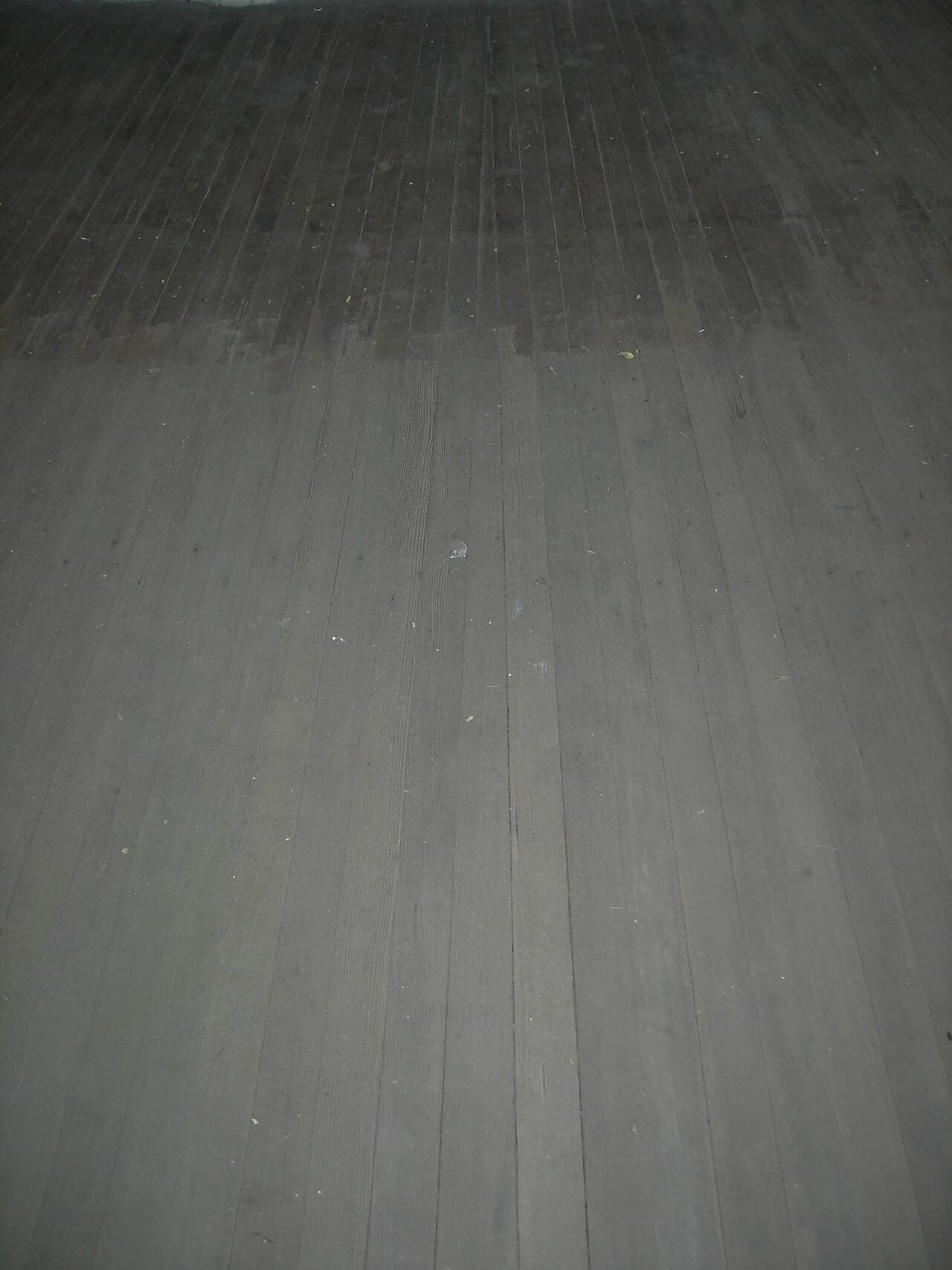
You can look without touching the structure. Note where the floor dips and whether it dips at a post, midway between supports, or along the house wall. Look for gaps opening between the porch and the house, posts leaning or sitting on bare soil, stained or crumbling wood, rusted metal, and railings or stairs that move. Photograph what you see, with a tape measure in the frame, so a contractor can compare it later. A dip in the floor boards alone, with solid framing under it, can be a board problem; see how to replace a rotted porch floorboard.
If you see issues with connection points or wood quality, Fairfax County says to "consider staying off your deck until a professional inspects it, repairs it or replaces it."[1] Treat a porch that moves underfoot the same way.
Permits
A sagging-porch repair usually touches structure. The Uniform Statewide Building Code requires a permit for alterations involving "any structural component," with exemptions for some minor work.[4] Localities add their own thresholds. The Town of Christiansburg lists "More than one support post replacement" as work needing a permit, and says "Any deck or porch over 16 inches above finished grade will need a permit to replace an existing deck."[5] Ask your building department; the contractor normally pulls the permit and arranges the inspection.
What drives the cost
Price depends on how many members are bad and how hard they are to reach: one post against a whole beam line, a footing that needs rebuilding, a ledger that must be re-flashed behind siding, and whether the stairs and railings are affected. Ask each contractor to name the cause, list the parts to be replaced, and say whether the quote includes the permit and inspection. For ranges, see how much porch repair costs in Virginia, and if the damage is widespread, whether to repair or rebuild your porch.
When to call a licensed pro
Call one for any sag. Fixing the supports means lifting a loaded structure and replacing members that carry it. In Virginia, a contractor performing or managing repair work on a single contract of "over $1,000 but less than $30,000" needs at least a Class C licence.[6] Larger jobs need a higher class.
Before you sign:
- Look the licence up with DPOR. As the Board for Contractors puts it, "A license number in an advertisement or on a business card does not necessarily mean the contractor's license is valid."[7]
- Insist on a written contract. The Board says, "Virginia law requires all licensed contractors to provide a written contract for residential work."[7]
- Ask for the cause of the sag, in writing, along with the scope and the permit plan.
Getting help in Virginia
Loclis lists DPOR-licensed contractors with their licence number and class. Browse porch repair, deck repair businesses, or read more home repair answers.
When you are ready, describe the porch once and licensed local contractors quote it.
Common questions
- Is a sagging porch dangerous?
- It can be. A sag means a support has moved or weakened, and you cannot tell by looking how much load is left in it. Fairfax County's advice for a deck with problems at the connections or in the wood is to consider staying off it until a professional inspects it, repairs it or replaces it. Keep people and heavy items off a sagging porch until it has been looked at.
- What usually makes a porch sag?
- Most often water. Wet wood decays, and the posts at the ground, the beam ends and the joists nearest the house are where it tends to start. Other causes are a footing that has settled or washed out, rusted or loose fasteners, a ledger that is no longer secure on the house wall, and more weight than the porch was built to carry.
- Can I jack up a sagging porch myself?
- No. Lifting a porch and replacing a post, beam or joist is structural work. Jacking can crack connections, shift a railing or stair, and put people under a load that is not yet supported. The cause of the sag, which is usually moisture, a footing or a connection, has to be found and fixed or the porch settles again.
- Do I need a permit to fix a sagging porch in Virginia?
- Often yes. The Uniform Statewide Building Code requires a permit for alterations involving any structural component, and replacing posts, beams or joists usually involves one, though the code exempts some minor work. The Town of Christiansburg, for one, requires a permit for more than one support post replacement and for replacing a deck or porch over 16 inches above grade. Your local building department decides, so ask before work starts.
- Who should look at a sagging porch?
- A Virginia-licensed contractor with carpentry or structural repair experience, and in many cases the building official. A bid for a sag should name the cause it found, say which parts it will replace, and state whether it includes a permit and inspection.
- Can a sagging porch be repaired, or does it have to be rebuilt?
- Often it can be repaired if the damage is limited to a few members, such as one post or a section of beam. If the framing is widely decayed or the ledger is compromised, a rebuild may cost about the same. Our guide to repairing versus rebuilding a porch sets out how to decide.
Sources
- [1] How to Ensure the Safety of Your Decks, Fairfax County, Virginia. Checked October 28, 2026.
- [2] Wood Handbook, Chapter 14: Biodeterioration of Wood (FPL-GTR-282), U.S. Forest Service, Forest Products Laboratory. Checked October 28, 2026.
- [3] Typical Deck Details (based on the 2021 Virginia Residential Code), Fairfax County, Virginia. Checked October 28, 2026.
- [4] 13VAC5-63-80. Section 108 Application for permit (Virginia Uniform Statewide Building Code), Virginia Administrative Code, Virginia General Assembly. Checked October 28, 2026.
- [5] Deck Building FAQs, Town of Christiansburg, Virginia. Checked October 28, 2026.
- [6] Va. Code § 54.1-1100, Definitions, Code of Virginia, Virginia General Assembly. Checked October 28, 2026.
- [7] What You Should Know Before You Hire a Contractor, Virginia Board for Contractors, DPOR. Checked October 28, 2026.
Want a pro to handle it?
Describe the job once. Licensed local businesses send quotes, and you pay only when you book one.
Get a quote for Home Repair