How do I replace a rotted porch floorboard?
Probe the board and its neighbours, then pry up only the rotted boards, checking the joists beneath with a screwdriver. If the joists are solid, cut a matching board to length, prime its ends and edges, and fasten it to every joist with corrosion-resistant screws. If a joist, post or beam is soft, stop: that is a structural repair.
Free to ask. Local shops send quotes, and you pay only when you book one.
By Kasra Taheri, Founder, LoclisPublished
Researched and drafted with AI, then checked claim by claim against the sources listed below before it was published. Prices and rules change; the dates beside each source say when it was last checked.
Step by step
Read when to stop and call a pro, further down this page, before you start.
Step 1: Find the extent of the rot
Press a screwdriver into the suspect board and its neighbours. Wood that lets the tip sink in or feels spongy is decayed.[1]
Step 2: Check the porch is fit to stand on
Look at the posts at the ground, the railings and the stairs before you kneel on the floor. Stay off the porch if any connection or post looks unsound.[2]
Step 3: Mark and gather what you need
Mark the bad boards, then buy matching boards of the same thickness and species or treatment, plus corrosion-resistant screws and a pot of primer.
Step 4: Pull the old fasteners
Back out the screws or pry up the nails holding the bad board, working slowly to protect the good boards beside it.
Step 5: Lift the board out
Pry the board up from one end. If it is tongue-and-groove, you may need to split the board along its length to free it.
Step 7: Cut the new board
Measure the gap and cut the replacement so it ends over a joist, then test-fit it dry.
Step 8: Seal the cut ends
Brush primer or the manufacturer's recommended preservative on every cut end and edge, and let it dry.
Step 9: Fasten it
Pre-drill, then drive corrosion-resistant screws into every joist the board crosses, keeping a small gap to its neighbours for drainage.
Step 10: Finish to match
Prime and paint or stain the new board along with the rest of the floor, and dispose of the old board properly.[4]
The short version
Replace a rotted porch floorboard by prying up only the bad boards, checking the joists beneath them, and fastening a matching board over every joist. The job is safe for a homeowner only while the damage stays in the floor boards. A soft joist, post or beam moves it out of this article and into a contractor's hands.
Confirm it is rot
Gray, rough, cracked wood is weathered, not necessarily rotted. Decay is different: the Forest Products Laboratory says "Serious decay occurs only when the moisture content of the wood is above the fiber saturation point (average 30%)."[1] On a porch that means wood that stays wet from rain, a leak or ground contact. Wood attacked by white-rot fungi, for one, "often feels spongy."[1]
Press a screwdriver into the board along its length, especially near the ends, near the house wall and at the porch edge. If the tip sinks in, the board is done. Mark every board that fails, then check the boards on either side, because rot usually spreads.
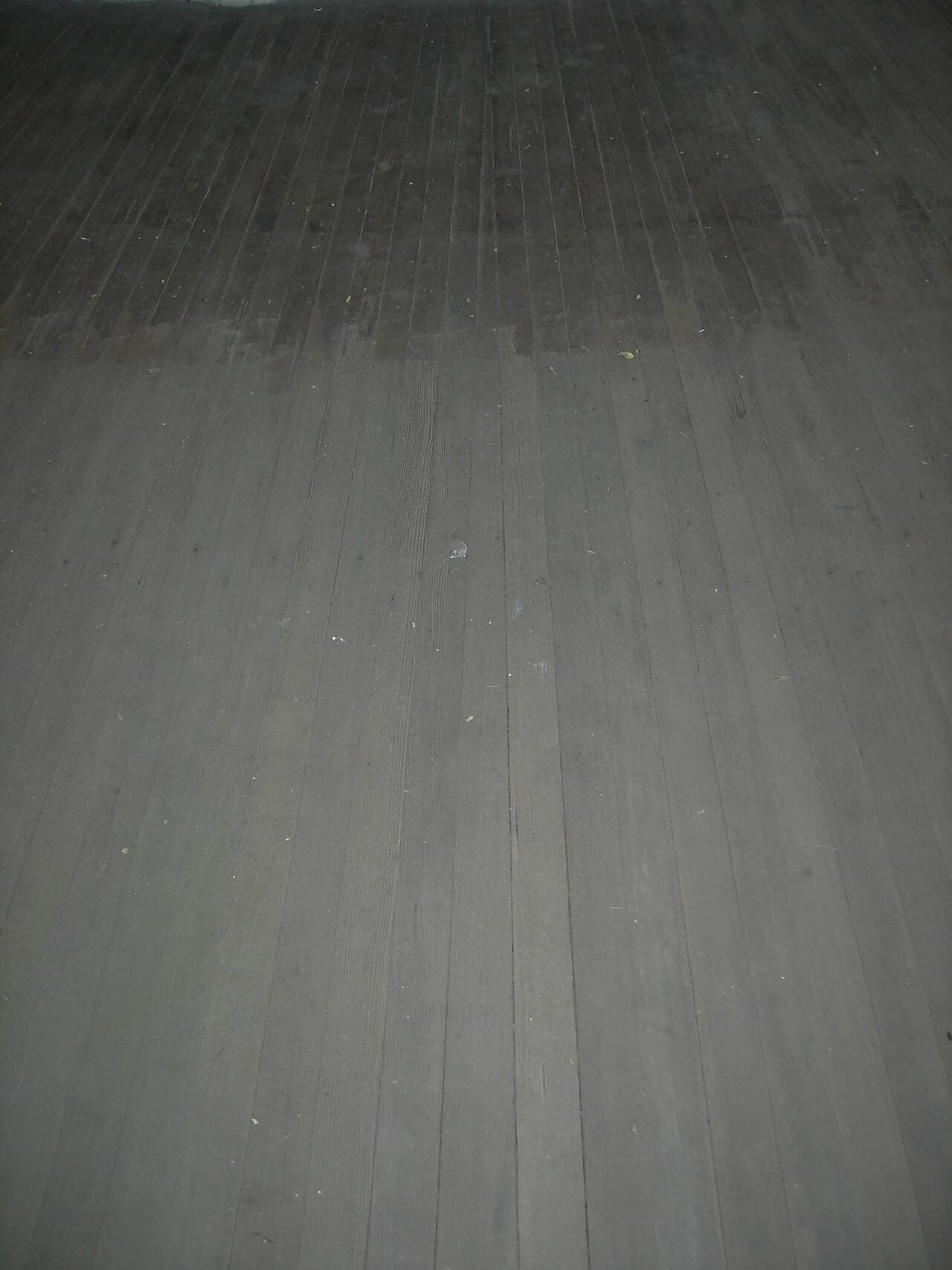
Look at the structure first
Before you kneel on the floor, look at what holds it up. Fairfax County's building official suggests asking: "Is the material of your wood deck still solid, no wood rot or splitting or insect damage, including the posts at the ground?" and advises that if you see issues with connection points or wood quality, "consider staying off your deck until a professional inspects it, repairs it or replaces it."[2] The same applies to a porch.
Permits and who may do it
Replacing boards is ordinary maintenance in the places that have spelled it out. The Town of Christiansburg's list of changes that need no building permit includes "Replacing deck floor boards."[3] The same town requires a permit for "More than one support post replacement," and says "Any deck or porch over 16 inches above finished grade will need a permit to replace an existing deck."[3] Other localities set their own thresholds, so ask your building department when in doubt.
Replace the board
Pull the fasteners first, then pry the board up gently so you do not split the good boards beside it. A tongue-and-groove board often needs to be split lengthwise to lift out. Once it is out, probe every joist it crossed with the screwdriver. Dry, firm joists mean you can carry on. A soft or crumbling joist means you stop.
Cut the new board so it ends over a joist, not in mid-span, and test-fit it dry. Match the thickness of its neighbours. Seal the cut ends and edges before the board goes down, since end grain soaks up water fastest, then pre-drill and screw it to every joist it crosses with corrosion-resistant screws. A small gap to the next board lets the floor drain and dry. Finish it to match the rest.
Old treated lumber
A porch built before 2004 may contain arsenic. CPSC's guidance says that for a residential wood structure built before 2004 and not made of cedar or redwood, "it was most likely constructed with wood pressure-treated with Chromated Copper Arsenate (CCA)."[4] CPSC advises working outdoors and wearing protection ("goggles, gloves, and dust mask") when sawing, cleaning or handling CCA-treated wood, and contacting your state or local authorities about disposal.[4] CPSC's advice is blunt: "Do not burn CCA or other preservative-treated wood to avoid possible inhalation of toxic chemicals in the smoke and ash."[4]
Stop and call a pro if
- A joist, beam or post is soft when you probe it. Replacing framing is structural work, and the Uniform Statewide Building Code requires a permit for alterations involving "any structural component."[5]
- The ledger or posts are pulling away, or a railing or stair wobbles. Fairfax County says to stay off the porch until a professional has inspected it.[2]
- Rot covers a large area of the floor, which usually means the framing under it has been wet too.
- You would have to replace more than one support post, which needs a permit in Christiansburg.[3]
- The porch is more than a few steps up and you would be working near an open edge.
Getting help in Virginia
If the floor is only the start, read should I repair or rebuild my porch and how much porch repair costs in Virginia. Browse porch repair, deck repair businesses, or more home repair answers.
When the framing needs attention, describe the porch once and licensed local contractors quote it.
Common questions
- Do I need a permit to replace porch floorboards in Virginia?
- Usually not for the boards alone. The Town of Christiansburg lists "Replacing deck floor boards" among the changes that do not need a building permit, but it requires one for more than one support post replacement and for work on a deck or porch over 16 inches above grade that amounts to replacing the deck. Rules are set locally, so call your building department before you start.
- How can I tell a rotted board from a weathered one?
- Weathered wood is gray and rough but firm. Decayed wood often feels spongy, and a screwdriver tip sinks into it. Probe the board near the ends and the edges, where water sits.
- What if the joist under the board is soft?
- Do not build on it. A soft joist means water has been reaching the framing, and replacing framing is a structural repair for a licensed contractor. The Uniform Statewide Building Code requires a permit for work on any structural component.
- Is the old wood hazardous?
- It can be. A residential structure built before 2004 and not made of cedar or redwood was most likely built with CCA-treated lumber, which contains arsenic. CPSC advises working outdoors and wearing goggles, gloves and a dust mask when sawing or handling it, and never burning it.
- Why prime the cut ends?
- Rot starts where water gets into wood, and end grain absorbs the most. Sealing the cut ends and edges before the board goes down slows that.
Sources
- [1] Wood Handbook, Chapter 14: Biodeterioration of Wood (FPL-GTR-282), U.S. Forest Service, Forest Products Laboratory. Checked October 27, 2026.
- [2] How to Ensure the Safety of Your Decks, Fairfax County, Virginia. Checked October 27, 2026.
- [3] Deck Building FAQs, Town of Christiansburg, Virginia. Checked October 27, 2026.
- [4] CCA-Pressure Treated Wood: Guidance for Outdoor Wooden Structures, U.S. Consumer Product Safety Commission. Checked October 27, 2026.
- [5] 13VAC5-63-80. Section 108 Application for permit (Virginia Uniform Statewide Building Code), Virginia Administrative Code, Virginia General Assembly. Checked October 27, 2026.
Want a pro to handle it?
Describe the job once. Licensed local businesses send quotes, and you pay only when you book one.
Get a quote for Home Repair