How do I pressure wash vinyl siding without damaging it?
Read your siding maker's care instructions first, because some, such as CertainTeed, advise against power washing vinyl at all. Where a pressure washer is allowed, fit the widest, gentlest nozzle, stand about 4 feet back, never spray upward behind the laps, apply cleaner from the bottom up, rinse from the top down, and work only from the ground.
Free to ask. Local shops send quotes, and you pay only when you book one.
By Kasra Taheri, Founder, LoclisPublished
Researched and drafted with AI, then checked claim by claim against the sources listed below before it was published. Prices and rules change; the dates beside each source say when it was last checked.
Step by step
Read when to stop and call a pro, further down this page, before you start.
Step 1: Check the siding maker's rules
Find the brand on your paperwork or the installer's invoice and read its care page; CertainTeed, for one, does not recommend power washing vinyl.[1]
Step 2: Try the gentle wash first
Wash a test section with mild soapy water, a soft brush and a garden hose, and stop there if it comes clean.[1]
Step 3: Clear and cover the area
Close windows and doors, cover nearby plants, and move toys, bikes and furniture away from the wall.[4]
Step 4: Put on protection
Wear ANSI Z87.1 safety glasses or goggles, hearing protection, long sleeves and trousers, and closed rubber-soled shoes.[4]
Step 5: Set a gas washer well away
Run a gas pressure washer outside, at least 20 feet from windows, doors and vents, never in a garage.[4]
Step 6: Fit the white 40-degree nozzle
Use the widest-fan nozzle, the one the manual lists for vinyl and painted siding, and the lowest pressure setting the unit has.[4]
Step 7: Stand back about 4 feet
Start with the nozzle about 4 feet from the siding and move closer only as far as it takes to lift the dirt.[4]
Step 8: Never spray upward
Keep the spray level with or angled down onto the siding so water runs off the laps instead of being driven up behind them.[4]
Step 12: Stay on the ground
Hold the wand with both hands, expect it to kick back, and never use a pressure washer while standing on a ladder.[4]
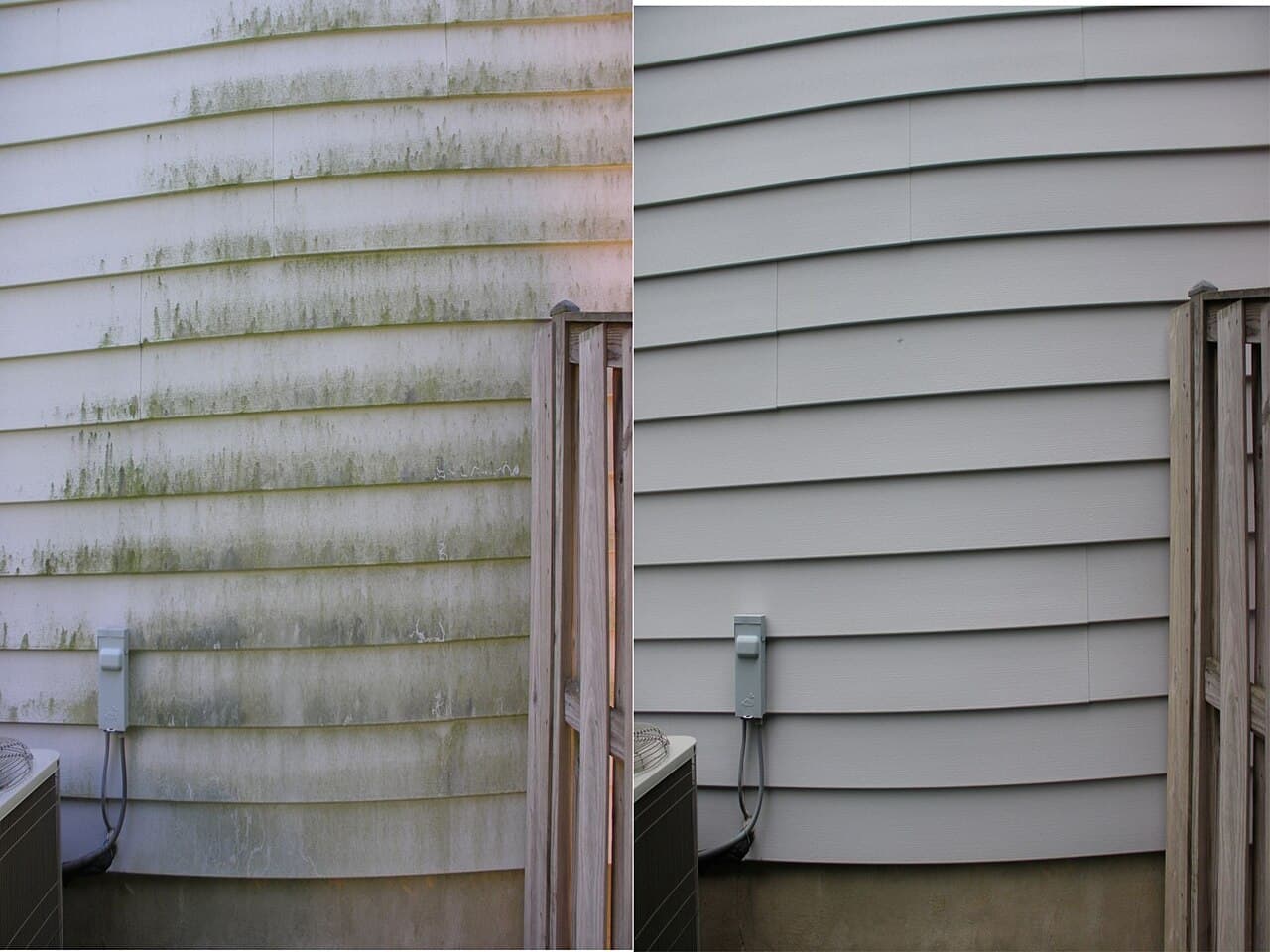
You can clean vinyl siding with a pressure washer without harming it, but only gently, and only if your siding maker allows it. Many do not. CertainTeed's care page says: "We do not recommend power washing vinyl or polymer siding as it can cause moisture intrusion, damage, and/or discoloration."[1] The safest washing is low pressure, a wide fan of spray, plenty of distance, a cleaner that does the work, and no spray ever pointed up under the laps.
Start with what your siding maker says
Find the brand on the original paperwork or the installer's invoice, then read that brand's care page before you wash.
- CertainTeed does not recommend power washing its vinyl and suggests a house wash that connects to your hose instead.[1]
- Alside says rainfall ordinarily keeps its siding clean, with a periodic rinse from a garden hose where rain does not reach.[2] For a deeper clean it calls for a soft-bristled, long-handled brush, and warns against rubbing hard, which can leave glossy patches on the finish.[2]
- Fiber cement trim or siding often sits beside vinyl. James Hardie's answer is blunt: "Using a pressure washer can damage the surface of Hardie® siding."[3]
If the brand rules out pressure washing, a soft brush, a hose-end sprayer of siding cleaner and a garden-hose rinse will clean most walls. The pressure washer is a rinse tool here, not a scrubber.
Mix a cleaner that does the work
Dirt comes off vinyl with chemistry, not force. Alside's recipe for hard-to-remove grime is 1/3 cup powdered detergent and 2/3 cup household cleaner in 1 gallon of water.[2] Where mildew is the problem, swap 1 quart of the water for 1 quart of laundry bleach.[2][1] Both makers warn that greater concentrations may damage the finish.[2][1]
What to keep off vinyl: no cleaners with abrasive particles, solvents or ammonia, and no paint remover.[2] The ammonia rule is also a safety rule. As the EPA puts it: "Never mix chlorine bleach solution with other cleaning solutions or detergents that contain ammonia because toxic fumes could be produced."[5]
Timing matters as much as the mix. Alside suggests an overcast, cool day between 55 and 75 degrees, wetting small areas so the solution stays on for at least 3 minutes and is rinsed before it dries.[2] Apply it low on the wall first: start at the bottom and work up, because less streaking results.[2] Rinse in the other direction, from the top down.
Set the washer up to be gentle
The pressure washer's own manual is the rulebook for the machine. The Simpson manual, typical of homeowner units, lists the white 40-degree nozzle for vinyl and painted siding,[4] and tells you to keep the nozzle about 4 feet from siding.[4] The same table reserves the red and yellow tips for concrete, brick and bare metal, so keep them away from siding.[4]
Direction is what protects the wall. Vinyl panels overlap like shingles, with each lap open at the bottom edge. Spray aimed level or slightly down runs off; spray aimed up goes behind the panel. The manual says it plainly: "Avoid driving water up behind siding."[4] Be careful around the open, ventilated parts of the house too: soffit vents, gable vents, dryer and bath fan hoods, and the gaps at the tops of windows and doors.
Keep yourself safe
A pressure washer is a serious tool. Its spray can cause fluid injection injuries to human and animal flesh, severe lacerations, amputations, and/or death,[4] so never point it at a person, a pet or your own hand, and treat any spray injury as a medical emergency, not a cut. The wand kicks back when you squeeze the trigger, which is why the manual says: "Do not use pressure washer while standing on a ladder."[4]
Water and power do not mix: "Spray directed at electrical receptacles or switches, or objects connected to an electrical circuit, could result in a fatal electrical shock."[4] Keep the spray off outdoor outlets, light fixtures, the electric meter and the outdoor air-conditioning unit's electrical box. With a gas unit, remember: "Engine exhaust contains carbon monoxide, an odorless, colorless, poisonous gas."[4] Run it outside and well away from open windows and doors.
Where the water goes
Siding cleaner and grime run off the wall and down the driveway. Roanoke County's stormwater tips on keeping wash water out of local streams say to "collect and discharge all wash water into the sanitary sewer system, NOT the storm drainage system."[7] Rules differ by locality, so check with yours. Whatever the rule, use as little cleaner as the job needs, rinse plants before and after, and keep runoff off the street and out of storm drains.
Stop and call a pro if
- The wall is above the first storey. Anything you would need a ladder to reach is a job for a crew with extension wands or lifts, not a homeowner on a ladder.
- The roof needs cleaning too. Stay off it, and keep the spray off shingles.
- The house was built before 1978 and has painted trim or siding. If your home was built before 1978, it is more likely to have lead-based paint.[6] Do not blast flaking paint; have a lead-safe certified firm handle it.
- Panels are cracked, loose or warped, or you find water inside the wall after washing. That is a siding repair, not a cleaning job.
- Wires, the meter or an outdoor unit sit where you need to spray.
Related answers
If the wall is green, start with why siding turns green; for timing, see how often to wash a house; and if you are weighing a company, read whether to wash it yourself or hire someone and what siding washing costs. You can browse pressure washing businesses, find exterior pros around Blacksburg, or read the other exterior answers. If washing turns up damaged panels, describe the siding repair once and licensed local businesses will quote it.
Common questions
- What PSI should I use on vinyl siding?
- Siding makers do not agree on a number, and some do not want a pressure washer used at all. Use the widest nozzle, the lowest setting your washer has, and distance: the further the nozzle is from the wall, the lower the pressure that reaches it. If dirt only comes off up close, switch to a brush and cleaner.
- Will pressure washing void my vinyl siding warranty?
- It can, depending on the brand. Alside's warranty requires normal cleaning practices and is void if harmful cleaning compounds are used, and CertainTeed does not recommend power washing its vinyl. Read your own brand's warranty and care page before you start.
- Can I use bleach on vinyl siding?
- Diluted, for mildew: Alside and CertainTeed both give a recipe with about 1 quart of household bleach per gallon of solution, and both warn that stronger mixes can damage the finish. Never mix bleach with a cleaner that contains ammonia, wear eye protection, and rinse plants and the wall well.
- Why did water get inside after I washed the siding?
- Vinyl laps overlap from the top down, so spray aimed upward or held close can be forced behind the panels and into vents, light boxes and gaps at windows. Look for wet drywall or stains indoors, let the wall dry, and have a siding pro check any area that stays wet.
- Is an electric pressure washer safer than a gas one?
- It removes the carbon monoxide risk of a gas engine, but the spray can still cause injection injuries and shocks if it is aimed at outlets, switches or anything on a circuit. The nozzle, distance and ground-only rules are the same.
Sources
- [1] How to Clean Vinyl Siding, CertainTeed. Checked October 26, 2026.
- [2] The Care and Cleaning of Vinyl Siding, Soffit and Accessories (Alside Vinyl Siding Limited Warranty), Alside. Checked October 26, 2026.
- [3] Frequently Asked Questions, James Hardie. Checked October 26, 2026.
- [4] Pressure Washer Use and Care Manual (part 7110656NOCA, rev. B, February 2026), Simpson Cleaning (FNA Group). Checked October 26, 2026.
- [5] A Brief Guide to Mold, Moisture and Your Home, U.S. Environmental Protection Agency. Checked October 26, 2026.
- [6] Protect Your Family from Sources of Lead, U.S. Environmental Protection Agency. Checked October 26, 2026.
- [7] Only Rain Down the Storm Drain: wash water tips, Roanoke County Stormwater Management. Checked October 26, 2026.
Want a pro to handle it?
Describe the job once. Licensed local businesses send quotes, and you pay only when you book one.
Get a quote for Roofing