Should I pressure wash my house myself or hire someone?
Wash it yourself if the house is one storey, your siding maker allows the method, and the paint is not old and flaking. Hire a company for any wall you would need a ladder to reach, for heavy growth across a large house, and for painted siding on a pre-1978 home, where paid crews must be lead-safe certified.
Free to ask. Local shops send quotes, and you pay only when you book one.
By Kasra Taheri, Founder, LoclisPublished
Researched and drafted with AI, then checked claim by claim against the sources listed below before it was published. Prices and rules change; the dates beside each source say when it was last checked.
Step by step
Read when to stop and call a pro, further down this page, before you start.
Step 1: Check the height
Walk around the house and mark every wall you could not wash standing on the ground; those are the ones to hire out.[1]
Step 4: Try the gentle method on one wall
Clean a ground-level wall with siding cleaner, a soft brush and a garden hose to see how much work the house really needs.[2]
Step 5: Price both options
Compare what you would spend on cleaner, brushes and a rented or bought washer with written quotes for the walls you cannot reach.
Step 6: If hiring, get three written quotes
Ask at least three companies to quote the same described job in writing, including the method, cleaner and plant protection.[6]
Step 8: Pay when the work is done
Keep any deposit small, pay the balance after you have walked the house, and do not pay in cash.[6]
Wash the house yourself when every wall you need to clean can be reached from the ground, your siding maker allows the method, and the paint is not old and flaking. Hire a company for anything above the first storey, for heavy mildew or algae across a big house, and for painted siding on a home built before 1978. Many houses end up as a mix: you do the ground-floor walls and the porch, and a crew does the gables.
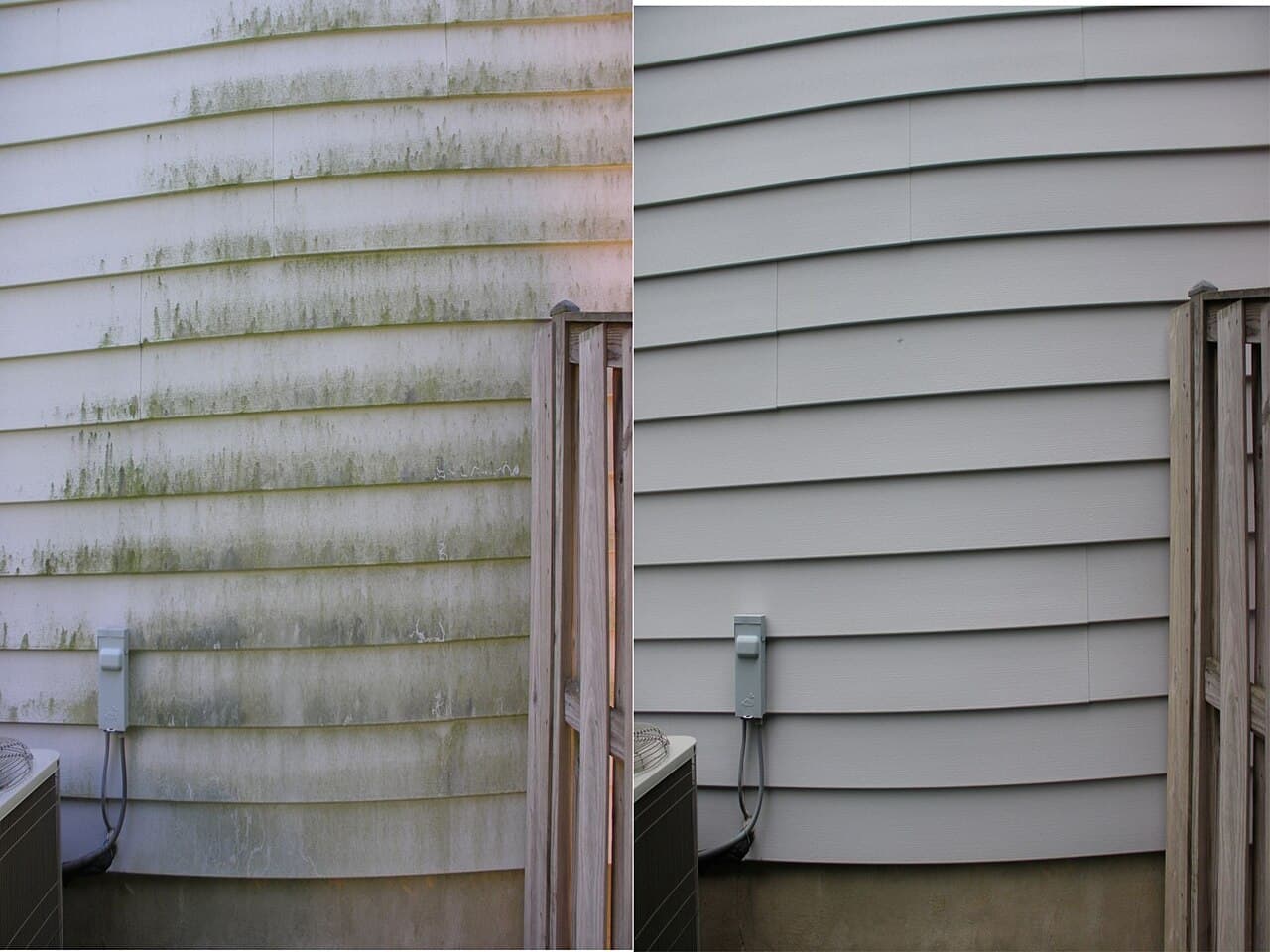
When doing it yourself makes sense
One storey, firm ground. A ranch or the lower walls of a larger house can be washed from the ground with a soft brush, a siding cleaner and a garden hose, with a pressure washer on its gentlest nozzle where the siding allows it. See how to pressure wash vinyl siding without damaging it for the method.
Siding that tolerates it. Check your siding brand before you rent anything. CertainTeed does not recommend power washing vinyl or polymer siding,[2] and James Hardie says: "Using a pressure washer can damage the surface of Hardie® siding."[3] For those, the do-it-yourself job is a brush and hose job, which is slower but much harder to get wrong.
Light, regular dirt. A wall that gets a wash every year or so mostly needs mild soap and a rinse. That is a pleasant afternoon, not a project.
When to hire someone
Anything you would need a ladder for. This is the clearest line. The manual for a typical homeowner unit says: "Do not use pressure washer while standing on a ladder."[1] It explains why: "Reactive force of the spray will cause spray gun/wand to kickback and could cause the operator to slip or fall or misdirect the spray."[1] Crews handle upper walls with extension wands, cleaners that are sprayed on from the ground, or lifts.
Older painted houses. If your home was built before 1978, it is more likely to have lead-based paint.[4] Spray knocks loose paint off the wall, and EPA notes that yards and playgrounds can become contaminated when exterior lead-based paint from houses, other buildings and older playground equipment flakes or peels and gets into the soil.[4] EPA's rule requires that anyone paid to perform work that disturbs painted surfaces in homes, childcare facilities and preschools built before 1978 be certified.[5] The rule does not reach you on your own house: "In general, the RRP Rule does not apply to homeowners doing RRP projects in their own pre-1978 homes."[5] Even so, EPA recommends that homeowners hire a lead-safe certified contractor[5] for work that disturbs old paint.
Big or stubborn jobs. A large house that has gone green on every shaded wall takes a day or more of careful work and a lot of cleaner. A crew with the right equipment often does it in hours.
The risks you take on when you do it yourself
A pressure washer is not a garden hose. Its spray can cause fluid injection injuries to human and animal flesh, severe lacerations, amputations, and/or death,[1] which is why you never point it at a person or a hand, and why the manual lists ANSI Z87.1 safety glasses or goggles, ear plugs or muffs, long sleeves and trousers, and rubber-soled shoes[1] for every use. A gas unit adds carbon monoxide; the same manual warns: "Running an engine indoors will kill you in minutes."[1] Keep it outdoors and away from open windows. Spraying outlets, light fixtures or the meter risks a shock. And too much pressure in the wrong direction drives water behind siding, which can cost more to fix than the wash would have cost.
How to hire a company
Virginia's Board for Contractors advises homeowners to get at least three written bids or estimates[6] for the same work. Describe the job the same way to each: the walls and storeys, the siding material and brand, the worst stains, and any extras such as the porch, walks or gutter faces. Then ask each company:
- What pressure, nozzle and cleaner will you use on this siding, and does that match the maker's care instructions?
- How will you protect plants, windows, vents and outdoor electrical fixtures?
- Where will the wash water go?
- Are you insured, and can you give me local references? DPOR's advice is the same for any home job: "Ask the contractor for local references, and call them to see if they were satisfied with the contractor’s work."[6]
- For a pre-1978 house: is your firm EPA lead-safe certified?
In Virginia, a Class C contractor's licence covers construction, removal, repair or improvement jobs with a single contract over $1,000 and under $30,000.[7] If a wash quote grows into siding repair or repainting above that line, check the licence on DPOR's lookup before you sign.
On payment, the Board's advice is to limit a deposit to 10% of the price or $1,000, whichever is less, do not pay 100% of the bill until the job is 100% complete, and never pay cash.[6] If the sale started with a knock on your door and you agreed at home, Virginia's Home Solicitation Sales Act says you may cancel at any time before midnight of the third business day after the date of the transaction.[8] For what moves the price, see what pressure washing siding costs in Virginia.
Stop and call a pro if
- A wall, gable or dormer is out of reach from the ground.
- The house was built before 1978 and the paint is peeling, cracking or chalking.
- You find cracked or loose panels, soft trim, or water inside after a wash.
- The growth comes back within months, which usually means a moisture source to fix first (see why siding turns green).
Finding help on Loclis
Browse pressure washing businesses, find exterior pros around Blacksburg, or read the other exterior answers, including how often to wash a house. If the wash turns up damaged siding, describe the siding repair once and licensed local businesses will quote it.
Common questions
- Can I wash a two-storey house myself?
- The ground-floor walls, yes, if your siding allows it. For the upper storey, stay off the ladder: pressure washer manuals forbid using one while standing on a ladder because the wand kicks back. A hose-end sprayer of siding cleaner reaches some upper walls from the ground; the rest is a job for a crew with extension wands or a lift.
- Does EPA's lead rule apply if I wash my own older house?
- Generally not. EPA's rule for work that disturbs painted surfaces in pre-1978 homes generally does not apply to homeowners working on their own homes, but EPA still recommends hiring a lead-safe certified contractor, and lead-safe practices if you do it yourself.
- Is it cheaper to buy a pressure washer or hire someone?
- It depends on how often you will use it and how much of the house you can reach from the ground. A homeowner washer also cleans walks, decks and outdoor furniture. If most of your siding is above the first storey, you will be hiring for those walls anyway.
- What should a pressure washing quote include?
- The walls and surfaces covered, the method and pressure for your siding, the cleaner, plant and window protection, where the wash water goes, cleanup, the price, the payment terms and the date. For a pre-1978 painted house, the firm's lead-safe certification.
- Can Loclis find someone to wash my house?
- You can browse pressure washing businesses on Loclis's discover pages. If the wash turns up damaged siding, you can describe the repair once and licensed local businesses quote it.
Sources
- [1] Pressure Washer Use and Care Manual (part 7110656NOCA, rev. B, February 2026), Simpson Cleaning (FNA Group). Checked October 26, 2026.
- [2] How to Clean Vinyl Siding, CertainTeed. Checked October 26, 2026.
- [3] Frequently Asked Questions, James Hardie. Checked October 26, 2026.
- [4] Protect Your Family from Sources of Lead, U.S. Environmental Protection Agency. Checked October 26, 2026.
- [5] Lead Renovation, Repair and Painting Program, U.S. Environmental Protection Agency. Checked October 26, 2026.
- [6] What You Should Know Before You Hire a Contractor, Virginia Board for Contractors, DPOR. Checked October 26, 2026.
- [7] Va. Code § 54.1-1100, Definitions (Contractors), Code of Virginia, Virginia General Assembly. Checked October 26, 2026.
- [8] Va. Code § 59.1-21.4, Receipt or written agreement (Virginia Home Solicitation Sales Act), Code of Virginia, Virginia General Assembly. Checked October 26, 2026.
Want a pro to handle it?
Describe the job once. Licensed local businesses send quotes, and you pay only when you book one.
Get a quote for Roofing