Why is my siding turning green?
Green on siding is usually algae or mildew growing on a film of dirt where the wall stays damp: shaded and north-facing walls, behind shrubs, under eaves and porch roofs, and below overflowing gutters. Vinyl itself resists mildew, so a gentle wash with a siding cleaner removes it, and drying out the wall keeps it from coming back.
Free to ask. Local shops send quotes, and you pay only when you book one.
By Kasra Taheri, Founder, LoclisPublished
Researched and drafted with AI, then checked claim by claim against the sources listed below before it was published. Prices and rules change; the dates beside each source say when it was last checked.
Step by step
Read when to stop and call a pro, further down this page, before you start.
Step 1: Map where it grows
Walk around the house and note which walls are green: shaded sides, behind shrubs, under eaves, or in stripes below the gutters.
Step 2: Test a spot with bleach
Dab a drop or two of fresh household bleach on a stain; mildew usually bleaches out in a minute or two, and dirt does not.[3]
Step 3: Rinse plants first
Soak shrubs and beds near the wall with plain water and cover delicate plants before you use any cleaner.
Step 4: Mix a mild mildew wash
For vinyl, use the siding maker's mix, such as 1/3 cup detergent, 2/3 cup trisodium phosphate cleaner, 1 quart of 5% bleach and 3 quarts of water.[1]
Step 5: Never add ammonia
Do not mix bleach with any cleaner that contains ammonia, and wear gloves and eye protection.[5]
Step 6: Scrub gently and rinse
Apply with a soft brush from the bottom up, let it work briefly without drying, then rinse well from the top down with a garden hose.[4]
Step 7: Fix the gutters
Clean and repair gutters so they do not overflow down the wall.[5]
Step 8: Open up the air
Trim shrubs and branches back from the wall so it gets more sun and air and dries faster after rain.[3]
Step 9: Aim sprinklers away
Adjust lawn sprinklers so they do not wet the siding.
Step 10: Repaint wood with a mildewcide
On painted wood, once it is clean and dry, repaint with a paint that contains a mildewcide.[3]
Siding turns green because something is growing on it, usually algae or mildew, and it grows where the wall stays damp. CertainTeed's care guide notes: "Algae build up is one example of a common siding stain."[1] Mildew can be green too: "The most common species are black, but some are red, green, or other colors."[3] The growth is a sign that dirt and moisture are sitting on that wall. Wash it off gently, then dry the wall out, and it stays off much longer.
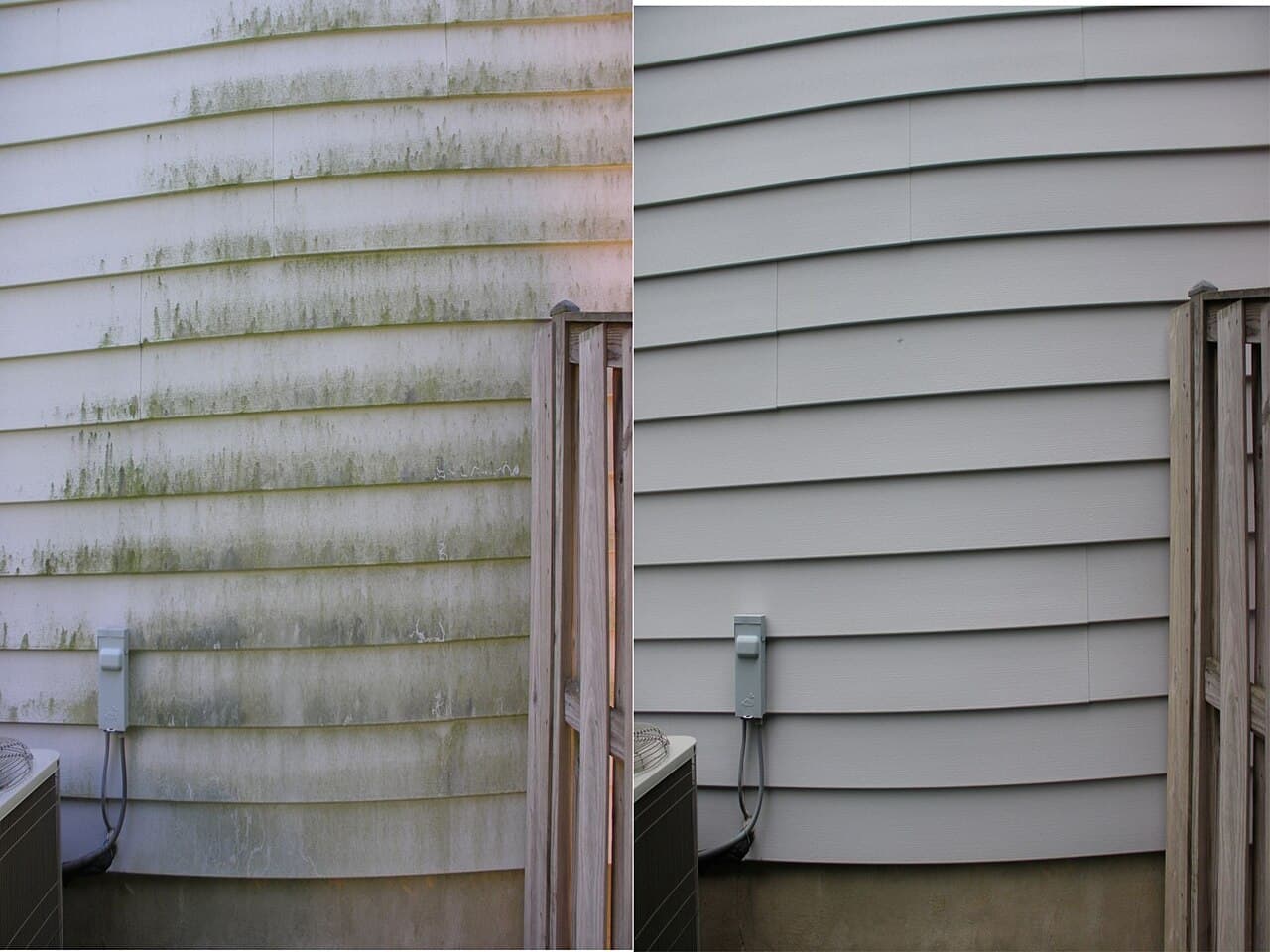
Why it grows on siding at all
Vinyl does not feed algae or mildew by itself. As CertainTeed puts it: "Vinyl siding is mold and mildew resistant. However if the siding is dirty, mildew could grow on the dirty coating especially in warmer climates with consistently high humidity."[1] A humid summer, spring pollen and nearby trees supply what it needs: a film of dirt, warmth and water.
On painted wood, the paint itself matters. Of the available water-base paints, acrylic latex is the most mildew resistant,[3] while paints containing linseed oil are very susceptible to mildew.[3]
Why it shows up where it does
Look at the pattern; it tells you where the water comes from.
- Shaded walls. Walls that see little sun, often the north side, stay wet longest after rain and dew.
- Behind shrubs and trees. Mildew is most common on walls behind trees or shrubs where air movement is restricted.[3]
- Under eaves and porch ceilings. These spots cool fast at night. "Dew will form on those parts of the house which are not heated and will cool rapidly such as eaves and the ceilings of carports and porches."[3] CertainTeed likewise points to areas of the home that don’t receive enough sunlight or access to rainfall, such as the eaves and porch enclosures.[1]
- Stripes below gutters. Green streaks running down from the gutter line usually mean the gutter overflows or drips there. See why gutters overflow.
- The bottom few courses. Low siding gets splashed by rain off the ground, mulch and sprinklers.
The EPA's starting point for mold applies here too: "The key to mold control is moisture control."[5] Among its moisture tips: "Clean and repair roof gutters regularly."[5]
Is it mildew or dirt?
Dark spots are not always growth. A simple test from Purdue Extension and the U.S. Forest Products Laboratory: put a drop or two of fresh household bleach on the stain. "Mildew will usually bleach out in one or two minutes. Stain that does not bleach is probably dirt."[3] Dirt and chalky film come off with plain detergent; growth needs a mildew wash.
How to clean it off
Use the siding maker's mix and a soft brush, not force. CertainTeed's mildew recipe for its vinyl is 1/3 cup of detergent, 2/3 cup of trisodium phosphate cleaner, one quart of 5% household bleach and three quarts of water,[1] with a caution: "Greater concentrations may cause damage to vinyl siding."[1] For stubborn algae, its spring checklist says to use a specialized cleaner recommended by your siding contractor,[2] and adds: "Test it in a discreet area first to make sure it does not discolor your siding."[2]
Safety comes with bleach: "Never mix chlorine bleach solution with other cleaning solutions or detergents that contain ammonia because toxic fumes could be produced."[5] Protect the plants too: "Avoid splashing the solution on yourself or on shrubbery or grass as it may have harmful effects."[3] Wet the plants first and rinse them afterward.
A pressure washer is not needed for this, and on many brands it is not recommended. If you do use one, see how to pressure wash vinyl siding without damaging it for the nozzle, distance and direction.
On painted wood, cleaning is also the first step of repainting: "Before repainting, the mildew must be killed, or it will grow through the new paint coat."[3] Once the surface is clean and dry, repaint with a paint containing a mildewcide.[3]
How to keep it from coming back
Cleaning treats the symptom; drying the wall treats the cause. Cut shrubs back from the siding so air can move and sun can reach it, keep gutters clean and fixed so they do not spill down the wall, turn sprinklers away from the house, and keep mulch from piling against the bottom course. A yearly gentle wash removes the dirt film before growth takes hold; see how often to wash a house.
Stop and call a pro if
- The green is on second-storey walls, gables or the roof. Washing up there means ladder or roof work; hire it out.
- The house was built before 1978 and the paint is flaking. If your home was built before 1978, it is more likely to have lead-based paint.[6] Do not scrub or blast loose paint yourself.
- Wood under the growth is soft, or the paint keeps failing in the same spot. That points to rot or water getting into the wall, which is a siding repair.
- You find mold indoors on the other side of the wall. That is a water problem inside the house; EPA notes that absorbent or porous materials, such as ceiling tiles and carpet, may have to be thrown away if they become moldy.[5]
Getting help
Browse pressure washing businesses or exterior pros around Blacksburg, compare doing it yourself and hiring someone, or read the other exterior answers. If cleaning turns up damaged or rotted siding, describe the siding repair once and licensed local businesses will quote it.
Common questions
- Is green algae on siding harmful?
- On vinyl it mostly means dirt and dampness: the growth lives on the film of dirt, not in the vinyl. On painted wood, mildew left in place grows through new paint, so clean it and find the moisture source before you repaint.
- Why is only the north side of my house green?
- That side gets the least sun, so it stays damp longest after rain and dew. Mildew and algae grow most where walls are shaded and air does not move, such as behind shrubs and under eaves.
- Can I just pressure wash the green off?
- High pressure removes the growth but can drive water behind vinyl laps, and some siding makers do not recommend it. A siding cleaner, a soft brush and a garden-hose rinse usually lifts algae and mildew without that risk.
- Will vinegar work instead of bleach?
- Some people use it for light growth, but the siding makers' own instructions call for a detergent wash and, for mildew, a diluted bleach mix or a cleaner your siding contractor recommends. Whatever you use, test a hidden spot first.
- How fast will it come back?
- On a wall that stays shaded and damp, it comes back sooner than on a sunny one. Cutting back plants, keeping gutters clear and a yearly gentle wash are what slow it down.
Sources
- [1] How to Clean Vinyl Siding, CertainTeed. Checked October 26, 2026.
- [2] Spring Cleaning Starts at the Top, CertainTeed. Checked October 26, 2026.
- [3] Discoloration of House Paint: Causes and Cures (NCR-134), Purdue University Cooperative Extension Service, with the USDA Forest Products Laboratory. Checked October 26, 2026.
- [4] The Care and Cleaning of Vinyl Siding, Soffit and Accessories (Alside Vinyl Siding Limited Warranty), Alside. Checked October 26, 2026.
- [5] A Brief Guide to Mold, Moisture and Your Home, U.S. Environmental Protection Agency. Checked October 26, 2026.
- [6] Protect Your Family from Sources of Lead, U.S. Environmental Protection Agency. Checked October 26, 2026.
Want a pro to handle it?
Describe the job once. Licensed local businesses send quotes, and you pay only when you book one.
Get a quote for Roofing