How do I replace a sump pump?
First ask your building department whether a permit is needed. For a plug-in pump, unplug the old one, lift it out, clean the pit, set the new pump on a solid level base, connect it to rigid discharge pipe through a check valve, plug it into a GFCI outlet and watch it cycle. A hardwired pump, or no GFCI outlet in reach, is a job for an electrician.
Free to ask. Local shops send quotes, and you pay only when you book one.
By Kasra Taheri, Founder, LoclisPublished
Researched and drafted with AI, then checked claim by claim against the sources listed below before it was published. Prices and rules change; the dates beside each source say when it was last checked.
Step by step
Read when to stop and call a pro, further down this page, before you start.
Step 1: Check whether a permit is needed
Call your county or city building department and ask whether replacing a sump pump needs a permit there, since Pittsylvania County requires one; if yours does, stop and hire a licensed plumber.[4]
Step 2: Confirm it is a plug-in pump
Make sure the old pump has a plug and that a grounded, three-prong GFCI outlet sits within reach of the new pump's cord; if it is hardwired or there is no such outlet, stop and call an electrician.[1]
Step 3: Have a way to remove water
Keep a wet-dry vacuum or buckets ready, because nothing will empty the pit while the pumps are out of service.[2]
Step 4: Unplug the old pump
Pull the plug before you touch the pump, pipe or water, and do not stand on a wet floor while the pump is still plugged in.[1]
Step 5: Let it cool
If the pump has just been running, give it at least two hours to cool, since the oil inside gets hot under normal use.[1]
Step 6: Separate the discharge pipe
Loosen the union or rubber coupling above the check valve and let the water in the pipe drain back into the pit.
Step 7: Lift the old pump out
Lift it by its handle or lift ring, never by the power cord.[1]
Step 8: Clean the pit
Clear out silt, stones and debris from the bottom of the basin.[1]
Step 9: Set the new pump on a solid base
Stand it level on the basin floor, or on a brick or block if the pit bottom is clay, earth, gravel or sand.[1]
Step 10: Give the switch room
Turn the pump so the float switch is away from the inlet and has at least 1 inch of clearance from the basin wall all through its travel.[1]
Step 11: Connect rigid pipe and a check valve
Join the pump to rigid PVC discharge pipe with a check valve above the basin; do not use flexible hose.[1]
Step 12: Secure the cord
Zip-tie the power cord to the discharge pipe so it cannot tangle with the float.[1]
Step 13: Plug into the GFCI outlet
Plug the pump straight into the GFCI outlet, with no extension cord or surge protector.[1]
Step 14: Test several cycles
Fill the pit with water and watch the pump start and stop on its own, then do it again and check the float moves freely each time.[1]
Step 15: Check the outlet and close the pit
Make sure the water leaves the pipe at least 3 feet from the foundation, then refit the basin cover and gasket.[1]
For a plug-in pump, and where your building department confirms no permit is needed, replacing it is a manageable afternoon job: unplug the old pump, lift it out, clean the pit, set the new pump on a solid base, connect it to the discharge pipe through a check valve, plug it into a GFCI outlet and watch it run through a few cycles. Keep a wet-dry vacuum or buckets handy, because nothing empties the pit while the pump is out.
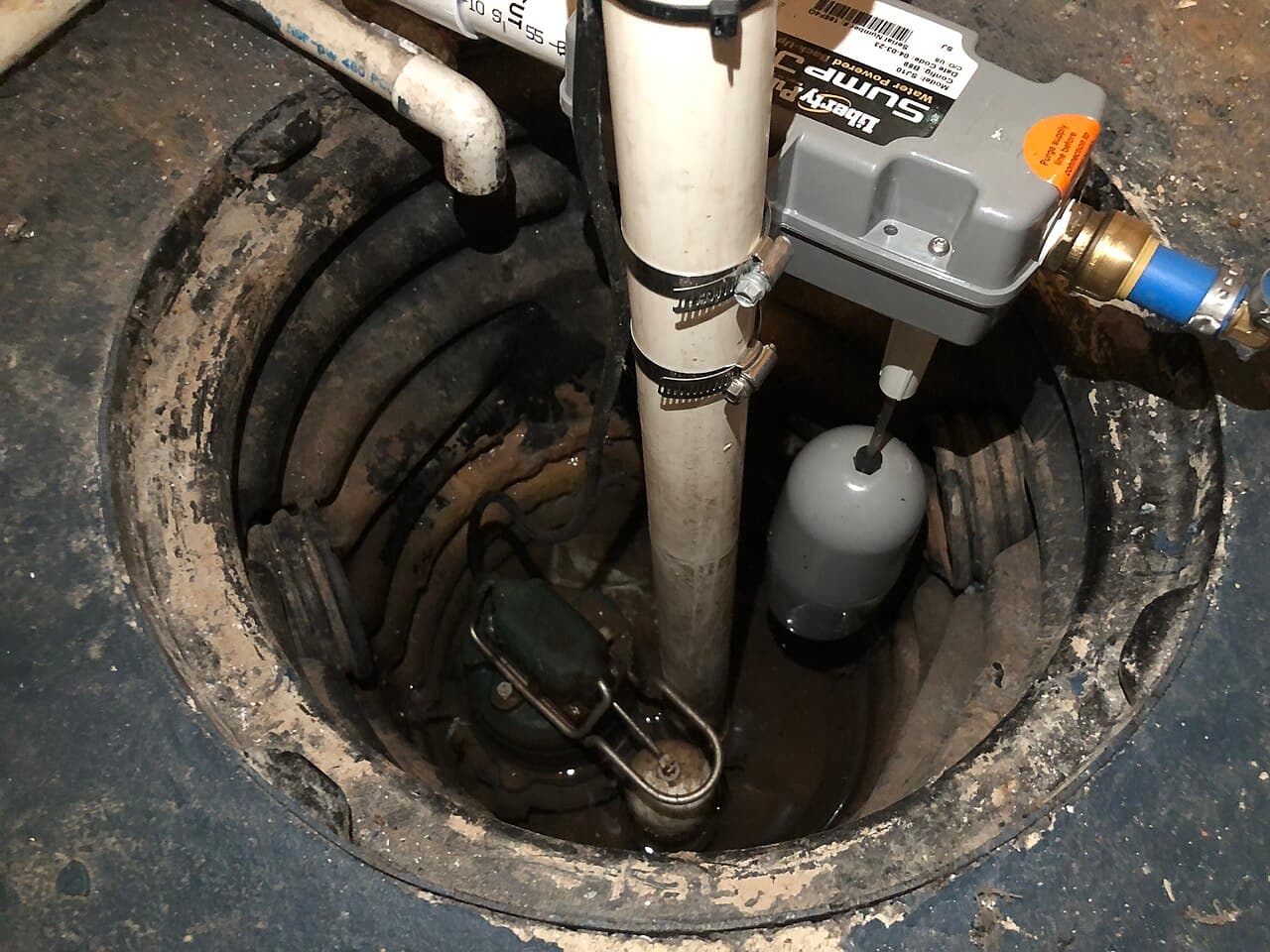
First, make sure it is a plug-in swap
This guide covers a pump that plugs into an outlet next to the pit. Follow the cord. If it runs into a junction box or into the wall instead of ending in a plug, the pump is hardwired and the swap belongs to an electrician.
Check the outlet too. Wayne's manual for its submersible sump pumps says the outlet must be protected by a ground fault circuit interrupter (GFCI) and that all wiring must be done by a qualified licensed electrician.[1] It also rules out extension cords and surge protectors: if the outlet is out of the cord's reach, a licensed electrician should install a new one.[1] A GFCI outlet usually has Test and Reset buttons on its face.
Ask about a permit before you buy. Virginia's Uniform Statewide Building Code requires a permit before work on a building's sanitary drainage system, electric wiring or any equipment regulated by the USBC, and exempts work the local building official deems minor and ordinary.[3] Pittsylvania County lists sump pumps among the work that needs a building permit.[4] Rules can differ by locality, so ask your county or city building department before you start. If it says a permit is needed, this is no longer a do-it-yourself job: hire a licensed plumber who pulls the permit.
Choosing the replacement
The easiest swap is a pump of the same type, size and switch style as the old one, so the pipe lines up and the switch fits the pit.
Pit size. Measure the basin's width and depth. On Wayne's models, a tether-switch pump needs a basin at least 14 inches across, a vertical-float pump at least 11 inches, and both at least 22 inches deep.[1] Other brands publish their own minimums on the box or in the manual.
Switch. The switch decides when the pump runs. Wayne's vertical float switches come set to turn on at about 9 inches of water and off at about 4; its tether switches turn on at about 13 inches and off at about 7.[1] A tether switch needs a wider pit because the float swings out on its cord.
Capacity. Pump output drops as the pump has to push water higher. Measure the lift, the height from the pit floor to where the pipe leaves the house, and read the maker's performance chart at that height rather than the headline number. Wayne's 1/3 horsepower CDU790, for example, is rated at 4,600 gallons an hour with no lift and 3,060 gallons an hour at 10 feet.[1] If the old pump kept up through wet seasons, a pump with similar output at your lift is usually enough.
Parts. Wayne requires a check valve to stop water in the pipe flowing back into the pit after each cycle, and requires rigid piping rather than flexible hose, because a pump that moves around can keep its switch from working.[1] Buy a new check valve with the pump, plus PVC cement or rubber couplings to suit your pipe, and a few zip ties.
Is it really a sump? Sump pumps are built for clear groundwater only: Wayne's manual says not to use them for raw sewage or grey water.[1] If a washing machine, sink or toilet drains into your pit, it is a sewage ejector, which is a different pump and a job for a plumber.
After the swap
Run the pump through several fill-and-empty cycles and check that the float moves freely, that nothing leaks at the check valve, and that water comes out outdoors. The same manual calls for replacing a tether switch every two years.[1] Wayne's submersible pumps contain dielectric oil for cooling, and Wayne says to follow state environmental laws when you dispose of one.[1] Your locality's solid waste office can tell you where to take it.
If you add a battery backup in the same pit, Wayne's backup-pump manual says a check valve must be used on both the primary and backup sump pump discharge.[2]
Where the water should go
A new pump is a good time to check where the pipe ends. Salem puts it plainly: "Sump pumps are intended to pump clear water to a greenspace or storm drain."[5] Spotsylvania County counts groundwater sump pumps among the improper connections to a private sewer lateral, because the extra water costs more to treat and can overload the public sewer and cause overflows.[6]
Outside, the water should not run straight back toward the foundation. The Northern Virginia Soil and Water Conservation District suggests extensions of non-perforated corrugated plastic pipe to carry sump and downspout water farther from the house, discharged to a suitable area.[7] It also counts your property line as an unsuitable place to send the water: "Don't solve your own issue by creating a problem for your neighbor."[8] If gutters dump water next to the same wall, see how to adjust gutters so they drain properly.
Stop and call a pro if
- The pump is hardwired, or there is no GFCI outlet within reach of its cord.
- The outlet is an old two-prong receptacle with no ground. Wayne says to connect its pumps only to a properly grounded, grounding-type receptacle, and never to remove the ground prong from the plug.[1]
- The new pump or its cord arrives damaged. Wayne says not to install or operate a pump that has been damaged in any way, and to return a damaged unit to the place of purchase.[1]
- The new pump trips the GFCI when you plug it in or it runs. Wayne's troubleshooting chart traces that to a bad GFCI or a bad pump, and says to contact an electrician to replace the GFCI.[1]
- There is water on the basement floor. Wayne says not to walk on the floor while water is present until all power is off, and to call an electrician if the electrical panel is in the basement.[1]
- The pit takes drains from a washer, sink or toilet. That is a sewage pump, not a sump pump.
- The basin is cracked, the pit is too small for any pump you can buy, or you want a pit where there is none. Fairfax County's flood program calls a sub-slab drainage system, perforated pipe under the floor feeding a sump pump, "a major project requiring demolition, wiring, plumbing, and permits."[9]
- The discharge pipe runs into a floor drain, laundry drain or sewer cleanout.
- Your building department says the work needs a permit. Hire a licensed plumber who pulls it.
Getting help
If you would rather not do it yourself, browse sump pump installers or plumbers in Blacksburg, see what drives the price in how much sump pump installation costs in Virginia, or read more plumbing answers. Once the new pump is in, test it a few times a year.
To have a licensed plumber quote the job, describe your sump pump job once on Loclis.
Common questions
- Can I reuse my old check valve?
- You can if it opens and closes freely and does not leak, but a check valve is inexpensive and a worn one makes the new pump cycle more often, so many people replace it with the pump. Wayne's manual requires a check valve on the discharge to stop water flowing back after each cycle.
- Do I need a permit to replace a sump pump in Virginia?
- It depends on your locality. Pittsylvania County lists sump pumps among the work that needs a building permit. Elsewhere the building official decides what counts as minor and ordinary work under the state building code, so call your county or city building department before you start.
- Can I plug the new pump into an extension cord?
- No. Wayne's manual says not to use an extension cord or surge protector, and to have a licensed electrician install a new outlet if the existing one is out of the cord's reach.
- Should I add a backup pump while I am at it?
- If a flooded basement would do real damage, it is worth considering. Wayne recommends an independent high water alarm or backup pump where there is a risk of damage from high water. Wayne's backup-pump manual also calls for a check valve on both the main and the backup pump's discharge.
- Where can the discharge pipe go?
- Outdoors, to ground that can take it, in most places. Salem says sump pumps are intended to pump clear water to a greenspace or storm drain, and Spotsylvania County lists groundwater sump pumps among the improper connections to a private sewer lateral. Rules are set by your own locality and sewer utility, so ask them before you reroute the pipe.
Sources
- [1] Submersible Sump Pumps: Operating Instructions and Parts Manual (600002W-001 J, 06/25), Wayne Water Systems. Checked October 26, 2026.
- [2] ESP25n 12 Volt Backup Sump Pump: Operating Instructions and Parts Manual (600005W-001 J, 08/26), Wayne Water Systems. Checked October 26, 2026.
- [3] 13VAC5-63-80. Section 108 Application for permit (Virginia Uniform Statewide Building Code), Virginia Administrative Code, Virginia General Assembly. Checked October 26, 2026.
- [4] Do I Need a Permit, Pittsylvania County Building Inspections, Virginia. Checked October 26, 2026.
- [5] Water & Sewer: Backup vs. Overflow, frequently asked questions, City of Salem, Virginia. Checked October 26, 2026.
- [6] Utilities: Sanitary Sewer Lateral, frequently asked questions, Spotsylvania County, Virginia. Checked October 26, 2026.
- [7] Gutters and Downspouts: Wetness or Erosion Problems, Northern Virginia Soil and Water Conservation District, Fairfax County. Checked October 26, 2026.
- [8] Glossary - Solving Drainage and Erosion Problems, Northern Virginia Soil and Water Conservation District, Fairfax County. Checked October 26, 2026.
- [9] Flood Mitigation Assistance Program: Approved List of Practices, Northern Virginia Soil and Water Conservation District, Fairfax County. Checked October 26, 2026.
Want a pro to handle it?
Describe the job once. Licensed local businesses send quotes, and you pay only when you book one.
Get a quote for Plumbing Repair