Why is my sump pump running constantly?
Either a lot of water is coming in, which is normal after heavy rain, or something is wrong: a stuck or failed float switch, a leaking check valve letting pumped water fall back into the pit, a blocked or frozen discharge line, water recirculating from a discharge too close to the house, or a pump too small for the inflow.
Free to ask. Local shops send quotes, and you pay only when you book one.
By Kasra Taheri, Founder, LoclisPublished
Researched and drafted with AI, then checked claim by claim against the sources listed below before it was published. Prices and rules change; the dates beside each source say when it was last checked.
Step by step
Read when to stop and call a pro, further down this page, before you start.
Step 1: Watch the pit for a few minutes
With the lid off, see whether water is pouring in from the drain pipe and refilling the pit quickly, or whether the pump runs with little water in it.
Step 2: Unplug before reaching in
Unplug the pump before you touch the pump, float, pipe or water, and do not stand in water while it is plugged in.[1]
Step 3: Stand the pump upright
Check that vibration has not tipped the pump onto its side, which can jam the float.[1]
Step 4: Free the float
Make sure the float or tether switch moves freely and is not caught on the cord, the pipe or the basin wall.[1]
Step 5: Clear the inlet screen
Clear small stones and debris from the pump's inlet screen and the pit floor.[1]
Step 6: Test the check valve
Plug the pump back in, let it empty the pit, and listen for water rushing back down the pipe when it stops; if it does, the check valve needs examining or replacing.[1]
Step 7: Follow the discharge outside
Find where the pipe ends and clear anything blocking it, such as leaves, soil, ice or a crushed extension.[1]
Step 9: Check nearby downspouts
Make sure downspouts near the pit corner empty onto a splash block or extension that carries roof water away from the foundation.[3]
Step 10: Run a final test
Fill the pit with a bucket of water and watch the pump start, empty the pit and shut off on its own.[1]
A sump pump that runs constantly is either keeping up with a lot of water, which is normal during and after heavy rain, or telling you something is wrong. The usual faults are a stuck or failed float switch, a leaking check valve that lets pumped water fall back into the pit, a blocked or frozen discharge line, water recirculating from a discharge that ends too close to the house, or a pump too small for the water coming in.
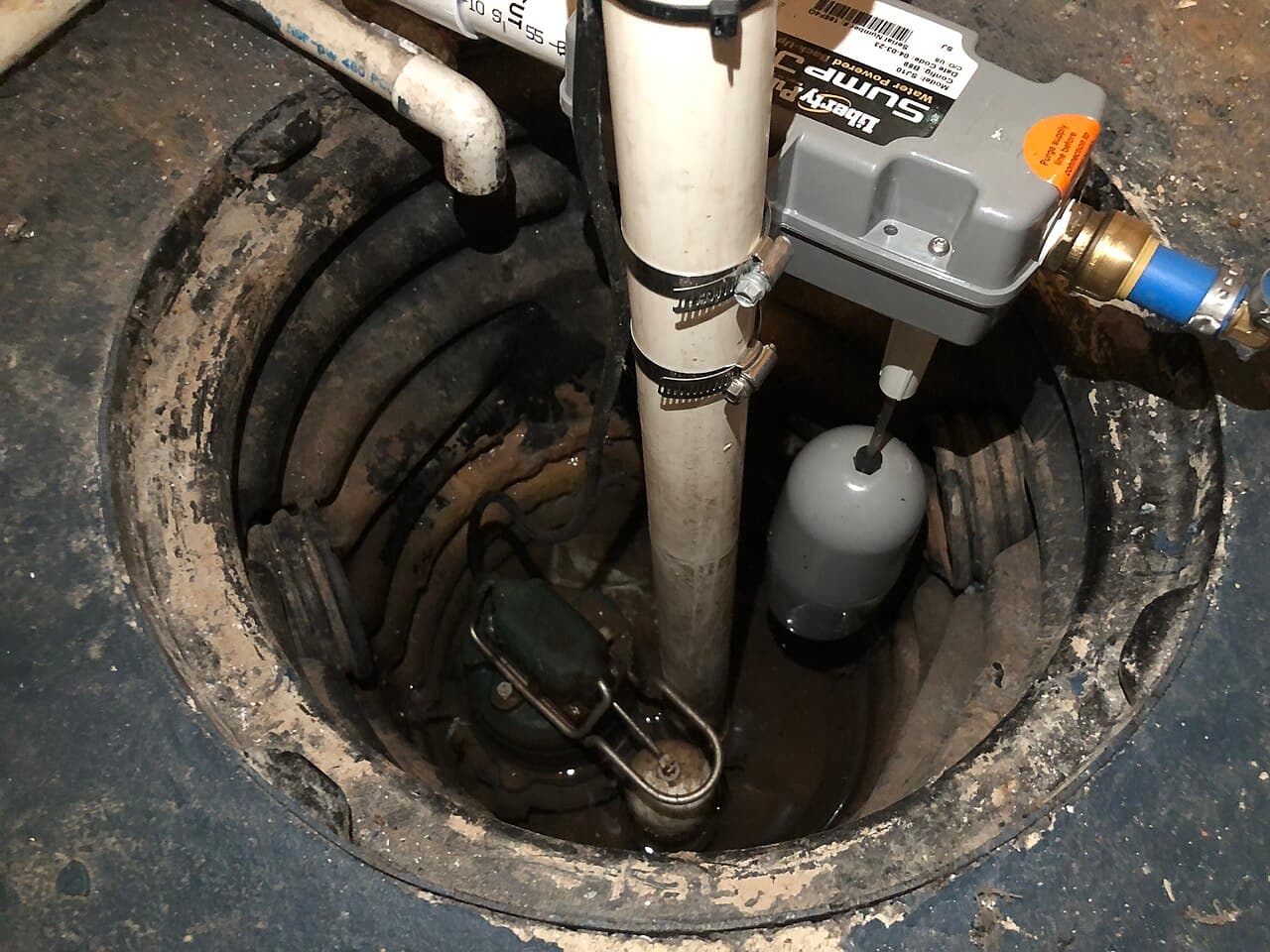
Two symptoms, different causes
Start by working out which of these you have, because the causes differ.
It never shuts off. Wayne's troubleshooting chart lists four reasons a pump will not shut off: a failed switch, something obstructing the switch, a restriction in the discharge piping, or more water coming in than the pump was sized for.[1]
It shuts off, then starts again every few minutes. For a pump that starts and stops too often, it lists water flowing back from the discharge pipe, a failing switch, and a check valve that is not working properly or leaks.[1]
Lift the lid and watch. If water is pouring into the pit from the drain pipe and refilling it as fast as the pump empties it, the pump is doing its job. If the pump runs with little water in the pit, or the pit refills with no water coming in, look at the switch and the check valve.
A stuck or failed switch
The float switch tells the pump when to start and stop. If it hangs up in the on position, the pump keeps running whatever the water level. Wayne's manual warns that vibration can make a pump fall or tilt onto one side and jam the float so it cannot work.[1] A tether float can catch on the power cord or the pit wall, and a vertical float can stick on built-up grit.
Switches also wear out. Wayne calls for replacing a tether switch every two years, and says that maintenance reduces the risk of switch failure and flooding.[1] Wayne sells replacement float and tether switch kits, and its chart's remedy for a failed switch is to replace the tether switch or replace the pump.[1]
Water falling back into the pit
When the pump stops, the water standing in the discharge pipe wants to run back down. Wayne requires a check valve with its pumps to prevent water flowing back after each cycle.[1] If the valve is missing, worn or stuck open, that pipe-full of water drops back into the pit and the pump has to move it again, often within minutes. You can usually hear it: a rush of water down the pipe right after the pump shuts off.
Wayne's chart says to remove and examine the check valve for proper installation and free operation, and to replace it if necessary.[1] Many check valves have an arrow showing the direction of flow, which should point up, away from the pump.
Water going nowhere, or coming straight back
Follow the pipe outside. Leaves, soil, a crushed extension or ice can block the end, so the pump runs and moves little water. Wayne's manual says the discharge should carry water to a point at least 3 feet from the foundation, and that a line exposed to freezing temperatures must slope downward away from the foundation so leftover water drains out instead of freezing.[1]
Water that lands next to the house can soak straight back down to the drain pipe and into the pit, so the pump keeps pumping the same water. The Northern Virginia Soil and Water Conservation District lists downspouts and sump pump pipes among the causes of wetness near foundation walls, and suggests non-perforated extension pipes to carry the water farther from the house.[3] Check the gutters and downspouts on that side of the house too; its guide to wet basements says most of them are a result of water problems outside the house.[4] If gutters spill over in a storm, see why gutters overflow.
Too much water for the pump
Some houses simply take on a lot of groundwater in wet seasons. If the switch, valve and discharge are all fine and the pump still cannot get ahead, it may be undersized. Wayne's answer to excessive inflow is to recheck the sizing calculations to determine the proper pump size.[1] A plumber can measure the inflow and the lift and recommend a pump with more output at your lift.
Overheating and stopping on its own
Wayne's pumps have an automatic resetting thermal protector, and the manual says its tripping indicates the motor is overloaded, from causes including excessively high or low voltage, inadequate wiring or the end of the pump's life.[1] A pump that cuts out and restarts on its own, regardless of the water level, may be tripping it. Wayne says its pumps should not be used for water above 77 degrees F.[1]
Something connected that should not be
A sump pit is meant for groundwater only. Spotsylvania County lists foundation drains and groundwater sump pumps among the improper connections to a private sewer lateral.[5] Going the other way, if a washing machine or other drain empties into the pit, the pump will run every time it is used, and a sump pump is not built for that water.
Stop and call a pro if
- The pump keeps tripping its GFCI outlet. For a pump that trips its GFCI, Wayne's chart lists a bad GFCI or a bad pump, and says to contact an electrician to replace the GFCI.[1]
- There is water on the basement floor near the pit or the electrical panel. Wayne says not to walk on the floor while water is present until all power is off, and to call an electrician if the electrical panel is in the basement.[1]
- The pump keeps cutting out and restarting on its own, or you suspect a wiring or voltage problem. For a pump that shuts off and turns on independently of its switch, Wayne's chart lists low supply voltage among the causes, with the remedy "Contact an electrician".[1]
- The pump hums but moves no water, or runs with the pit nearly empty and the switch is free.
- The water keeps rising even with the pump running.
- A laundry or other household drain empties into the pit.
If flooding would do real damage, protection matters while you sort out the cause. Wayne recommends an independent high water alarm or a backup pump where high water could damage property.[1] Wayne's battery backup pump sits in the same pit, its float set so it turns on only when the water rises above the main pump's normal on level.[2]
Getting help
Once it is running normally, test it a few times a year. If the pump is worn out, see how to replace a sump pump. You can also browse sump pump repair, find plumbers in Blacksburg, or read more plumbing answers.
To have a licensed local plumber look at it, describe your sump pump problem once on Loclis.
Common questions
- Is it normal for a sump pump to run a lot after heavy rain?
- Yes. After a long wet spell the pit can refill as fast as the pump empties it, so the pump may run often or almost continuously while the ground stays saturated. It is a problem when it runs with little or no water coming in, or keeps running long after the weather dries out.
- Why does my sump pump turn on every few minutes even when it is dry outside?
- One common cause is water falling back into the pit through a failed or missing check valve, so the pump keeps re-pumping the same water. A failing switch can do it too. Wayne's troubleshooting chart lists both for a pump that starts and stops too often.
- My pump runs but the pit stays full. What is wrong?
- Something is stopping the water getting out: a clogged inlet screen, a check valve stuck closed or put in backwards, a closed shut-off valve, a blocked or frozen discharge line, or a broken impeller. If the pipe and valves are clear and the pump still moves little water, it usually needs replacing.
- Can a sump pump run itself to death?
- Running constantly puts more hours on the motor, and Wayne's pumps have a thermal protector that shuts the motor off when it is overloaded. Repeated tripping is a sign of a problem, or of a pump at the end of its life.
- Should I add a second pump?
- If inflow regularly outpaces the pump, a correctly sized replacement is the first fix. A battery backup in the same pit adds protection when the power fails or the main pump cannot keep up, because it starts only when the water rises above the main pump's normal level.
Sources
- [1] Submersible Sump Pumps: Operating Instructions and Parts Manual (600002W-001 J, 06/25), Wayne Water Systems. Checked October 26, 2026.
- [2] ESP25n 12 Volt Backup Sump Pump: Operating Instructions and Parts Manual (600005W-001 J, 08/26), Wayne Water Systems. Checked October 26, 2026.
- [3] Gutters and Downspouts: Wetness or Erosion Problems, Northern Virginia Soil and Water Conservation District, Fairfax County. Checked October 26, 2026.
- [4] Solving Drainage and Erosion Problems, Northern Virginia Soil and Water Conservation District, Fairfax County. Checked October 26, 2026.
- [5] Utilities: Sanitary Sewer Lateral, frequently asked questions, Spotsylvania County, Virginia. Checked October 26, 2026.
Want a pro to handle it?
Describe the job once. Licensed local businesses send quotes, and you pay only when you book one.
Get a quote for Plumbing Repair