How do I stop a bed frame from squeaking?
Most bed frame squeaks come from loose bolts or parts rubbing where they meet. Tighten every bolt and bracket, then check the slats, the headboard joints and the legs for rubbing. Where two parts touch, add a thin layer of felt, cloth or wax between them. Test after each change so you know what fixed it.
Free to ask. Local shops send quotes, and you pay only when you book one.
By Kasra Taheri, Founder, LoclisPublished
Researched and drafted with AI, then checked claim by claim against the sources listed below before it was published. Prices and rules change; the dates beside each source say when it was last checked.
Step by step
Read when to stop and call a pro, further down this page, before you start.
Step 1: Find where it squeaks
Have someone shift their weight on the bed while you listen at the headboard, the sides, the foot and the middle.
Step 2: Strip the bed
Take off the mattress and the bedding so you can see and reach the whole frame.
Step 3: Tighten every bolt
Snug up each bolt, screw and bracket that holds the headboard, footboard and side rails together; wooden frames shrink and swell, so expect to repeat this.
Step 4: Check the bolt holes
If a bolt will not stay tight, add a flat washer under its head, or a lock washer, or use a slightly longer bolt of the same thread.
Step 5: Separate rubbing parts
Where wood meets wood or metal meets metal, slip in a strip of felt, thin cloth or cork, or rub a candle or bar of soap along the contact surface.
Step 6: Settle the slats
Press each slat; fit slat caps or tape a strip of felt where a slat ends rest on the rail, and replace any slat that is cracked.
Step 7: Check the legs and the floor
Make sure each leg sits flat and the centre support leg, if there is one, touches the floor, then add felt pads under the feet.
Step 8: Test and retighten
Put the mattress back, test the bed, and tighten the bolts again after a week or two.
Most squeaky bed frames need nothing more than tighter bolts and a bit of padding where two parts rub. Work out where the noise starts, snug up the hardware, then separate any parts that touch. It is a 30-minute job with a screwdriver, a wrench and a scrap of felt.
Why bed frames squeak
A squeak is two surfaces moving against each other under load. On a bed that usually means one of three things: a joint that has loosened, a slat or rail that slides a little on its support, or metal rubbing on metal at a bracket.
Joints loosen because wood moves with the seasons. The Forest Products Laboratory says that in built-up assemblies such as roof trusses, it may be necessary to tighten bolts or other fastenings occasionally to maintain full bearing of the connectors as the members shrink.[1] A bolted bed frame is a small version of the same thing. The National Park Service makes a related point about furniture: rungs and stretchers may become loose in chair legs because of the differential in shrinkage along and across the grain.[2] The same thing happens in a bed frame, where side rails meet posts and headboards meet legs. The National Park Service adds that below 30% relative humidity the glue may desiccate and joints may loosen.[2]
Find the squeak first
Strip the bed down to the frame. Then have a helper shift their weight on it while you listen at the headboard, both sides, the foot and the middle. Squeaks travel through a frame, so the sound often seems to come from somewhere other than its source. Put a hand on a joint while the bed is loaded: the one that clicks or shifts under your palm is usually the one.
Tighten the hardware
Go over every bolt, screw and bracket that holds the headboard, footboard and side rails together. Use the right size of wrench or hex key, and snug each one firmly without forcing it. Over-tightening can strip a hole or crack the wood around it.
Check bolts that will not stay tight. A flat washer under the head, or a lock washer, often keeps it from backing out. Where a threaded hole is worn, a slightly longer bolt of the same thread can bite into fresh material. On a metal-to-metal thread, a drop of thread-locking compound is another option.
Rust matters on older steel frames. The National Park Service notes that fasteners are most often made from ferrous metals, which corrode in high relative humidity, and that severely corroded metal will expand, crushing and splitting the surrounding wood.[2] A bolt with heavy rust in a wooden post should be replaced, not just tightened.
Pad the parts that rub
When hardware is tight and the bed still talks, something is rubbing. Lift each part and look for shiny, polished or dusty spots, which show where it has been moving.
- Wood on wood. Slip a strip of felt, cork or thin cloth into the joint, or rub a candle or bar of soap along the contact surface. Wax is clean, dry and easy to reapply.
- Metal on metal. Wrap a thin strip of cloth or felt around the bracket, or put a plastic or rubber washer between the plates.
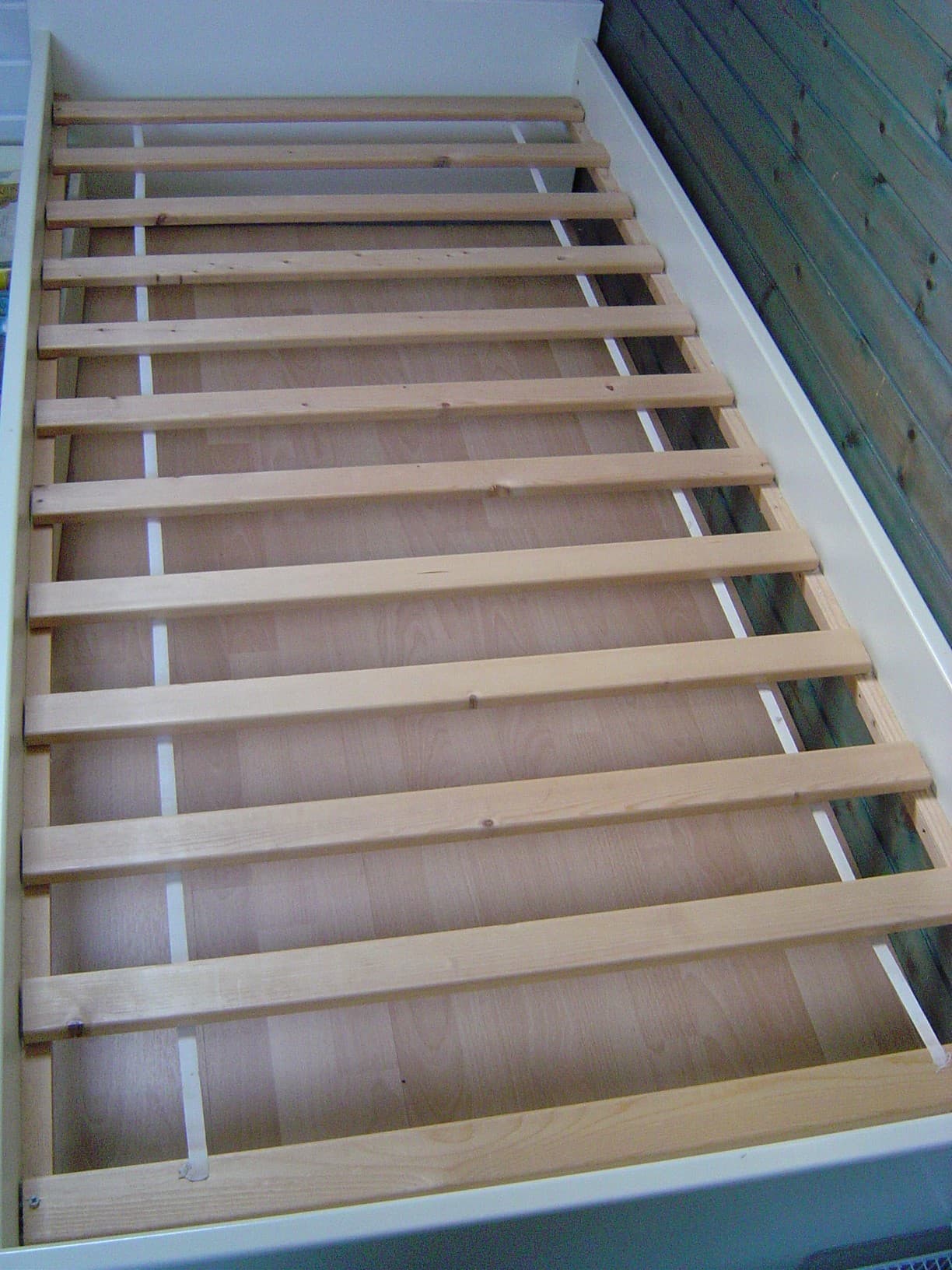
- Slats. Press each slat. A slat that shifts on the rail will squeak, so seat it firmly, add slat caps, or tape felt where its ends rest on the rail. Replace a cracked slat.
- Centre support. On queen and king frames, make sure the centre leg reaches the floor and carries load. A gap lets the frame flex and groan.
- Feet. Felt pads under the legs stop squeaks that start at the floor and are also easier on hardwood.
Test after each change, even if it means putting the mattress back on and lying down. That way you know which fix worked, and you will not rebuild the whole bed for a single loose bracket.
If the joint itself is loose
A headboard or post joint that moves even with the bolts tight has a worn or opened wood joint. For a glued joint, the repair is the same as for a wobbly table: clean off the old glue, glue, and clamp. The method is in how to fix a wobbly table. If the bed is solid wood and the joint gap is large, a furniture repairer can often fix it faster than you can.
After the fix
Check the bolts again in a week or two. A frame that has been squeaking for a while often needs a second round once the parts settle. Then tighten them again at the start of the heating season, when the wood tends to dry and shrink.
Stop and call a pro if
- A rail, post or slat is cracked or split. Gluing or taping over the crack usually fails, and the frame can give way under load.
- The bolt holes are stripped or the wood around them is crumbling. The part needs to be repaired or replaced, not tightened.
- The frame is an antique or a family piece. A repairer can use repairs that can be undone later and will not hurt its value.
- The squeak is in a mattress, box spring or adjustable base. Powered adjustable bases are plug-in electrical equipment, so leave opening one to the maker or a repairer.
- You see small round exit holes or fine powder under the frame. That points to wood-boring insects, which need treatment before any repair.
Getting help in Virginia
If the frame needs more than hardware, read how to fix a wobbly table for the gluing method, see what table repair costs in Virginia for an idea of how furniture repair is priced, and browse bed frame repair requests or more furniture repair answers.
When you are ready, describe the repair once and local furniture repairers can quote it.
Common questions
- Why does my bed frame squeak when I roll over?
- Because your weight moves the frame slightly and two parts rub. The usual culprits are bolts that have worked loose at the headboard or side rails, slat ends sliding on the rail, and metal brackets rubbing on metal. Tightening the hardware and padding the contact points fixes most of them.
- Can I use WD-40 or oil on a squeaky bed frame?
- It is better to avoid it on wood. Oil can stain bedding and soak into wood, and the squeak usually returns. A dry fix lasts longer: felt, cloth or cork between parts, or a rub of candle wax or bar soap on contact surfaces. On a metal frame, a small amount of lubricant at a metal-to-metal joint is reasonable, wiped clean afterwards.
- Why does a bed that was quiet start squeaking in winter?
- Wood changes size as the air gets drier. The National Park Service notes that below 30% relative humidity glue may dry out and joints may loosen,[^nps-wood] and a bolted wooden frame can loosen the same way. Tighten the hardware once the heating season starts.
- Will a new mattress stop the squeak?
- Usually not, because the noise comes from the frame. Some squeaks do come from a spring mattress or a box spring, so lift the mattress off and press on the frame alone. If the frame is quiet by itself, look at the mattress or foundation instead.
- How tight should the bed bolts be?
- Snug and firm, not as hard as you can turn the wrench. Over-tightening can strip the hole or crack the wood around it. If a bolt keeps loosening, a washer under its head or a drop of thread-locking compound on a metal-to-metal thread usually holds it.
Sources
- [1] Wood Handbook, Chapter 13: Drying and Control of Moisture Content and Dimensional Changes (FPL-GTR-190), USDA Forest Service, Forest Products Laboratory. Checked October 27, 2026.
- [2] Museum Handbook, Part I, Appendix N: Curatorial Care of Wooden Objects, National Park Service, U.S. Department of the Interior. Checked October 27, 2026.
Want a pro to handle it?
Describe the job once. Licensed local businesses send quotes, and you pay only when you book one.
Get a quote for Furniture