Is it worth hiring someone to mulch my beds?
Mulching is simple work most homeowners can do, so hiring is worth it mainly when the job is big, the beds need weeding, edging or old mulch removed, or hauling several cubic yards is hard on you. Hire a crew that keeps mulch 2 to 3 inches deep and off trunks, and put the depth and every extra in a written quote.
Free to ask. Local shops send quotes, and you pay only when you book one.
By Kasra Taheri, Founder, LoclisPublished
Researched and drafted with AI, then checked claim by claim against the sources listed below before it was published. Prices and rules change; the dates beside each source say when it was last checked.
Step by step
Read when to stop and call a pro, further down this page, before you start.
Step 1: Measure the beds
Add up the square footage of every bed you want mulched, including tree rings and foundation strips.
Step 2: Work out the volume
Multiply the square footage by the depth in inches and divide by 324 for cubic yards.[5]
Step 3: Check the existing depth
Dig a trowel into the beds; if old mulch is still 2 to 3 inches deep, you may only need it raked and lightly topped up.[1]
Step 4: Price the material
Price the mulch alone, including free mulch from your county if it offers it, so you know what share of a quote is labor.
Step 5: List the extra work
Note whether the beds need weeding, a new edge, old mulch removed or a weed preventer; those take more time than spreading.
Step 6: Compare written bids
Get at least three written bids for the same scope and weigh them against the hours the job would take you.[9]
Often it is not, because mulching is one of the simplest jobs in a yard: weed, edge, spread, rake. Hiring pays off when the beds are large, when they need real cleanup before any mulch goes down, or when moving several cubic yards by wheelbarrow is more than you want to take on. Whoever does it, the result depends on depth and placement, so those belong in the quote.
When doing it yourself makes sense
A small bed or two that is already weeded and edged is an afternoon's work. You buy the mulch, rake it out and you are done. You also control the two things crews most often get wrong: depth and where the mulch touches.
To size the job, one cubic yard covers 324 square feet an inch deep.[5] Multiply your bed area by the depth in inches and divide by 324. Before ordering, dig into the beds with a trowel. Virginia Cooperative Extension calls for mulch 2 to 3 inches deep around shrubs,[1] so a bed that still has an inch or two of last year's mulch needs only a light top-up. The full method is in how to mulch flower beds the right way.
When hiring is worth it
The job is big. Many yards of mulch across long foundation beds and tree rings is a full day or more of hauling.
The beds need cleanup first. Weeding an overgrown bed, cutting a new edge and pulling out years of built-up mulch is where most of the time goes, and it is the part people put off.
Old mulch has built up. Over time, mulch can pile up to five, six or more inches,[4] and excessive mulch reduces soil oxygen and suffocates roots.[4] Clearing that out is heavy work and worth paying for.
Lifting is hard on you. Bags and wheelbarrow loads are heavy. If that is a health concern, the job is a reasonable one to hand off.
What to make sure a crew does right
A crew that spreads mulch badly can cost you plants. Virginia Tech's guidance is blunt: mulch piled against a trunk keeps the bark moist and open to decay organisms, insects and voles, which may girdle and kill the tree.[2]
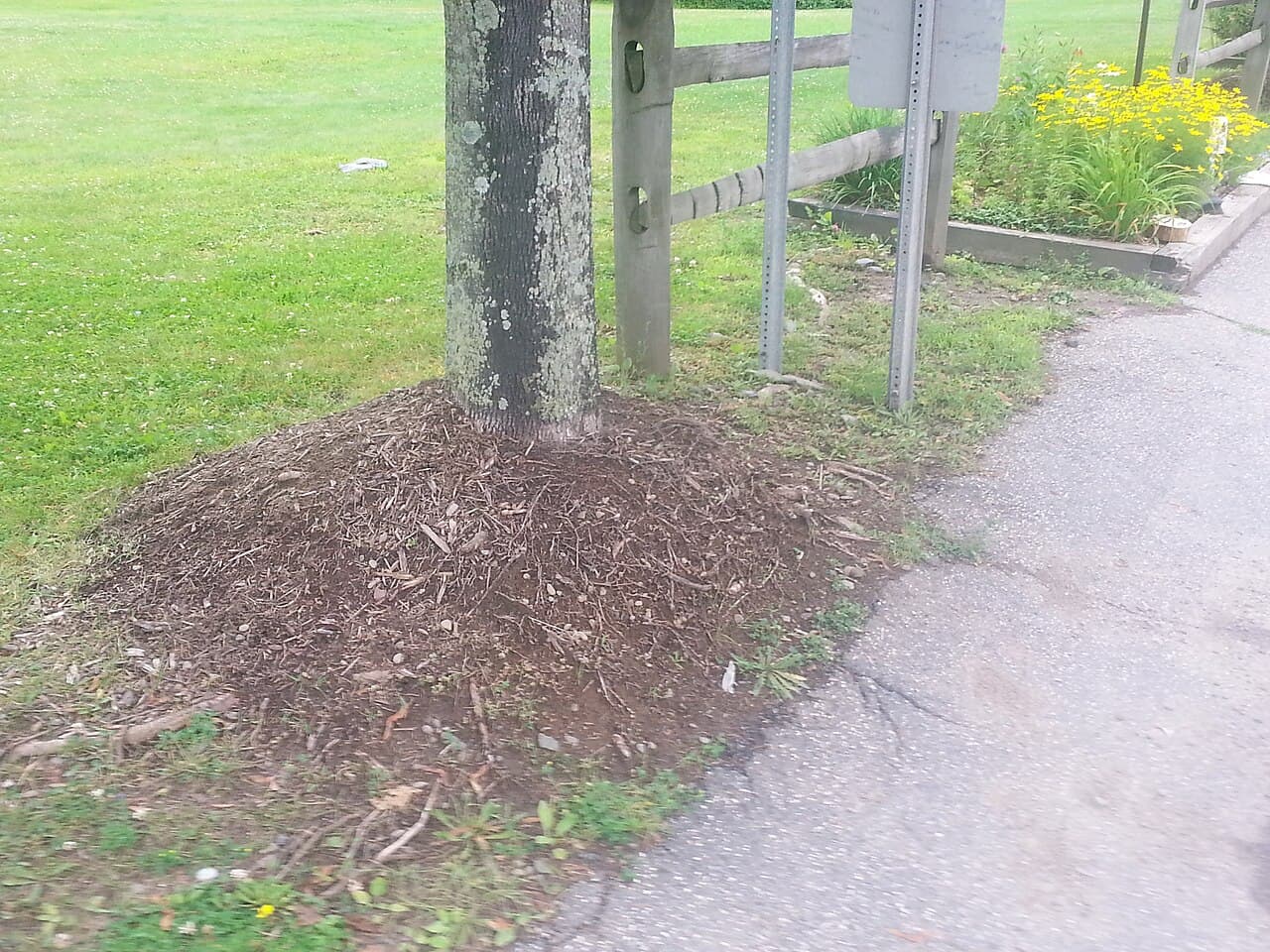
Put these in writing:
- a finished depth of about 2 to 3 inches, not 3 new inches on top of old mulch
- mulch kept off trunks and stems; Clemson Extension's rule is to keep mulch 2 to 3 inches away from the stems of woody plants[5]
- mulch held back from the house; Extension's termite advice is to pull all mulch and landscaping back at least 6 inches from the foundation[3]
- weeding and edging before mulching, listed as separate items
- how much old mulch is removed and where it goes
Licences and herbicides
Many mulch services add a pre-emergent weed preventer. That is pesticide work, and in Virginia anyone who uses pesticides on someone else's property in exchange for compensation must work for a company with a Pesticide Business License.[6] Ask for it before you agree to the add-on.
The Board for Contractors defines landscape service contracting as the alteration or improvement of land by means of excavation, clearing, grading, construction of retaining walls for landscaping purposes, or placement of landscaping timbers.[7] Mulch spreading is not named in that definition. If your job includes that kind of work, Virginia law defines Class C contractors as those whose single contract or project is over $1,000 but less than $30,000,[8] and the company should hold a licence you can look up.
How to hire well
DPOR's consumer guide has rules that suit any yard job. Its first tip, where a licence applies, is "Hire only licensed contractors."[9] It says to get at least three written bids,[9] and warns: "Beware of any bid substantially lower than the others."[9] For payment, it suggests you limit your deposit to 10 percent down or $1,000, whichever is less,[9] and do not pay 100 percent of the bill until the work is 100 percent complete.[9]
For what drives the price and a quote checklist, see what mulch installation costs in Virginia.
Stop and call a pro if
- Trees have had mulch piled against their trunks for years and roots now circle the trunk or the bark is soft.
- The beds sit on a slope where soil and mulch wash out after every storm.
- You see signs of termites where the beds meet the house.
- You want a herbicide program and are not sure which products are safe for your plants.
Browse the lawn and landscaping answers, see mulch and bed services, or look up lawn and landscaping businesses around Blacksburg. To get written quotes for your own beds, describe the job once and local businesses quote it.
Common questions
- Is mulching hard to do yourself?
- Not technically. It is weeding, a wheelbarrow and a rake. The work is physical: a cubic yard is 27 cubic feet of material, and a medium yard can take several. If lifting and hauling that much is the problem, hiring makes sense.
- What should a good mulch crew do?
- Weed and edge first, spread mulch to a finished depth of about 2 to 3 inches, keep it off shrub stems and tree trunks, and hold it back from the house. A crew that builds cones of mulch around trees is doing harm, however neat it looks.
- Does someone spreading mulch need a licence in Virginia?
- Spreading mulch is not among the landscape work the Board for Contractors lists, but grading, clearing, retaining walls and landscape timbers are. Any company that applies a weed preventer or other pesticide for pay must have a VDACS Pesticide Business License.
- How do I compare mulch quotes?
- Ask each company to state the beds, the mulch type, the cubic yards and finished depth, and whether weeding, edging and old mulch removal are included. Quotes that leave those out cannot be compared on price.
- Should I pay up front for mulching?
- DPOR's general advice for contractors is a deposit of no more than 10 percent or $1,000, whichever is less, and no final payment until the job is complete. Walk the beds before you pay.
Sources
- [1] Shrubs: Functions, Planting, and Maintenance (426-701), Virginia Cooperative Extension, Virginia Tech. Checked October 27, 2026.
- [2] Home Grounds and Animals 2026, Home Ornamentals (Pest Management Guide 456-018, ENTO-634-D), Virginia Cooperative Extension, Virginia Tech. Checked October 27, 2026.
- [3] Home Grounds and Animals 2026, Household and Structural Pests (Pest Management Guide 456-018, ENTO-634-F), Virginia Cooperative Extension, Virginia Tech. Checked October 27, 2026.
- [4] Excess Mulch Problems, University of Maryland Extension. Checked October 27, 2026.
- [5] Mulch (HGIC 1604), Clemson Cooperative Extension Home and Garden Information Center. Checked October 27, 2026.
- [6] Becoming a Certified Pesticide Applicator, Virginia Department of Agriculture and Consumer Services. Checked October 27, 2026.
- [7] 18VAC50-22-30. Definitions of specialty services, Virginia Administrative Code (Board for Contractors). Checked October 27, 2026.
- [8] Code of Virginia § 54.1-1100. Definitions, Virginia General Assembly (Code of Virginia). Checked October 27, 2026.
- [9] What You Should Know Before You Hire a Contractor, Virginia Department of Professional and Occupational Regulation. Checked October 27, 2026.
Want a pro to handle it?
Describe the job once. Licensed local businesses send quotes, and you pay only when you book one.
Get a quote from a local pro