How often should I replace mulch?
Rarely all at once. Top up organic mulch as it breaks down, only enough to bring it back to about 2 to 3 inches. Pine needles and bark usually last 2 to 4 years before needing more, wood chips are mostly gone within 2 years, and leaves and compost need adding every year. Remove old mulch only when it has built up too deep.
Free to ask. Local shops send quotes, and you pay only when you book one.
By Kasra Taheri, Founder, LoclisPublished
Researched and drafted with AI, then checked claim by claim against the sources listed below before it was published. Prices and rules change; the dates beside each source say when it was last checked.
Step by step
Read when to stop and call a pro, further down this page, before you start.
Step 1: Check the depth each spring
Push a trowel or your finger down through the mulch in a few spots and note how deep it is before buying any.
Step 2: Rake it loose
Rake faded or crusted mulch to loosen it and break up any matted layer so water gets through.[1]
Step 3: Top up only what is missing
Add just enough fresh mulch to bring the total back to about 2 to 3 inches, never more than 3.[2]
Step 4: Pull it back from trunks
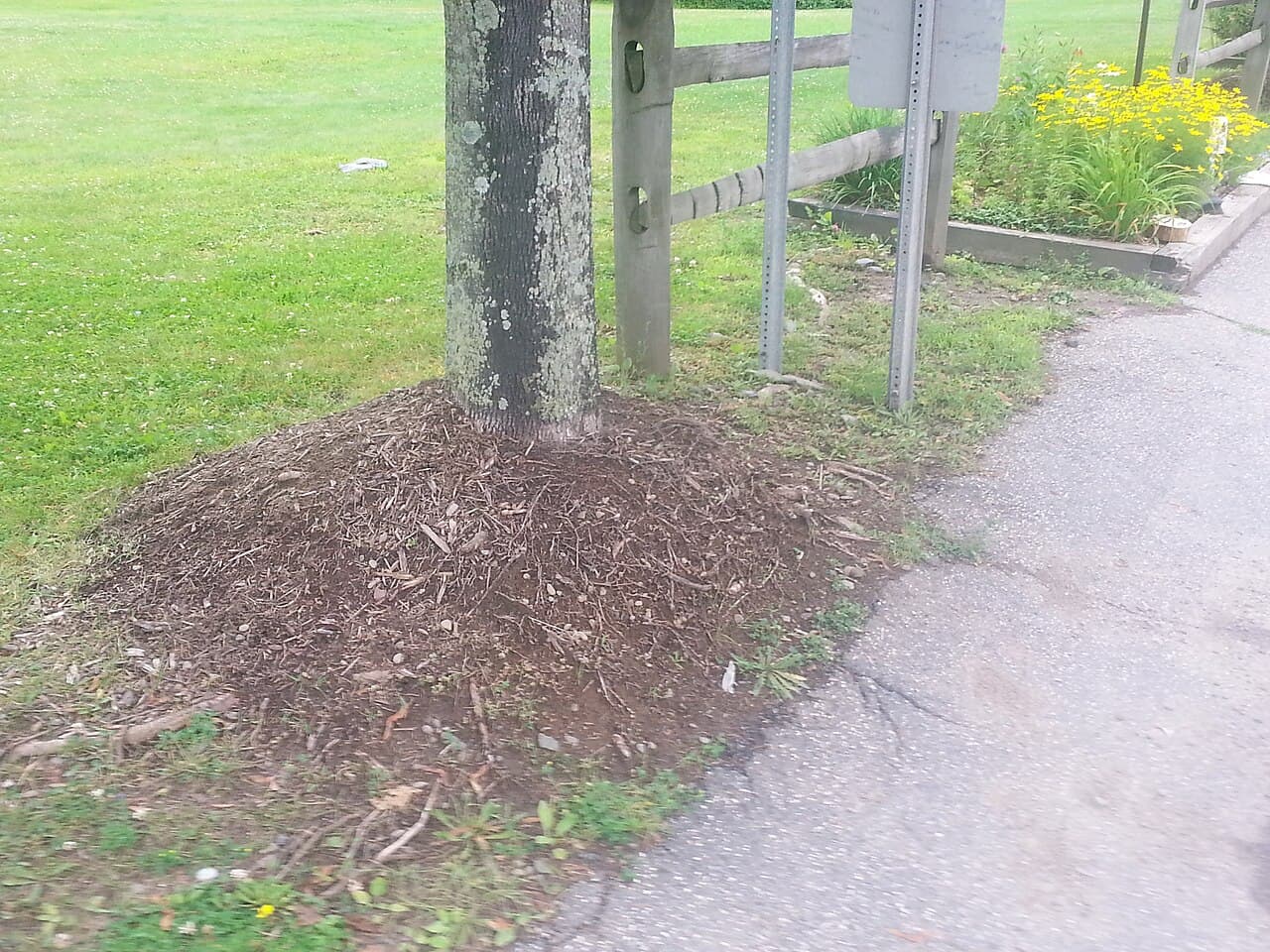
Clear mulch away from tree trunks and shrub stems, leaving a gap of about 3 inches so the bark stays dry.[2]
Step 5: Clear the foundation
Pull mulch back at least 6 inches from the foundation each time you refresh it.[6]
Step 6: Remove buildup
If the layer has grown past 3 inches, rake the excess out before adding any new mulch.[2]
Step 7: Reuse the old mulch
Work decomposed mulch gently into the bed or move it to other garden areas instead of bagging it.[2]
Step 8: Mulch at the right time
Do the yearly refresh in early spring, before weed seeds germinate.[1]
Most beds never need their mulch replaced, only topped up. Organic mulch breaks down into the soil, which is part of its job, and you add enough each year or two to bring the layer back to about 2 to 3 inches. How often that is depends on what you used. The time to take mulch out is when years of top-ups have piled it too deep.
How long each mulch lasts
Clemson Extension's rule of thumb is that pine needles and bark mulches typically last for around 2 to 4 years before the need to add more.[1] Wood chips are usually completely decomposed within 2 years.[1] Grass clippings and leaves decompose very fast and need replenishing frequently,[1] and Maryland Extension notes that compost used as mulch keeps decomposing and needs replacing every year.[3] Inorganic mulches such as gravel and pebbles rarely need replenishing.[1]
Pine-bark mulches are slow to decompose,[3] so a pine-bark bed usually needs topping up less often than one of small wood chips.
Beds also need less over time. As the plants grow and fill in the bed areas, less and less mulch is needed.[1]
Top up to depth, not by habit
Each spring, the thing to check is how deep the mulch is now, not when you last added it. Maryland Extension says organic mulches should only be replaced as needed to maintain their original depth,[2] and when freshening it up, do not let it exceed a depth of 3 inches.[2] Virginia Cooperative Extension's shrub guidance is mulch 2 to 3 inches deep.[4]
Check by pushing a trowel down through the mulch in a few places. If there are 2 inches left, an inch of new mulch is plenty. If there are 3, you can skip a year.
Why piling it on every year backfires
Spreading 3 fresh inches every spring is the most common way beds go wrong. Over time, mulch can pile up to five, six or more inches.[2] Excessive mulch reduces soil oxygen, suffocating roots,[2] and roots that grow up into the extra mulch die when it dries out.[2]
When that has happened, rake out the excess so the layer is back to 3 inches or less. Nothing is wasted: old mulch can be gently worked into the planting bed to improve the soil, or removed and worked into other garden areas.[2]
Weeds are another reason not to let old mulch build into a thick, soft layer. As organic mulches break down, they become a suitable growing medium for weeds.[5] Fresh mulch on top, kept to the right depth, keeps that layer covered. For more on that, see how to keep weeds out of garden beds.
Reset the edges each time
Every refresh is a chance to fix placement. Keep mulch 3 inches away from the base of trunks,[2] and pull back any that has crept up stems or into a cone like the one in the photo. Along the house, Virginia Tech's termite advice is to pull all mulch and landscaping back at least 6 inches from the foundation.[6]
Some plantings need less than the usual depth. Virginia Tech's wildlife guide suggests, for beds where voles are a problem, limiting mulch to no more than 1 inch.[7] Shallow-rooted plants like boxwood should not have more than one inch of mulch.[2]
Loosen what is left
Old mulch can crust over and shed water. If existing mulch is matted, break apart the matted layers with a rake,[1] then water the bed so the new layer settles. Fungi and slime that appear after rain are part of mulch breaking down; see why mold or fungus grows in mulch.
When to do it
Around established plants, mulch is applied in early spring, as plants begin to grow and before weed seeds start to germinate.[1] New plants get mulch right after planting, whatever the season. The full method is in how to mulch flower beds the right way.
Stop and call a pro if
- Mulch has been piled against tree trunks for years and the bark is soft, cracked or girdled by roots.
- Shrubs in a deeply mulched bed are thinning, yellowing or dying back.
- You find signs of termites where the bed meets the foundation.
- Clearing years of buildup from large beds is more hauling than you can do.
Browse the lawn and landscaping answers, see mulch and bed services, or look up lawn and landscaping businesses around Blacksburg. For what a refresh costs, see mulch installation costs in Virginia. To have beds cleaned out and topped up, describe the job once and local businesses quote it.
Common questions
- Do I need to remove old mulch before adding new?
- Usually not. Old mulch breaking down into the soil is doing its job. Rake it loose and add only enough to bring the layer back to 2 to 3 inches. Remove some only when the bed has built up above the base of the shrubs or past about 3 inches.
- How long does mulch last?
- It depends on the material. Clemson Extension puts pine needles and bark at about 2 to 4 years before you need to add more, wood chips at under 2 years to decompose fully, and leaves, grass clippings and compost at a season or so. Gravel and stone rarely need adding to.
- Is it bad to add mulch every year?
- Adding a full 3 inches every year is. Layers build up, starve roots of oxygen and keep trunks wet. A yearly top-up is fine as long as the total stays around 2 to 3 inches.
- My mulch has faded. Does it need replacing?
- Not if it is still deep enough. Faded mulch still conserves moisture and blocks weeds. Raking it turns up darker material; if you want fresh color, add a thin layer rather than a thick one.
- When is the right time of year to refresh mulch?
- Early spring, as plants start growing and before weed seeds germinate. New plantings get mulch right after you plant them, whatever the season.
Sources
- [1] Mulch (HGIC 1604), Clemson Cooperative Extension Home and Garden Information Center. Checked October 27, 2026.
- [2] Excess Mulch Problems, University of Maryland Extension. Checked October 27, 2026.
- [3] Mulching Trees and Shrubs, University of Maryland Extension. Checked October 27, 2026.
- [4] Shrubs: Functions, Planting, and Maintenance (426-701), Virginia Cooperative Extension, Virginia Tech. Checked October 27, 2026.
- [5] Home Grounds and Animals 2026, Home Ornamentals (Pest Management Guide 456-018, ENTO-634-D), Virginia Cooperative Extension, Virginia Tech. Checked October 27, 2026.
- [6] Home Grounds and Animals 2026, Household and Structural Pests (Pest Management Guide 456-018, ENTO-634-F), Virginia Cooperative Extension, Virginia Tech. Checked October 27, 2026.
- [7] Home Grounds and Animals 2026, Conflicts with Vertebrates (Pest Management Guide 456-018, ENTO-634-H), Virginia Cooperative Extension, Virginia Tech. Checked October 27, 2026.
Want a pro to handle it?
Describe the job once. Licensed local businesses send quotes, and you pay only when you book one.
Get a quote from a local pro