How do I mulch flower beds the right way?
Weed the bed first, then spread a fresh, sweet-smelling organic mulch 2 to 3 inches deep across the whole bed. Keep it a few inches back from stems and trunks and at least 6 inches back from the house. Mulch new plantings right after planting and established beds in early spring, and never heap it into a cone around a tree.
Free to ask. Local shops send quotes, and you pay only when you book one.
By Kasra Taheri, Founder, LoclisPublished
Researched and drafted with AI, then checked claim by claim against the sources listed below before it was published. Prices and rules change; the dates beside each source say when it was last checked.
Step by step
Read when to stop and call a pro, further down this page, before you start.
Step 1: Weed the bed
Pull or dig out the weeds already growing before you spread anything; organic mulch smothers new annual weeds, not established perennial ones.[1]
Step 2: Cut a clean edge
Cut a crisp edge between lawn and bed with a flat spade or edging tool so the mulch has a lip to sit behind and grass runners are easier to spot.
Step 3: Measure and order
Multiply the bed's square footage by the depth you want in inches and divide by 324 to get cubic yards.[5]
Step 4: Smell the mulch
Refuse mulch that smells of vinegar, ammonia, sulfur or silage; good mulch smells like fresh-cut wood or earthy soil.[5]
Step 5: Lay newspaper if you like
Spread a layer of newspaper on bare soil first to help suppress weeds, then cover it completely with mulch.[1]
Step 6: Spread 2 to 3 inches
Rake the mulch out evenly 2 to 3 inches deep over the whole bed, not just in rings around each plant.[2]
Step 8: Pull it back from stems
Keep mulch 2 to 3 inches away from the stems of shrubs and other woody plants.[5]
Step 9: Make a donut around trees
Around a tree, spread a thin ring with little or no mulch touching the trunk, never a cone.[1]
Step 10: Keep it off the house
Hold mulch at least 6 inches back from the foundation so it does not keep the base of the house damp.[3]
Step 11: Water it in
Water newly spread mulch so it settles and does not dry into a mat that sheds water.[5]
To mulch a bed properly, clear out the weeds, spread a fresh organic mulch 2 to 3 inches deep across the whole bed, and keep it pulled back from stems, trunks and the house. Most mulching problems come from piling it too deep or against plants, not from choosing the wrong type.
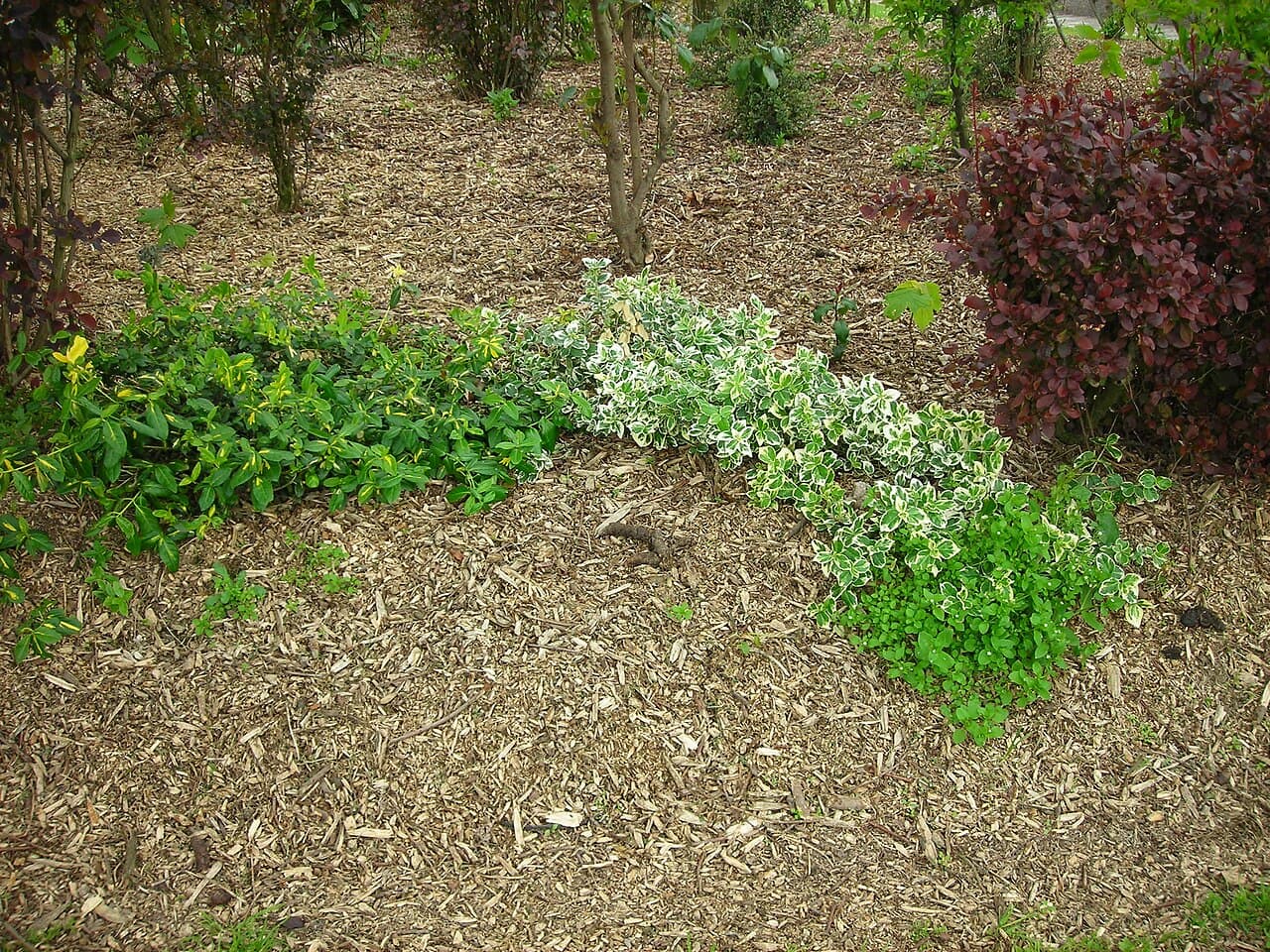
Pick a mulch that suits the bed
Virginia Cooperative Extension's home ornamentals guide lists pine bark, hardwood bark, pine straw and wood chips as good mulches,[1] and its shrub guide adds straw and slightly decomposed or shredded leaves.[2] They behave differently once they are down:
- Pine needles interlock and stay in place better than most mulches, especially on a slope.[5]
- Shredded hardwood does not wash away easily and decomposes relatively slowly.[5]
- Large pine bark nuggets float and may not stay put in a heavy rain.[5]
- Small wood chips decompose quickly and use nitrogen from the soil as they do.[5]
Texture matters for weeds too: shredded mulches encourage weed growth more than larger particle mulches.[1] On very acid soil, note that hardwood barks may contain high levels of manganese, which can be toxic to plants in soils with a pH below 5.0.[6] A soil test tells you where you stand.
Check it before you spread it
Smell a handful. Extension's advice is to use mulch that is free of weed seed and has no rotten egg or ammonia odor, because improperly composted mulch can have a low pH and contain chemicals that injure plants.[1] Sour mulch smells like vinegar, ammonia, sulfur or silage,[5] and bedding plants and low-growing woody plants are the most easily damaged.[5] Good mulch smells like fresh-cut wood or garden soil.
If you mulch with grass clippings, check where they came from. Do not use clippings from a lawn treated that season with herbicides or a weed-and-feed product.[6]
Work out how much you need
There are 27 cubic feet in a cubic yard, and one cubic yard covers 324 square feet an inch deep.[5] So multiply the bed's length by its width, multiply that by the depth you want in inches, and divide by 324. A 10-by-20-foot bed at 3 inches comes to 200 × 3 ÷ 324, or just under 2 cubic yards. Bulk mulch is sold by the yard; bags are labeled in cubic feet, so check the bag size before you count bags.
Prepare the bed
Weed first. Organic mulches suppress annual weeds but not perennial ones,[1] so dig out anything with runners or deep roots before you cover it. Extension also notes that newspaper on the soil surface before mulching helps suppress weeds;[1] lay it on bare soil and cover it completely.
A clean, cut edge between the lawn and the bed holds the mulch in place and makes creeping grass easier to spot. For keeping beds clean over the season, see how to keep weeds out of garden beds.
Spread it at the right depth
Extension's shrub guide says to place mulch 2 to 3 inches deep,[2] and its ornamentals guide says two to four inches deep and to avoid over mulching.[1] Texture decides where you land in that range: fine-textured wood and bark mulches should not be more than 2 to 3 inches deep, while coarse pine bark nuggets can go to 4 inches.[5] Grass clippings and shredded leaves should never be deeper than 2 inches, because they mat together.[5] Shallow-rooted plants like boxwood should have no more than an inch of mulch over their roots.[7]
Deeper is not better. In Extension's words, overly deep mulch, or mulch piled against the trunk, promotes shallow roots, disease and pest injury.[2] Excessive mulch reduces soil oxygen for roots.[7] If you can still see last year's mulch, you may only need to rake it loose and add a thin layer; see how often to replace mulch.
Keep it off stems, trunks and the house
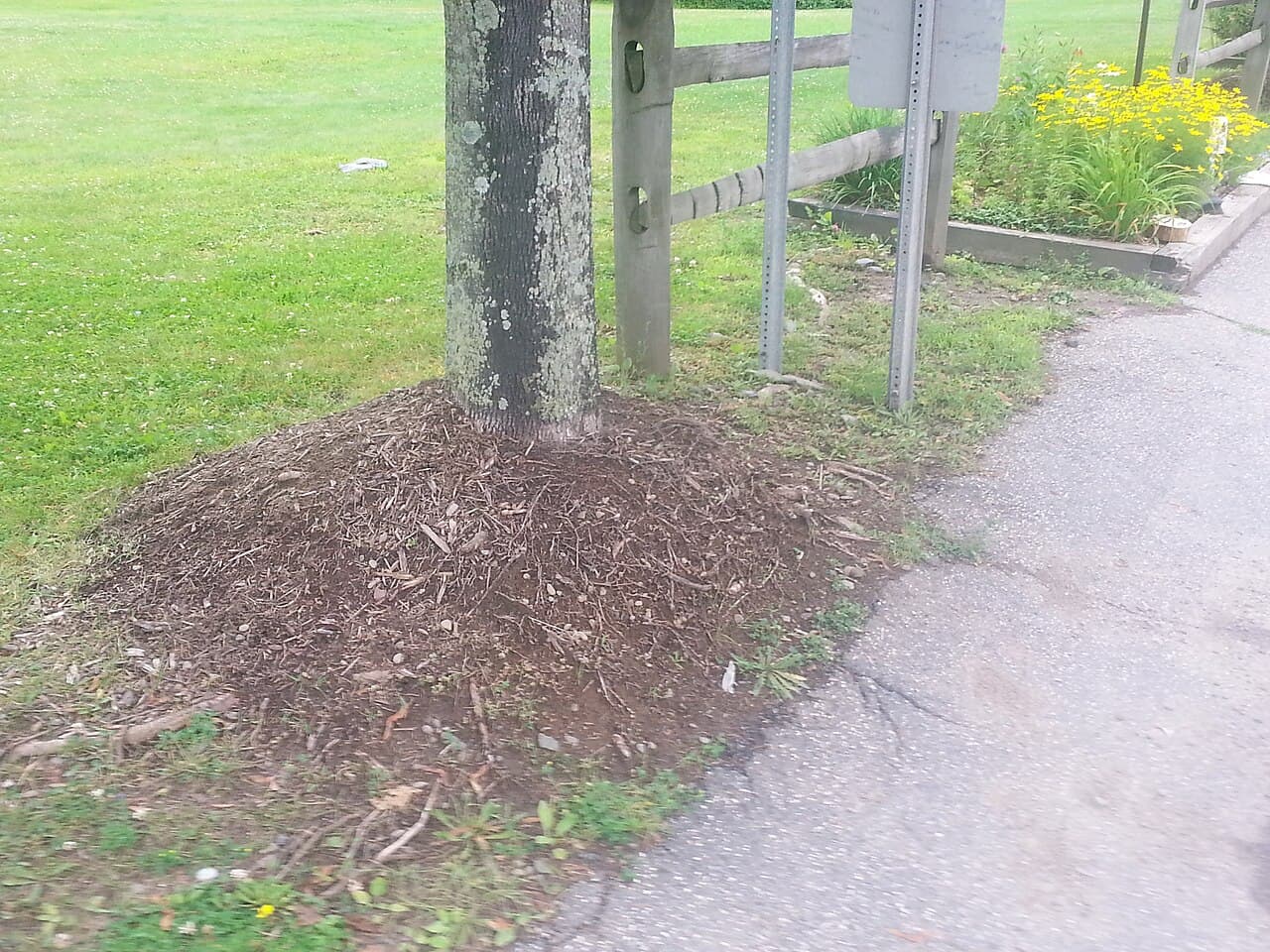
The cone of mulch in the photo is the most common mistake. Clemson Extension says to keep mulch 2 to 3 inches away from the stems of woody plants to prevent decay and rodent damage.[5] Around trees, Virginia Tech recommends a thin layer no more than two inches deep, in a donut-shaped ring with little or no mulch touching the trunk.[1] It explains why: mulch piled against a trunk keeps the bark moist, inviting decay organisms, insects and voles that feed below the mulch surface, which may girdle and kill the tree.[1]
Along the house, Extension's termite advice is to pull all mulch and landscaping back at least 6 inches from the foundation.[3] Its termite publication explains that mulch spread against the foundation holds moisture at the base of the house, and moist soil is prime termite habitat.[4]
Timing and watering
Clemson suggests you mulch new plantings right after you plant them, and established plants in early spring, before weed seeds germinate.[5] Newly installed mulch should be watered[5] so it settles and does not dry into a mat that sheds rain.
About landscape fabric
Fabric under organic mulch rarely stays weed-free. Extension notes that weeds may germinate in organic mulch over landscape fabric and send roots through it,[1] and advises a shallow mulch layer (1 inch) above the fabric.[1] It calls landscape fabrics more appropriate for tree and shrub beds[1] and says not to use them when planting groundcovers or bulbs.[1] In a flower bed you replant often, plain mulch is easier.
Stop and call a pro if
- Soil washes out of the bed on a slope and holding it means regrading or building a wall.
- You find mud tubes, soft wood or swarming insects where the bed meets the house.
- Mushrooms are growing from the base of a tree, or a trunk has been buried in mulch for years and roots now circle it.
- Water stands in the bed after rain and the fix is drainage, not mulch.
- The job is several cubic yards and moving it by wheelbarrow is more than you can do safely.
If the mulch grows mushrooms or slime after rain, see why mold or fungus grows in mulch. Browse the lawn and landscaping answers, see mulch and bed services, or look up lawn and landscaping businesses around Blacksburg. To have your beds weeded, edged and mulched, describe the job once and local businesses quote it.
Common questions
- How deep should mulch be in a flower bed?
- About 2 to 3 inches for shredded bark, hardwood or pine straw. Coarse pine bark nuggets can go to about 4 inches, while grass clippings and shredded leaves should stay at 2 inches or less. Around boxwood and other shallow-rooted plants, an inch is enough.
- Should mulch touch the plants?
- No. Keep it 2 to 3 inches back from shrub stems and spread it in a flat donut around trees with little or none touching the trunk. Mulch against bark keeps it wet and invites decay, insects and voles.
- How far should mulch be from the house?
- At least 6 inches from the foundation, per Virginia Cooperative Extension's termite guidance. Mulch against the foundation keeps the soil there damp, and moist soil is where subterranean termites like to live.
- Do I need landscape fabric under mulch?
- Usually not in a flower bed. Weeds sprout in organic mulch laid on fabric and root through it. Extension says fabric suits tree and shrub beds better, and advises about an inch of mulch on top of it.
- When is the right time to mulch?
- Right after planting for new plants, and early spring for established beds, before weed seeds sprout. Water fresh mulch after spreading it so it settles and does not form a dry mat.
- How much mulch do I need?
- Multiply the bed's square footage by the depth in inches and divide by 324 to get cubic yards. A 10-by-20-foot bed at 3 inches needs a little under 2 cubic yards.
Sources
- [1] Home Grounds and Animals 2026, Home Ornamentals (Pest Management Guide 456-018, ENTO-634-D), Virginia Cooperative Extension, Virginia Tech. Checked October 27, 2026.
- [2] Shrubs: Functions, Planting, and Maintenance (426-701), Virginia Cooperative Extension, Virginia Tech. Checked October 27, 2026.
- [3] Home Grounds and Animals 2026, Household and Structural Pests (Pest Management Guide 456-018, ENTO-634-F), Virginia Cooperative Extension, Virginia Tech. Checked October 27, 2026.
- [4] Conditions Conducive to Subterranean Termite Infestation (444-501), Virginia Cooperative Extension, Virginia Tech. Checked October 27, 2026.
- [5] Mulch (HGIC 1604), Clemson Cooperative Extension Home and Garden Information Center. Checked October 27, 2026.
- [6] Mulching Trees and Shrubs, University of Maryland Extension. Checked October 27, 2026.
- [7] Excess Mulch Problems, University of Maryland Extension. Checked October 27, 2026.
Want a pro to handle it?
Describe the job once. Licensed local businesses send quotes, and you pay only when you book one.
Get a quote from a local pro