Should I hire a carpenter or a painter to fix exterior trim?
Probe the trim with a screwdriver. If the wood is sound and only the paint or caulk is failing, a painter is the right call. If the wood is soft, split, loose or missing, you need a carpenter first, then paint soon after. In Virginia, a contractor taking a job over $1,000 needs a licence covering that work.
Free to ask. Local shops send quotes, and you pay only when you book one.
By Kasra Taheri, Founder, LoclisPublished
Researched and drafted with AI, then checked claim by claim against the sources listed below before it was published. Prices and rules change; the dates beside each source say when it was last checked.
Step by step
Read when to stop and call a pro, further down this page, before you start.
Step 1: Probe the trim
Push a small screwdriver into several spots on each damaged piece, especially bottom edges, sills and end grain.[7]
Step 2: Read the paint failure
Note whether the paint is crazed, cracked, peeling to bare wood, or lifting only where the wood underneath is soft.
Step 3: Check joints and nails
Look for open miters, loose boards and rusted nails, which point to carpentry even when the paint looks fair.[6]
Step 4: Note the year built
If the house was built before 1978, either trade must be lead-safe certified to disturb its paint for pay.[4]
Step 5: Choose the trade
Sound wood with failing paint goes to a painter; soft, split or missing wood goes to a carpenter, followed by paint.
Step 6: Check the licence covers it
For a job over $1,000, confirm on DPOR's website that the business is licensed for the work it is quoting.[3]
Step 7: Schedule paint right after carpentry
Book the painter so bare wood is primed within 48 hours of the paint coming off.[5]
Step 8: Put it all in writing
Get a written contract that names who does the wood repair, who primes, who paints, and with what products.[3]
Start with a screwdriver, not a phone call. Push it into the trim in a few places, especially the bottom edges and anywhere water sits. If the wood is firm and the problem is cracked or peeling paint and dried-out caulk, a painter is the right hire. If the tip sinks in, the wood is split or loose, or a piece is missing, you need carpentry first, and then paint soon after. Many trim jobs need both, and the order matters.
Why the wood decides
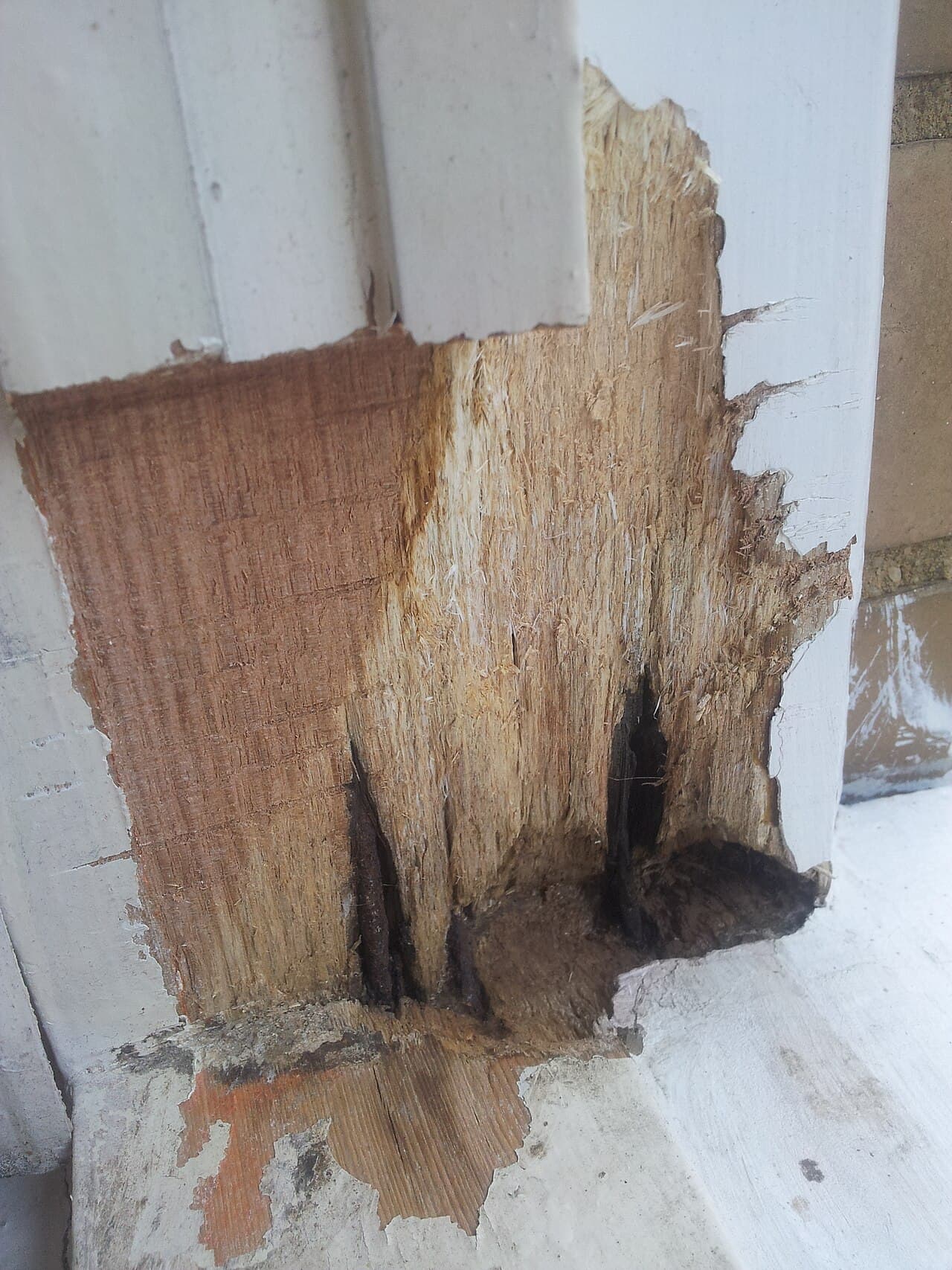
Decayed wood does not hold paint,[7] so painting over rot only hides it for a season. Rot is also easy to miss: the surface can look sound over decayed wood, which is why the Forest Products Laboratory advises probing several areas with a small-tipped screwdriver.[7] A painter who probes before quoting will tell you when a spot needs a carpenter; a quote that never mentions the wood underneath should make you ask.
When a painter is the right call
The wood is sound and the trouble is the coating: paint that is chalking, crazing, cracking or peeling, caulk that has split away from the joints, or bare spots where paint has worn through. In Virginia, painting and wallcovering contracting is a licensed specialty that includes surface preparation, caulking, sanding, and cleaning preparatory to painting,[1] which covers most trim refinishing.
How much paint has to come off depends on the failure. Crazing, the fine web of hairline breaks that forms when many layers of old paint turn hard and brittle, can be sanded and repainted.[5] If the cracking has reached bare wood and the paint is flaking, the paint has to come off entirely.[5] For more on reading the failure, see why paint on window trim cracks.
When you need a carpenter
The wood itself is the problem. Repair or replacement of deteriorated wood should take place before repainting,[5] and decayed boards should be replaced, not painted over.[7]
Call a carpenter when:
- The screwdriver sinks into soft or stringy wood.
- A board has deep checks or splits. Even the best paints cannot bridge over large cracks or checks that develop in the wood,[7] and where cross-grain checking comes from unstable juvenile wood near the center of the log, there is no fix other than replacing the board.[7]
- Miters have opened and boards have pulled loose. An open joint should be checked for decay and for a lost connection such as rusted nails before it is filled.[6]
- A profile has to be matched, a section spliced in, or a larger area rebuilt with two-part epoxy, where experience working with epoxies is needed for successful repairs.[6]
Finish carpentry contracting (FIN) covers the installation, repair and finishing of sash casing, door casing and other millwork,[1] the trim around most windows and doors.
When it takes both
Most rotted trim takes a carpenter and a painter, or one business that does both. Virginia's licensing allows for that: the home improvement contracting (HIC) specialty and the residential and commercial building contractor classifications also provide for both painting and finish carpentry.[1] One contractor who handles the whole job removes the scheduling gap, which is where repairs often go wrong.
That gap matters because new wood should not sit bare. Bare wood left after paint removal should be primed within 48 hours,[5] and research cited by the Forest Products Laboratory found that as little as one week of sun exposure before painting significantly shortened the life of the paint.[7] If you hire two trades, ask the carpenter to prime every face and cut end before the boards go up, and book the painter to follow within days.
Licences, lead and contracts for either trade
Licence. A Class C licence covers jobs over $1,000 but less than $30,000,[2] so whichever trade you hire, a job over $1,000 calls for a Virginia contractor's licence that covers the work. Check it yourself: "A license number in an advertisement or on a business card does not necessarily mean the contractor’s license is valid."[3] See how to check a contractor's licence in Virginia.
Lead. For an older house, the rule is that anyone paid to disturb paint in a home built before 1978 must be certified, and the EPA names painters and carpenters among the trades covered.[4] Minor repairs that disturb 20 square feet or less of exterior paint are exempt, but window replacement is always covered.[4] Ask for the firm's certification.
Contract. Virginia law requires all licensed contractors to provide a written contract for residential work.[3] When the work is split between trades, say so in writing: "If you intend to do some of the work yourself or hire another contractor to do it, this also should be written into the contract."[3]
Questions to ask whoever you hire
- Will you probe the trim before quoting, and how will you price rot you find later?
- Who primes the new wood, and when? Will the backs and cut ends be primed before installation?
- Which caulk and paint will you use, and how many coats?
- For an older house, is your firm EPA lead-safe certified, and how will you contain the dust?
Stop and call a pro if
- The soft wood runs into the sheathing, a sill, a header or the framing behind the trim. That is structural carpentry.
- The damaged trim is above the first storey or along the roofline.
- You find mud tubes or tunnels in the wood, a sign of termites that needs an inspection before any repair.
- The house was built before 1978 and the job will disturb a large area of paint.
Hiring through Loclis
On Loclis you describe the trim job once, with photos and what the screwdriver found, and licensed local businesses quote it. See what trim replacement costs, browse exterior painting or shutters and exterior trim, find handyman businesses around Blacksburg, or read more exterior answers.
Common questions
- Can a painter fix rotted trim?
- Some painters handle small filler or epoxy repairs as part of their prep, and a business licensed for home improvement work can do both. For a board that is soft through, split, or needs a matching profile, you want someone who does carpentry. Ask each bidder exactly how they will handle the soft wood.
- Does a painter need a licence in Virginia?
- Yes, for jobs over $1,000. Painting and wallcovering is its own contractor specialty in Virginia, and home improvement and building contractor licences also cover painting. Check the licence on DPOR's website before you sign.
- Should the carpenter or the painter prime the new trim?
- Agree on it in writing before work starts. The best result comes from priming every face and cut end before the board goes up, which only the carpenter can do, and then painting within a couple of days, so whoever paints should be booked to follow closely.
- Can a handyman fix exterior trim?
- Yes, if the business holds the right licence for the job size. Virginia's contractor licences start at jobs over $1,000, and the home improvement specialty covers both trim carpentry and painting, so a licensed handyman business can often do the whole repair.
- Do both trades need lead-safe certification on an older house?
- Yes. For a home built before 1978, any firm paid to disturb paint must be EPA lead-safe certified unless the work disturbs 20 square feet or less of exterior paint, and window replacement is always covered.
Sources
- [1] 18VAC50-22-30. Definitions of specialty services (Board for Contractors Regulations), Virginia Administrative Code (Virginia General Assembly). Checked October 26, 2026.
- [2] Code of Virginia § 54.1-1100. Definitions (Contractors), Code of Virginia (Virginia General Assembly). Checked October 26, 2026.
- [3] What You Should Know Before You Hire a Contractor, Virginia Department of Professional and Occupational Regulation, Board for Contractors. Checked October 26, 2026.
- [4] Lead Renovation, Repair and Painting Program: Contractors, U.S. Environmental Protection Agency. Checked October 26, 2026.
- [5] Preservation Brief 10: Exterior Paint Problems on Historic Woodwork, National Park Service. Checked October 26, 2026.
- [6] Preservation Brief 45: Preserving Historic Wood Porches, National Park Service. Checked October 26, 2026.
- [7] Chapter 16: Finishing Wood, Wood Handbook (FPL-GTR-282), USDA Forest Service, Forest Products Laboratory. Checked October 26, 2026.
Want a pro to handle it?
Describe the job once. Licensed local businesses send quotes, and you pay only when you book one.
Get a quote for Roofing