Should I mulch leaves into the lawn instead of raking them?
Usually, yes. Research reviewed by Virginia Cooperative Extension found that chopping deciduous leaves into the lawn during regular mowing does not harm the turf, and it saves raking, bagging and hauling. Rake instead where leaves are deeper than your mower can chop, for pine needles, and for leaves on beds, walks and driveways.
Free to ask. Local shops send quotes, and you pay only when you book one.
By Kasra Taheri, Founder, LoclisPublished
Researched and drafted with AI, then checked claim by claim against the sources listed below before it was published. Prices and rules change; the dates beside each source say when it was last checked.
Step by step
Read when to stop and call a pro, further down this page, before you start.
Step 1: Start when leaves start
Begin mulching as soon as leaves cover the grass noticeably, instead of waiting for the last tree to drop.
Step 2: Pick up sticks first
Walk the lawn and remove sticks and limbs before every mulching mow so the mower does not throw them.[1]
Step 3: Wear goggles and a dust mask
Put on safety goggles and an air mask over your mouth and nose before you start.[1]
Step 4: Mow dry or slightly moist leaves
Mow when leaves are dry or just damp, not soaked, so they chop finely without straining the engine.[1]
Step 5: Make extra passes where needed
Go over deep spots again, since several passes may be needed, until the pieces settle down into the grass.[1]
Step 6: Repeat weekly through the fall
Mulch again every week or so while leaves keep falling, so the layer never gets deeper than your mower can handle.
Step 7: Rake what the mower cannot do
Rake pine needles, deep drifts and leaves on beds and hard surfaces, and compost them or use them as bed mulch.
Step 8: Keep fertilizing on schedule
Feed a cool-season lawn as you normally would in fall, because mulched leaves do not replace nitrogen fertilizer.[1]
Step 9: Service the mower
Keep the blade sharp and the air and fuel filters clean during a season of repeated leaf mulching.[1]
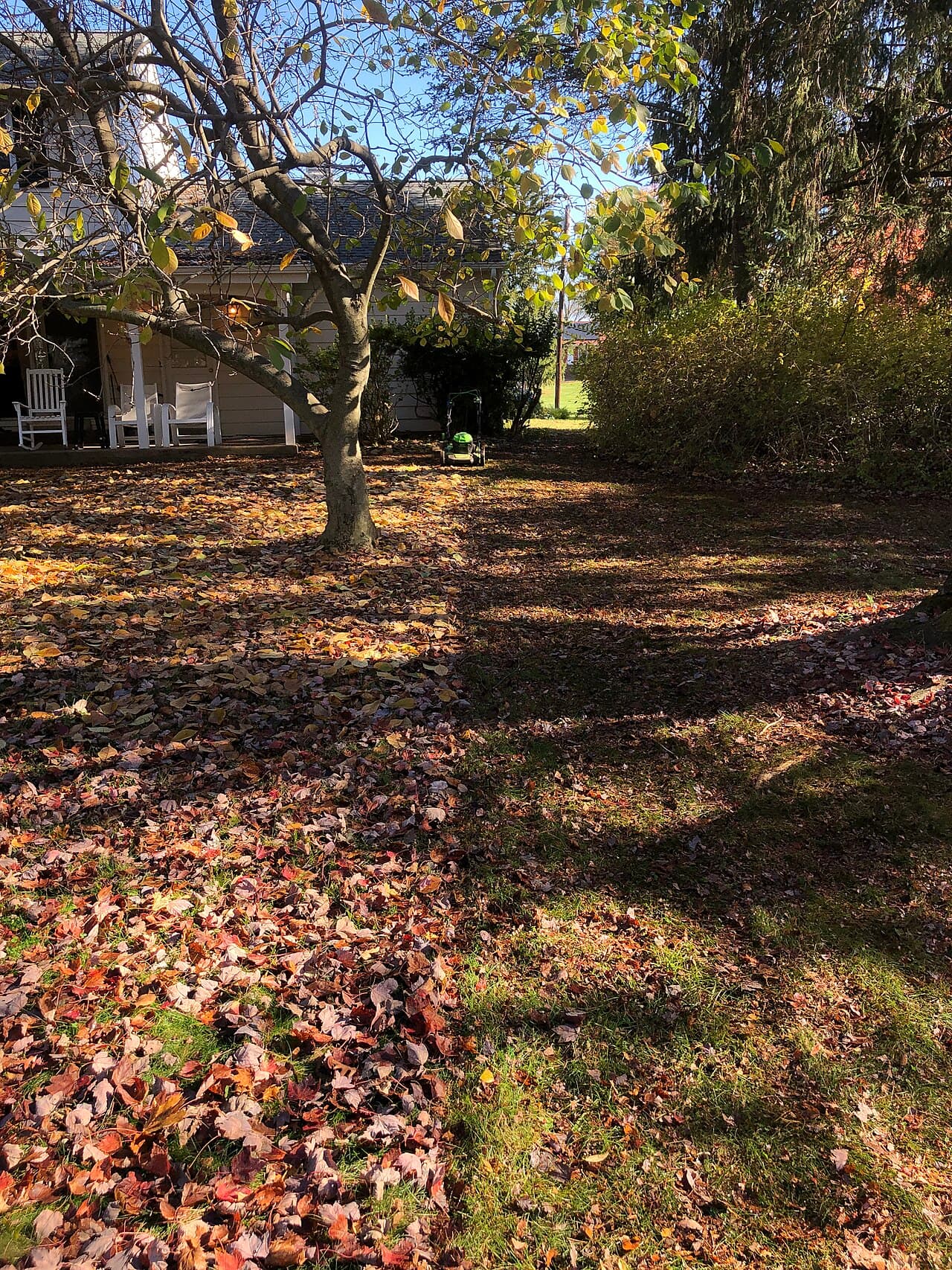
For most Virginia lawns, yes: mulching leaves into the grass with your mower is less work than raking and does the lawn no harm. University research reviewed by Virginia Cooperative Extension found that chopping up deciduous leaves as part of a regular mowing schedule is an effective means of managing these leaves without harming the turf.[1] Raking still has a place, for deep drifts, pine needles, and leaves on beds and hard surfaces, but it no longer has to be the main event of the fall.
What the research found
One study reviewed in the guide came from Purdue University. In it, up to 4,000 pounds of maple leaves per acre were mulched into a perennial ryegrass lawn in a single application.[1] The result was no undesirable effects on turf quality or color, growth, thatch accumulation, soil pH, weed populations or disease pressure.[1] One caution from the same work: the leaves were not a substitute for proper nitrogen fertilization.[1]
There may even be a weed benefit. Michigan State University research reported fewer dandelions and less crabgrass over time, because the leaf mulch filled gaps in the turf where those weeds would otherwise germinate.[1]
Mulching also keeps a lot of material out of trucks and landfills. In Fairfax County, the county and private haulers manage more than 200,000 tons of yard waste each year,[5] and its list of sustainable leaf management alternatives includes mulch mowing.[6]
When mulching works well
Mulching works with the mower you already have. A mulching mower helps, but most rotary mowers can do it. It works best when:
- The layer is not too deep. According to Michigan State research, up to 6 inches of leaves can be mulched at a time, though that varies with the size and performance of the mower, and several passes may be needed.[1] Mulching every week or so during leaf drop keeps the layer shallow.
- The leaves are not soaked. Moist leaves cut down on dust, but leaves that are too wet strain the engine and do not chop into pieces small enough to decompose easily.[1]
- The pieces end up small. You should be able to see the grass again after the pass. If a layer of chopped leaf still sits on top, go over it again.
When raking is the better choice
Pine needles. Pine needles are highly resistant to breaking down and stay physically intact for months even when chopped.[1] Rake them and use them as mulch around shrubs.
Deep drifts and late piles. If you have waited until every leaf is down and the layer is far deeper than your mower can handle, rake off the worst of it first and mulch the rest. Do not leave it: a thick layer of whole leaves blocks sunlight and holds moisture in the turf canopy, which slows the grass and raises the risk of disease.[1]
Beds, walks and driveways. The mower cannot reach shrub beds, and leaves left on paving can wash into the street and storm drains. Rake or blow them onto the lawn and mulch them there, or put them in the beds as mulch.
Before fall treatments. If you or a lawn company will treat the lawn this fall, clear or mulch the leaves first. Virginia Cooperative Extension notes that chemical sprays over the top of leaves are often a waste of time, effort and money.[2]

Fitting mulching into fall lawn care
Mulching leaves does not change the rest of your fall routine. Keep mowing at your normal height, and keep fertilizing on schedule: for cool-season lawns, Virginia Tech's fall guide says September, October and November are the months to apply nitrogen to cool-season grasses.[2]
If you have more leaves than the lawn can take, compost the extra. EPA's home composting guide says to use at least two to three times as much brown material, such as dry leaves, by volume as green material such as food scraps.[4] Virginia Cooperative Extension adds to chop or shred leaves before adding them, which speeds composting.[3] Running the mower over them with the bag on does both jobs at once.
Stop and call a pro if
- The lot has more leaves than you can keep up with by mowing weekly, or slopes too steep to mow safely.
- Leaves have built up in gutters or on the roof. That is ladder work; read how often gutters should be cleaned.
- Grass under the leaves is already dying in patches; see why grass dies under fallen leaves.
- You want fertilizer or weed control applied for you; see when to fertilize a lawn in Virginia and hire a licensed company.
For more, read the easiest way to get rid of fall leaves and what leaf removal costs in Virginia, browse the lawn and landscaping answers, or see leaf and yard cleanup services. If you would rather a crew mulched them for you, describe your leaf cleanup once and local businesses quote it.
Common questions
- Do mulched leaves add thatch?
- Research reviewed by Virginia Cooperative Extension found they do not. In a Purdue study, mulching up to 4,000 pounds of maple leaves per acre into a lawn had no undesirable effect on thatch accumulation, turf quality, soil pH, weeds or disease.
- Can mulched leaves replace fertilizer?
- No. The same research found the leaves were not a substitute for proper nitrogen fertilization. Keep feeding a cool-season lawn on its usual fall schedule; Virginia Cooperative Extension points to September, October and November as the months for nitrogen on cool-season grasses.
- How small should the leaf pieces be?
- Small enough to drop down between the grass blades so you can see the lawn again,. If you still see a layer of leaf pieces on top after mowing, make another pass.
- Can I mulch oak leaves?
- Yes. The research on leaf mulching covers deciduous leaves generally. Where they lie deep, they may need an extra pass. Pine needles are the exception, since they barely break down even when chopped.
- Should I bag the leaves with my mower instead?
- Bagging with the mower is a good way to collect chopped leaves for a compost pile or for mulching beds, and chopped leaves take up less space than whole ones. If the lawn itself does not need them removed, leaving them on the grass saves a step.
Sources
- [1] "Leave" Them Alone: Lawn Leaf Management (430-521), Virginia Cooperative Extension, Virginia Tech. Checked October 27, 2026.
- [2] Fall Lawn Care (430-520), Virginia Cooperative Extension, Virginia Tech. Checked October 27, 2026.
- [3] Making Compost from Yard Waste (426-703), Virginia Cooperative Extension, Virginia Tech. Checked October 27, 2026.
- [4] Composting at Home, U.S. Environmental Protection Agency. Checked October 27, 2026.
- [5] Yard Waste, Fairfax County Department of Public Works and Environmental Services. Checked October 27, 2026.
- [6] Vacuum Leaf Collection, Fairfax County Department of Public Works and Environmental Services. Checked October 27, 2026.
Want a pro to handle it?
Describe the job once. Licensed local businesses send quotes, and you pay only when you book one.
Get a quote from a local pro