What is the easiest way to get rid of fall leaves?
For most Virginia lawns the least work is to mow the leaves into the grass with a rotary or mulching mower every week or so while they fall, instead of raking everything at the end. Rake or blow only what the mower cannot chop, then compost it, use it under shrubs, or set it out the way your town or county's leaf collection asks.
Free to ask. Local shops send quotes, and you pay only when you book one.
By Kasra Taheri, Founder, LoclisPublished
Researched and drafted with AI, then checked claim by claim against the sources listed below before it was published. Prices and rules change; the dates beside each source say when it was last checked.
Step by step
Read when to stop and call a pro, further down this page, before you start.
Step 1: Clear the lawn first
Walk the yard and pick up sticks and limbs before you mow, so the blade cannot throw them at you or anyone nearby.[1]
Step 2: Put on eye and dust protection
Wear safety goggles and an air mask over your mouth and nose, since chopping leaves raises debris and dust.[1]
Step 3: Pick the right day
Mow when the leaves are dry or only slightly moist; soaked leaves strain the engine and do not chop into small pieces.[1]
Step 4: Mow at your usual height
Run a rotary or mulching mower over the leaves at the lawn's normal cutting height, overlapping each pass a little.
Step 5: Go over thick areas again
Make extra passes where leaves are deep, until the pieces are small enough to settle down between the grass blades.[1]
Step 6: Keep up every week
Mow every week or so while the trees are dropping, so the layer never builds up deeper than your mower can handle.
Step 7: Rake only what is left
Rake or blow pine needles, deep drifts and leaves on walks, patios and beds onto a tarp and drag it to where they are going.
Step 8: Compost or set out the rest
Add raked leaves to a compost pile, spread them under shrubs, or set them out exactly as your locality's leaf collection asks.
Step 9: Look after the mower
Keep the blade sharp and the air and fuel filters clean if you mulch leaves repeatedly through the fall.[1]
The easiest way to deal with fall leaves on a lawn is usually to let the mower do it. Run a rotary or mulching mower over them every week or so while the trees are dropping, and most of the leaves disappear into the grass as small pieces that break down over the winter. You only rake or blow what the mower cannot handle. Virginia Tech's turfgrass specialist calls mulching leaves directly back into the turf a relatively cost effective and time-saving means of leaf disposal.[1]
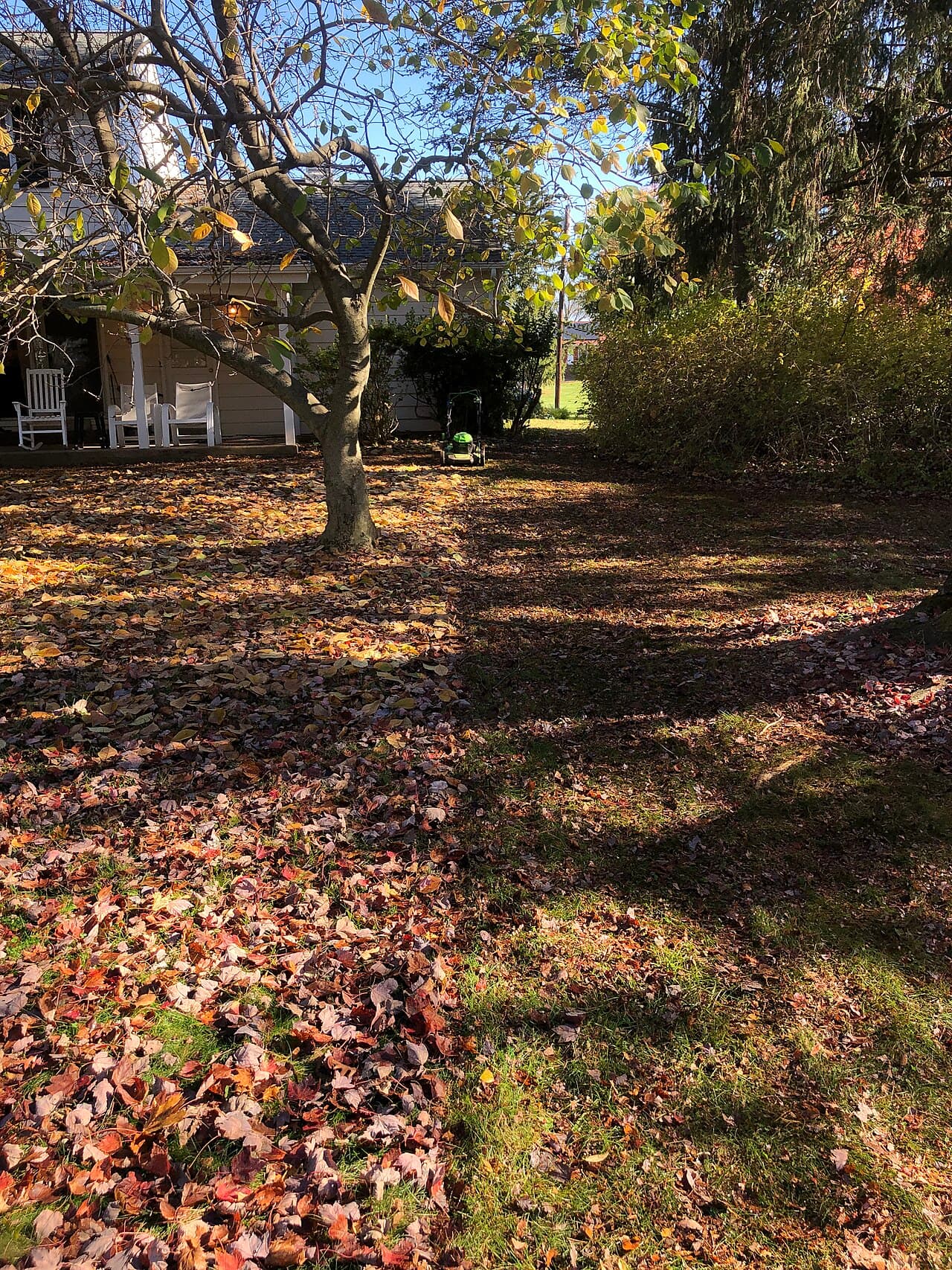
Why mowing them in is the least work
Raking a whole season of leaves into piles, bagging them and hauling them to the curb is the slow way. Mowing over them takes about as long as a normal mow, and you were going to mow anyway.
It does not hurt the lawn. University research reviewed by Virginia Cooperative Extension found that chopping up deciduous leaves as part of a regular mowing schedule is an effective means of managing these leaves without harming the turf.[1] In one Purdue study, up to 4,000 pounds of maple leaves per acre in a single application had no undesirable effects on turf quality or color, growth, thatch, soil pH, weeds or disease.[1]
You do not need special equipment. Mulching mowers have deck and blade designs made for the job, but almost any rotary mower can do it.[1]
How much your mower can take
Research from Michigan State University found that up to 6 inches of leaves can be mulched at a time, depending on the size and performance of the mower.[1] In practice, the deeper the layer, the more passes you need. That is why mowing every week during leaf drop is easier than waiting for the last leaf: the layer never gets deep enough to bog the mower down.
Timing matters too. Slightly moist leaves keep the dust down, but leaves that are too wet strain the engine and do not chop into pieces small enough to break down in the soil.[1] A dry afternoon a day or two after rain usually works well.
Pine needles are the exception. They resist breaking down and stay intact for months even when chopped,[1] so rake them up and use them as mulch around shrubs instead.
What to do with the leaves you rake
Some leaves still have to be moved by hand: deep drifts under large oaks and maples, leaves in flower beds, on the driveway and on the patio. Raking or blowing them onto a tarp and dragging it is usually quicker than filling bags.

Compost them. Fall leaves are the brown half of a compost pile. In Virginia Cooperative Extension's guide, dry leaves can make up an equal amount to three times as much of the pile, by volume, as fresh green material such as grass clippings.[2] Keep the pile about as moist as a wrung-out sponge, chop or shred the leaves first, and turn it now and then.[2] If the material is shredded, moist and turned several times, a pile can finish in one to two months.[2]
Use them in beds. Chopped leaves spread thinly under shrubs and in perennial beds act as a free mulch.
Set them out for collection. Some Virginia localities collect leaves in the fall, and each one has its own rules. Follow them exactly, because leaves raked into the street tend to clog storm drains and gutters and are costly to collect.[2]
- In Richmond, the city's Department of Public Works collects up to 6 bags of leaves on your normal trash day during its fall program, and the city also offers a paid vacuum pickup. When we checked the city's leaf collection page on October 27, 2026, it listed a $30 payment per vacuum request.[3] Rake leaves to the curb or property line, not into the street or gutter, and remove sticks and stones.[3]
- Fairfax County runs vacuum leaf collection in designated areas from November through January for households that pay an added service charge.[4] Its piles must sit no more than 4 feet from the edge of the street, must not block storm drains, and must be free of trash, sticks, grass and other debris.[4] For bagged leaves, Fairfax County prohibits plastic bags for yard waste, so use paper yard bags or reusable containers.[5]
Elsewhere, check your town or county public works page before you rake anything to the curb.
What about burning them?
Burning is seldom the easy option, and the rules are tight. Under state law, in the counties and cities organized for forest fire control under the State Forester, from February 15 through April 30 it is unlawful to burn leaves in or within 300 feet of woodland, brushland or a field of dry grass except between 4:00 p.m. and midnight.[6] Anyone burning in the open within 150 feet of woods, brush or dry grass must not leave the fire unattended and must put it out completely before leaving.[6] In the parts of Virginia where the state's stricter open burning rules apply, the regulation permits burning leaves on private property only where no regularly scheduled collection service for leaves and yard trimmings is available at the adjacent street.[7] On top of that, counties and cities can add their own restrictions, such as burn bans in dry, high fire danger weather.[8] Mulching, composting or collection is simpler.
Stop and call a pro if
- Leaves are packed in the gutters of a two-storey house. Gutter work from a tall ladder is a job for a gutter or roofing crew; see how often gutters should be cleaned.
- A storm has brought down large limbs or left branches hanging in the tree. That is tree work, not leaf cleanup; read how to tell if a tree is dead or dangerous.
- The lot is large, steep or heavily wooded and the leaves keep coming faster than you can mow and rake them.
- You cannot safely push a mower or rake for hours. A cleanup crew can do in an afternoon what takes several weekends alone.
- The grass underneath is already thin or dead in patches. See why grass dies under fallen leaves.
For more, read whether to mulch leaves instead of raking them and what leaf removal costs in Virginia, browse the lawn and landscaping answers, or see leaf and yard cleanup services and lawn and landscaping businesses near Blacksburg. If you would rather hand the job off, describe your leaf cleanup once and local businesses quote it.
Common questions
- Do I need a special mulching mower?
- No. A mulching mower has a deck and blade designed to chop clippings finely, which helps, but almost any rotary mower can mulch leaves. Expect to make more than one pass where the leaves are deep, and keep the blade sharp.
- Will mulched leaves smother the grass?
- Not when they are chopped small. University research summarised by Virginia Cooperative Extension found that mulching maple leaves into a lawn did not hurt turf quality, color, growth or thatch. A thick layer of whole leaves left sitting on the lawn is what blocks sunlight and holds moisture against the grass.
- Is a leaf blower faster than a rake?
- On a large, open lawn a blower usually moves leaves faster, especially dry ones, and a rake is often quicker for small yards and wet, matted leaves. Either way, mowing the leaves in first leaves far less to move.
- Can I rake leaves into the street for pickup?
- Only if your locality says so, and many say not to. Richmond asks residents to rake leaves to the curb or property line, not into the street or gutter, and Fairfax County wants vacuum piles within 4 feet of the street edge without blocking storm drains. Leaves in the street clog storm drains.
- Can I burn my leaves in Virginia?
- Sometimes, but it is rarely the easy option. State law limits burning near woods and dry fields to 4 p.m. to midnight from February 15 through April 30, the state's open burning rules restrict it in some areas where leaf collection is offered, and counties and cities can ban burning in dry weather. Check with your locality first.
Sources
- [1] "Leave" Them Alone: Lawn Leaf Management (430-521), Virginia Cooperative Extension, Virginia Tech. Checked October 27, 2026.
- [2] Making Compost from Yard Waste (426-703), Virginia Cooperative Extension, Virginia Tech. Checked October 27, 2026.
- [3] Leaf Collection, City of Richmond Department of Public Works. Checked October 27, 2026.
- [4] Vacuum Leaf Collection, Fairfax County Department of Public Works and Environmental Services. Checked October 27, 2026.
- [5] Yard Waste, Fairfax County Department of Public Works and Environmental Services. Checked October 27, 2026.
- [6] Va. Code § 10.1-1142, Regulating the burning of woods, brush, etc.; penalties, Code of Virginia, Virginia General Assembly. Checked October 27, 2026.
- [7] 9VAC5-130-40, Permissible open burning, Virginia Administrative Code, Virginia General Assembly. Checked October 27, 2026.
- [8] Fire Laws, Virginia Department of Forestry. Checked October 27, 2026.
Want a pro to handle it?
Describe the job once. Licensed local businesses send quotes, and you pay only when you book one.
Get a quote from a local pro