Why is my grass dying under fallen leaves?
A mat of whole leaves left on the lawn shades the grass and holds moisture against it, which slows growth and raises the chance of disease. Shaded cool-season lawns suffer most, and tall fescue cannot spread to fill the dead patches. Clear or mow the leaves in every week, and reseed bare spots of a cool-season lawn in late summer to mid-fall.
Free to ask. Local shops send quotes, and you pay only when you book one.
By Kasra Taheri, Founder, LoclisPublished
Researched and drafted with AI, then checked claim by claim against the sources listed below before it was published. Prices and rules change; the dates beside each source say when it was last checked.
Step by step
Read when to stop and call a pro, further down this page, before you start.
Step 1: Get the leaves off now
Mow the leaves in where the layer is light and rake away deep mats, so light and air reach the grass again.[1]
Step 2: Check what kind of grass it is
Find out whether the lawn is a cool-season grass such as tall fescue or a warm-season grass such as bermudagrass or zoysiagrass.
Step 3: Rule out normal dormancy
If it is bermudagrass or zoysiagrass, brown grass after the first killing frost is usually dormant, not dead.[3]
Step 4: Tug on the brown patches
Pull gently on a handful of brown grass; living grass holds firm, while dead grass often lifts out easily with little root.
Step 5: Watch the spots in spring
Wait for spring green-up and mark any patches that stay brown or bare after the rest of the lawn has greened.
Step 6: Reseed cool-season bare spots in fall
Seed bare patches of a cool-season lawn in late summer to mid-fall, the preferred window for establishing these grasses.[3]
Step 7: Use a shade-tolerant seed under trees
Under trees, choose a seed mix with fine-leaf fescue, the most shade-tolerant of the cool-season grasses.[2]
Step 8: Keep up next fall
Mow or clear leaves every week or so while they fall, so a heavy layer never sits on the grass for long.
Grass under fallen leaves usually dies for two reasons working together: the leaves shut out light, and they hold moisture against the grass. A thick layer of leaves blocks sunlight, which reduces turf growth through shading.[1] The leaves also trap and hold moisture in the turf canopy, increasing the potential for turf disease.[1] A few weeks of that, on grass that is already shaded by the trees that dropped the leaves, is enough to thin a lawn or kill patches outright.
The good news is that leaves are easy to stop being a problem, and most damage can be repaired the following fall.
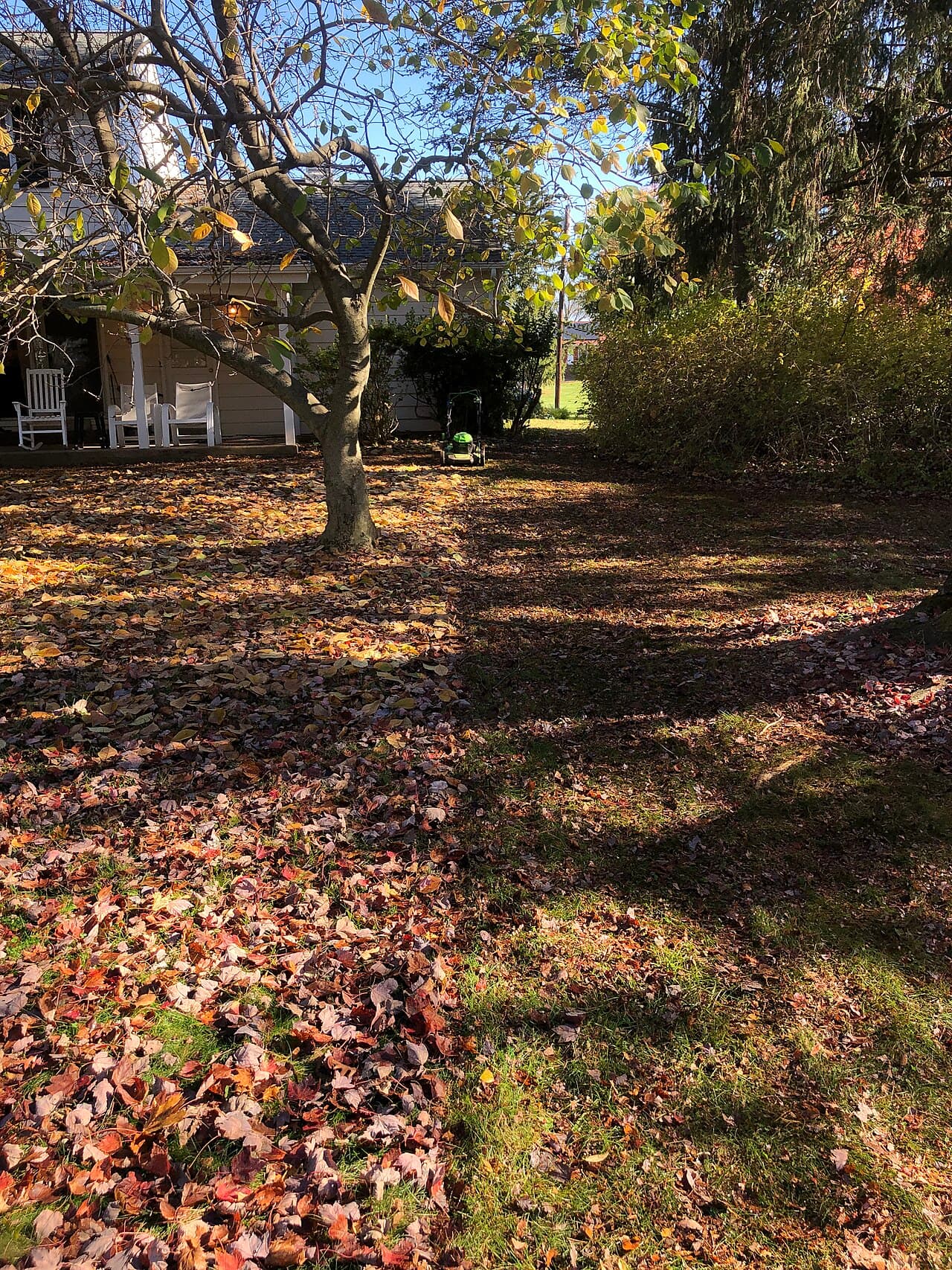
Whole leaves versus chopped leaves
The trouble comes from a mat of whole leaves, especially wet ones that stick together. Leaves chopped into small pieces are different. University research reviewed by Virginia Cooperative Extension found that chopping deciduous leaves as part of a regular mowing schedule manages them without harming the turf.[1] The small pieces settle between the grass blades and break down instead of sitting on top as a lid. Mowing the leaves in about once a week while they fall keeps the layer thin enough for the grass to keep growing.
Why some lawns suffer more than others
The grass was already short of light. The trees that drop the leaves also shade the lawn all summer. Shade tolerance varies a lot between grasses. Among the cool-season grasses common in Virginia, Kentucky bluegrass has poor shade tolerance,[2] tall fescue has only moderate shade tolerance,[2] and fine-leaf fescues have the best shade tolerance of the cool-season grasses.[2] Among warm-season grasses, bermudagrass has poor shade tolerance, while zoysiagrass has good shade tolerance.[2] A grass that is barely coping with summer shade has little in reserve when leaves cover it in the fall.
Tall fescue does not fill in. Tall fescue is one of the best-adapted lawn grasses across Virginia,[2] and many lawns here are tall fescue or a tall fescue blend. But tall fescue is a bunch-type grass with limited to no recuperative potential.[2] Once a patch dies, the plants around it will not creep in to cover it, so the bare spot stays bare until it is reseeded. Kentucky bluegrass, by contrast, can recover quickly in fall and spring because it spreads by rhizomes.[2]
Disease took hold. Damp, matted leaves create the moist conditions fungi like. Virginia Tech's turf guide also notes that brown patch has long been a disease concern in tall fescue.[2] A patch that died under wet leaves may have been finished off by disease rather than darkness alone.
Make sure it is really dead
If your lawn is bermudagrass or zoysiagrass, brown grass in late fall is normal. Warm-season grasses such as bermudagrass and zoysiagrass go dormant after the first killing frost,[3] and bermudagrass stays dormant and off-color for 4 to 5 months of winter.[2] Leaves on top do not change that. Clear them anyway, and judge the lawn after spring green-up.
For a cool-season lawn, grass that is brown and thin in late fall while the rest of the lawn is green is a warning sign. A gentle tug helps: living grass holds firm, while dead grass often lifts out with little root.
Fixing the damage
Clear the leaves now. Mow them in where the layer is light, and rake off deep mats. Do not spray over them: Virginia Cooperative Extension notes that chemical sprays applied over the top of leaves are often a waste of time, effort and money,[3] because the product lands on the leaves instead of the grass.
Reseed at the right time. Late summer to mid-fall is the preferred time to establish cool-season grasses,[3] so bare patches found now are usually reseeded the following late summer or early fall. Virginia Tech's maintenance calendar gives seeding rates per 1,000 square feet of 6 to 8 pounds for tall fescue and 3 to 5 pounds for fine-leaf fescues.[4] Warm-season lawns follow a different calendar: warm-season grasses should not be planted in the fall, unless one is installing sod in early to mid-fall.[3]
Pick a grass that suits the spot. Under trees, a seed mix that includes fine-leaf fescue usually holds on better than straight tall fescue or bluegrass. Where even that fails, a mulched bed under the tree may be the better answer.
Stay ahead next year. Weekly mowing during leaf drop, plus raking the deepest drifts, prevents most of this damage.
Stop and call a pro if
- Large areas of the lawn are dead, not just patches under the trees; a full renovation may be needed. See how to fix a lawn that is mostly weeds and bare spots.
- Patches keep dying in the same places year after year even when leaves are cleared; drainage, soil or disease may be the real cause. Read why a lawn has bare patches.
- The trees themselves look sick, have dead limbs or are dropping leaves early; that calls for a tree professional, and how to tell if a tree is dead or dangerous explains what to look for.
- You want weed or disease treatments applied for you; use a licensed lawn care company.
For more, read whether to mulch leaves instead of raking them and the easiest way to get rid of fall leaves, browse the lawn and landscaping answers, or see leaf and yard cleanup services. If you want help clearing leaves before they do more damage, describe your leaf cleanup once and local businesses quote it.
Common questions
- How long can leaves sit on the lawn before they hurt it?
- There is no fixed number of days; it depends on how thick and wet the layer is and how much the grass is still growing. A thin scattering does little harm, while a wet mat that blocks the grass from light for weeks can thin it. Clearing or mowing leaves in about once a week while they fall avoids the problem.
- Will the dead patches grow back on their own?
- It depends on the grass. Kentucky bluegrass spreads by rhizomes and can recover in fall and spring. Tall fescue, one of the best-adapted lawn grasses across Virginia, is a bunch-type grass with limited to no ability to fill in bare spots, so those patches usually need reseeding.
- My bermudagrass turned brown under the leaves. Is it dead?
- Probably not. Bermudagrass and zoysiagrass go dormant after the first killing frost and stay brown through winter. Clear the leaves anyway, then judge the lawn when it greens up in late spring. Patches that stay brown after the rest has greened are the ones to look at.
- Can I fertilize or spray weed killer over the leaves?
- It is not a good idea. Virginia Cooperative Extension notes that chemical sprays applied over the top of leaves are often a waste of time, effort and money, because the product lands on the leaves instead of the lawn. Clear or mulch the leaves first.
- Should I just stop trying to grow grass under my trees?
- In deep shade it may be the sensible choice. Fine-leaf fescues tolerate shade better than other cool-season grasses, but no lawn grass thrives without some sun. Where grass keeps failing under dense trees, a mulched bed or a shade-tolerant ground cover is often easier to keep looking good.
Sources
- [1] "Leave" Them Alone: Lawn Leaf Management (430-521), Virginia Cooperative Extension, Virginia Tech. Checked October 27, 2026.
- [2] Selecting Turfgrass for Virginia (SPES-748), Virginia Cooperative Extension, Virginia Tech. Checked October 27, 2026.
- [3] Fall Lawn Care (430-520), Virginia Cooperative Extension, Virginia Tech. Checked October 27, 2026.
- [4] Maintenance Calendar for Cool-Season Turfgrasses in Virginia (430-523), Virginia Cooperative Extension, Virginia Tech. Checked October 27, 2026.
Want a pro to handle it?
Describe the job once. Licensed local businesses send quotes, and you pay only when you book one.
Get a quote from a local pro