Should I replace my garage door opener or repair it?
Replace it if it does not reverse when the door hits an obstruction, or if it is old enough to predate the federal reversing and entrapment-protection rules. CPSC says a non-reversing opener should be repaired or replaced. Repair a newer opener with a single fault, such as a dead remote or a misaligned sensor. Always rule out the door itself first.
Free to ask. Local shops send quotes, and you pay only when you book one.
By Kasra Taheri, Founder, LoclisPublished
Researched and drafted with AI, then checked claim by claim against the sources listed below before it was published. Prices and rules change; the dates beside each source say when it was last checked.
Step by step
Read when to stop and call a pro, further down this page, before you start.
Step 1: Check whether the door itself is the problem
Close the door, pull the quick release to detach it from the opener, and move it by hand to see whether it is balanced and moves freely.[1]
Step 2: Test the reversing system
Place a 2x4 on the floor in the door's path and close the door; if it does not properly reverse on striking the board, disengage the opener until it is adjusted, repaired or replaced.[1]
Step 3: Look at the safety sensors
If the opener has an electric eye, check that it sits 4 to 6 inches above the floor and that nothing blocks it.[1]
Step 4: Rule out the cheap faults
Replace the remote battery and try the wall control, so you know whether the fault is the remote, the control or the opener itself.
Step 5: Write down what you have
Note the brand, the model number on the motor unit and the color of its Learn button, so a quote matches your door and accessories.[5]
Step 6: Get written quotes for both options
Ask at least three licensed companies for a written quote to repair and another to replace, using the same description of the problem.[6]
Replace the opener if it fails the reversing test, or if it is old enough to predate the federal reversing and entrapment-protection rules. Repair it when it is newer and has one clear, small fault such as a remote, a sensor or a travel setting. Before either, make sure the door itself is not the problem, because a new opener will not fix a door that is out of balance.
Start with the safety rules, not the price
CPSC's advice is blunt: homeowners with automatic garage door openers that do not automatically reverse should repair or replace them with new reversing openers.[1] CPSC requires that all garage door openers manufactured or imported for sale in the United States after January 1, 1991 have reversing systems, and a requirement for external entrapment protection system was added in 1993.[1]
So an opener from before those dates is not worth repairing as a convenience: it lacks protection that newer units have. If you do not know the age, the model label on the motor unit will tell you or a technician.
Test before you decide
CPSC and LiftMaster both put the reversing test on the regular maintenance list. CPSC says to inspect the garage door and the garage door opener every 30 days,[1] and LiftMaster lists "Test the safety reversal system."[2]
The test: "Place a 2x4 on the floor of the garage in the door's path." If the door does not properly reverse when striking it, the opener should be disengaged until it is adjusted according to the owner's manual, repaired or replaced.[1] If the opener has an electric eye, CPSC says it should be installed at a height of 4 to 6 inches above the floor.[1] A sensor that is knocked out of line or blocked is a repair, not a reason to replace.
Is it the opener or the door?
To check, make sure the door is closed and pull the "quick release" mechanism to detach the garage door from the opener, then move the door by hand.[1] If the door is heavy, binds or will not stay where you leave it, the trouble is in the door's springs or tracks. CPSC says that if doors are not "balanced," or if they bind or stick, they should be serviced by a professional.[1] LiftMaster says the same: if it is unbalanced or binding, call a trained door systems technician.[2] Replacing the opener on a door in that state means the new motor labors against the same fault.
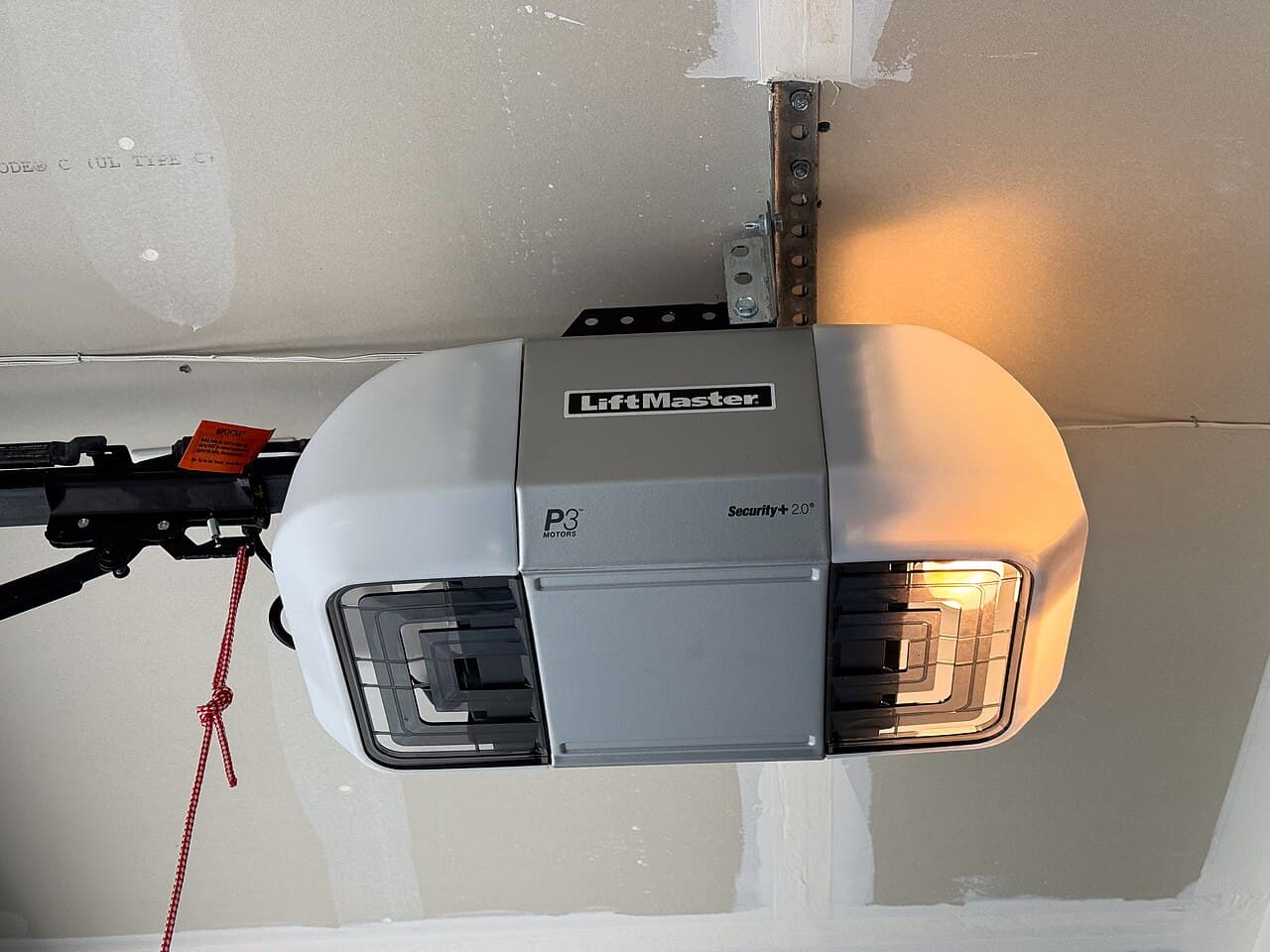
When repair makes sense
- A dead remote or wall control: replace the battery first, then reprogram. See how to program a garage door remote.
- A misaligned or blocked safety sensor.
- A door that stops short or reverses because its travel setting needs adjusting; the owner's manual covers it.
- A newer opener with one failed part and a door that is otherwise in good order.
When replacement makes sense
- It fails the 2x4 test and a technician cannot bring it into adjustment.
- It predates the 1991 and 1993 rules above.
- It keeps failing in different ways, so each repair visit costs and the next one is likely.
- You want features the old unit cannot take, such as smartphone control or battery backup.
One thing to budget for: new accessories. Chamberlain notes about its B2310 that most older accessories are not compatible,[3] so expect new remotes and a new keypad. Warranty length also varies; that same model lists a 5 year motor and belt warranty,[3] so ask what any opener you are quoted carries.
Hiring it done
Chamberlain says installation takes 2+ hours, depending on your skill level, and certain steps may require two people.[4] Many owners will hire it out. Virginia's Board for Contractors says it is advisable to get at least three written bids or estimates using identical plans and specifications so you can compare prices and contractors.[6] Ask for a repair quote and a replacement quote on the same problem. Beware of any bid substantially lower than the others,[6] and remember that a license number in an advertisement or on a business card does not necessarily mean the contractor's license is valid; look it up with DPOR.[6]
Stop and call a pro if
- The door does not reverse on the 2x4. Disconnect it with the quick release and have it adjusted or replaced.[1]
- The door is unbalanced, binds or sticks. Leave the springs and cables alone.[1]
- The opener needs wiring work beyond plugging it in, or you find damaged wiring.
- The mounting looks loose or the opener sags from the ceiling.
Getting help in Virginia
For prices and what drives them, see how much a garage door opener costs installed in Virginia and how much garage door repair costs. Browse garage door answers or garage door pros on Loclis.
When you are ready, describe the problem once and local pros will quote it.
Common questions
- How do I know if my opener is too old?
- CPSC says all openers manufactured or imported for sale in the United States after January 1, 1991 have reversing systems, and a requirement for external entrapment protection was added in 1993. An opener that predates those dates, or that fails the 2x4 test, is a replacement candidate.
- How do I test the reversing system?
- Place a 2x4 on the floor in the door's path and close the door. If the door does not reverse on striking it, CPSC says to disengage the opener until it is adjusted, repaired or replaced.
- Will my old remotes work with a new opener?
- Often not. Chamberlain says of its B2310 opener that most older accessories are not compatible, so plan to use the remotes and keypad that come with the new unit.
- Is the opener or the door the problem?
- Disconnect the door from the opener with the quick release and move it by hand. LiftMaster says that if it is unbalanced or binding, call a trained door systems technician. A bad spring is a door problem that a new opener will not fix.
- Can I install a new opener myself?
- Chamberlain says installation takes 2 or more hours depending on skill, and some steps may need two people. Many owners hire it out and ask for the work in a written quote.
Sources
- [1] Non-Reversing Automatic Garage Door Openers Are a Hazard (Pub. 523), U.S. Consumer Product Safety Commission. Checked October 27, 2026.
- [2] LiftMaster Residential Maintenance, LiftMaster (Chamberlain Group), maintenance sheet. Checked October 27, 2026.
- [3] B2310, 3/4 HP Belt Drive Opener with myQ Connectivity, Chamberlain. Checked October 27, 2026.
- [4] Garage Door Opener Installation, Chamberlain. Checked October 27, 2026.
- [5] Garage Door Opener Remote Replacement, Chamberlain. Checked October 27, 2026.
- [6] What You Should Know Before You Hire a Contractor, Virginia Board for Contractors, DPOR. Checked October 27, 2026.
Want a pro to handle it?
Describe the job once. Licensed local businesses send quotes, and you pay only when you book one.
Get a quote from a local pro