What does an electrician check when outdoor lights stop working?
An electrician works from the simple to the hard. First, how much is out: the whole system or a few lights. Then the power supply, including the GFCI and breaker, the timer or photocell, the transformer, and finally the wiring and connections out to the fixtures. Most of this is work on live circuits, so it is a job for a licensed electrician.
Free to ask. Local shops send quotes, and you pay only when you book one.
By Kasra Taheri, Founder, LoclisPublished
Researched and drafted with AI, then checked claim by claim against the sources listed below before it was published. Prices and rules change; the dates beside each source say when it was last checked.
This is a job for a licensed pro in Virginia
This page explains what the work involves, the permits, what a licensed pro does and what drives the cost. It does not give step-by-step instructions, because this work needs a licence, a permit or both, and doing it wrong can injure someone. Before you hire, check the licence on Virginia's DPOR record.
When outdoor lights stop working, an electrician does not start with the fixtures. The usual order runs from the simplest and cheapest cause to the hardest: how much of the system is out, whether power reaches it, whether the controls are doing their job, and only then the wire and connections between the transformer and the lights.
Knowing the order helps you describe the problem well, judge a quote, and see why a visit often costs more for diagnosis than for the repair itself.
What the electrician asks first
Before touching anything, a good electrician asks questions. Kichler's troubleshooting guide for lighting professionals starts with the obvious: is the entire system out or just certain lights, and is there visible damage to the fixtures.[1] It also lists recent construction on the property and new landscaping such as edging, new plants or mulching as questions that help point to the location of a problem.[1]
Have these answers ready: when you first noticed it, what changed outside lately, whether a storm came through, and whether the lights are off or just dim. A trench for a new bed or a sprinkler line often explains a dead run of lights.
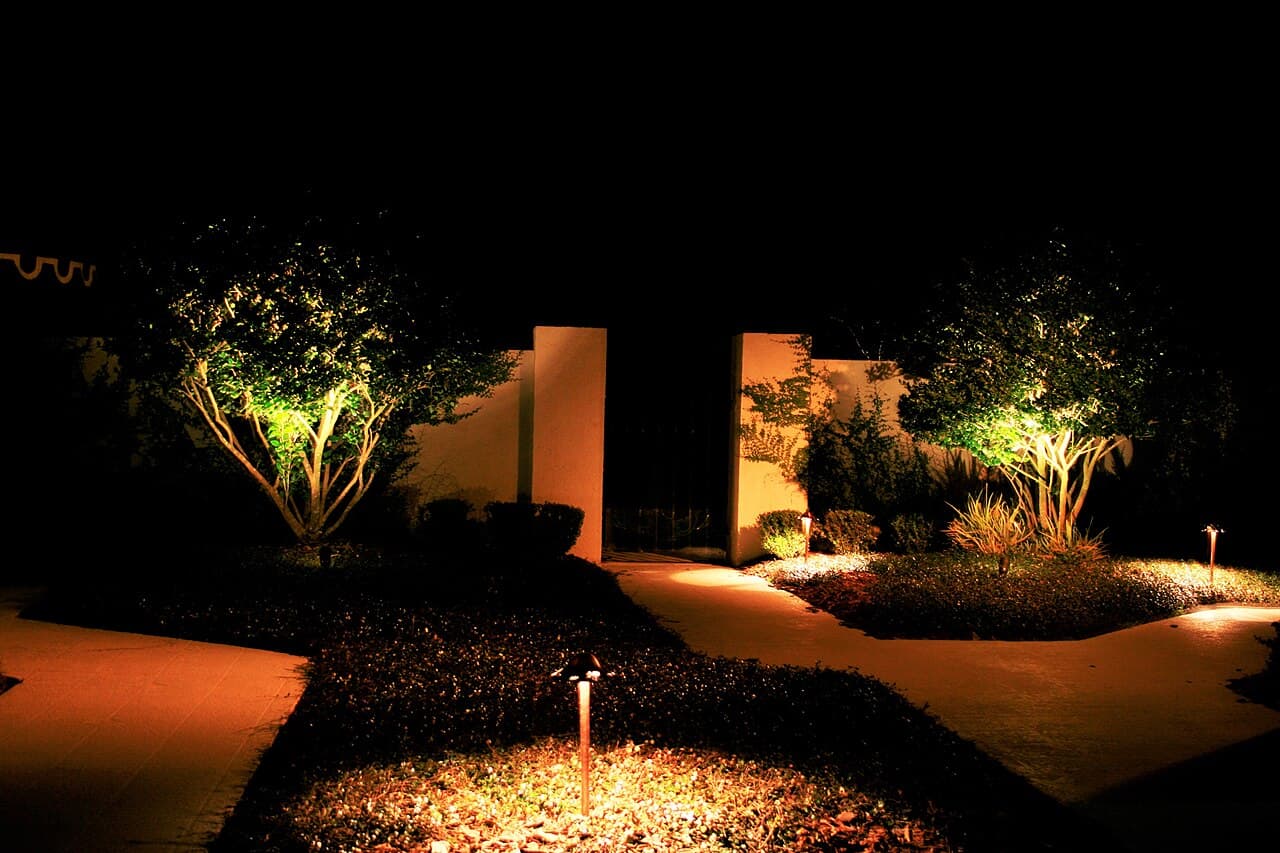
The power supply
If the whole system is out, Kichler says to check whether there is power at the 120V outlet and, if there is not, whether the GFI switch or the breaker tripped.[1] Outdoor outlets are normally protected by a GFCI, and one tripped device, sometimes in a garage or basement, can kill several outdoor circuits at once.
The US Consumer Product Safety Commission says to test every GFCI once a month according to the manufacturer's instructions.[3] An electrician will test the device and replace it if it no longer trips and resets properly. A breaker that trips again as soon as it is reset points to a short or an overload downstream, and that is when the work becomes diagnosis rather than a reset.
Timers, photocells and controls
Next come the devices that decide when the lights run. Kichler says to check control devices such as photocells, digital timers and smart timers, to see whether they need cleaning, whether a schedule needs to be reset and whether a backup battery needs replacing.[1] A photocell caked with dirt or shaded by a new plant can believe it is daytime all night. A timer that lost its settings in a power flicker produces the same symptom.
These are cheap to check and cheap to fix, which is why they come before anything involving the wiring.
The transformer and the wiring
Most residential landscape lighting runs on low voltage from a transformer. With the transformer checked, the electrician moves to the cables and connections. Kichler says to inspect the cables and the terminal block connectors and to make sure the wires are snug and separate.[1] Wires loosen over time as they go through thermal contraction, and they can also be damaged or chewed by pests.[2]
When lights are dim, or the farther fixtures are weaker than the near ones, the electrician measures voltage along the run to see where it falls. An overloaded transformer, a run that is too long and a poor connection can all cause it, and connections are the first suspects. Finding the bad one often means checking each splice, including the ones buried in the ground.
The fixtures themselves
Last, the fixtures. A lamp can fail, but so can a fixture that has taken on water. Kichler says that on older products dry gaskets do not protect a fixture from water or dust, and that fixtures with gaskets that are not replaced can have a shorter life.[2] Corroded sockets and cracked lenses are common findings in fixtures that have been outdoors for years.
Why the answer is not a DIY checklist
Several of these checks mean working on live circuits, opening boxes or testing wire that may be energised, and some of the problems they find lead to new wiring. Virginia's building code requires a permit before installations or alterations involving electric wiring,[4] though the code exempts most installations of wiring and equipment that operates at less than 50 volts from the permit requirement.[4] Which side of that line your repair falls on depends on what the electrician finds, and local building departments may apply it differently.
When to call a licensed pro
Call a licensed electrician if a GFCI or breaker trips again after it is reset, if you see burn marks, melted insulation or a burning smell, if fixtures or boxes have been underwater, or if a line-voltage fixture or cable looks damaged. The Code of Virginia says no individual may work as a tradesman, which includes electricians, unless licensed or working under the supervision of a licensed tradesman.[5] Check the licence before you agree to anything.
To see what a repair costs and how to compare quotes, read how much outdoor lighting repair costs in Virginia. For how these systems are built, see how low-voltage landscape lighting works, and for whether an installation needs a pro, should I hire an electrician for landscape lighting. Browse outdoor lighting repair, explore electrical repair services or read more electrical repair answers.
To have a licensed electrician find the fault, describe the problem once and local electricians quote the repair.
Common questions
- Why does the electrician ask when the lights stopped working?
- Timing points to the cause. Kichler lists recent construction and new landscaping such as edging, new plants or mulching as questions that help locate a problem, because a shovel or an edger can cut buried wire.
- Is it the whole system or just some lights?
- That is the first thing to find out. If the whole system is out, the cause is usually upstream, at the power supply, controls or transformer. If only some lights are out, it is usually a lamp, a fixture or a connection.
- Why are my lights dim instead of out?
- Dimming usually means the voltage is falling along the run, often at a loose or corroded connection, an overloaded transformer or a run that is too long. An electrician measures voltage along the run to find where it drops.
- Does an outdoor lighting repair need a permit?
- Virginia's building code requires a permit before installations or alterations involving electric wiring, with an exemption for wiring and equipment that operates at less than 50 volts. Replacing a fixture or a lamp is a different thing from adding a circuit, so ask the electrician and your local building department.
- Can I just replace the bulbs myself?
- Changing a lamp in a fixture that is switched off is ordinary maintenance. Anything past that, such as opening a junction box, working at the transformer or tracing wire, belongs to a licensed electrician.
Sources
- [1] Troubleshooting a Landscape Lighting System, Kichler Lighting. Checked October 27, 2026.
- [2] Landscape Maintenance, Kichler Lighting. Checked October 27, 2026.
- [3] Home Electrical Safety Checklist (Publication 513), U.S. Consumer Product Safety Commission. Checked October 27, 2026.
- [4] 13VAC5-63-80, Virginia Uniform Statewide Building Code, Section 108 Application for permit, Virginia Administrative Code, Legislative Information System. Checked October 27, 2026.
- [5] Code of Virginia § 54.1-1129, Necessity for licensure, Code of Virginia, Legislative Information System. Checked October 27, 2026.
Want a pro to handle it?
Describe the job once. Licensed local businesses send quotes, and you pay only when you book one.
Get a quote for Electrical Repair