Why are my outdoor lights not working?
If every outdoor light is out, the cause is usually upstream: a tripped GFCI or breaker, a timer or photocell that is not switching, or the transformer. If only some are out, it is usually a failed lamp, a loose or corroded connection, or a cut wire. Anything beyond a lamp means live circuits, so call a licensed electrician.
Free to ask. Local shops send quotes, and you pay only when you book one.
By Kasra Taheri, Founder, LoclisPublished
Researched and drafted with AI, then checked claim by claim against the sources listed below before it was published. Prices and rules change; the dates beside each source say when it was last checked.
This is a job for a licensed pro in Virginia
This page explains what the work involves, the permits, what a licensed pro does and what drives the cost. It does not give step-by-step instructions, because this work needs a licence, a permit or both, and doing it wrong can injure someone. Before you hire, check the licence on Virginia's DPOR record.
Start with how much is out. When every outdoor light is dead, the cause is almost always upstream of the fixtures: a tripped GFCI or breaker, a timer or photocell that is not switching, or the transformer. When only some are out, it is usually a failed lamp, a loose or corroded connection, or a wire that has been cut.
That split tells you what an electrician will look at first, and it lets you describe the problem in a way that saves time on the visit.
If the whole system is out
If the whole system is out, Kichler says to check whether there is power at the 120V outlet and, if there is not, whether the GFI switch or the breaker tripped.[1] Outdoor outlets are exposed to weather. The CPSC warns: "Moisture can get into outside outlets and cause a malfunction, which can pose a possible shock or fire hazard."[3] A GFCI that tripped after rain, sometimes one in a garage or basement that feeds several outdoor outlets, is a common reason for a dark yard.
The US Consumer Product Safety Commission says to test every GFCI once a month according to the manufacturer's instructions.[3] A device that will not reset, or a breaker that trips again straight away, means a fault downstream. That is a job for an electrician, not another reset. For the breaker side, see whether it is safe to reset a tripped circuit breaker, and for how the protective device works, what a GFCI outlet does.
If the lights have power but never come on
Power at the outlet with dark lights points to the controls. Kichler says to check control devices such as photocells, digital timers and smart timers, to see whether they need cleaning, whether a schedule needs to be reset and whether a backup battery needs replacing.[1] A dirty or shaded photocell can read daylight all night, and a timer that lost its schedule in a power flicker will do the same.
One detail catches installers out: Kichler's reminder is to cap the photocell while testing the system and to remove and store the cap once the work is done.[1]
If the lights are dim or only some are out
Kichler says dim lights throughout a system or in one spot can be voltage drop from an overloaded wire run, or a loose connection.[1] Connections are a frequent culprit because the wire moves as the ground and air temperature change. Wires can become loose over time as they go through thermal contraction, the heating, expanding and cooling cycle.[2]
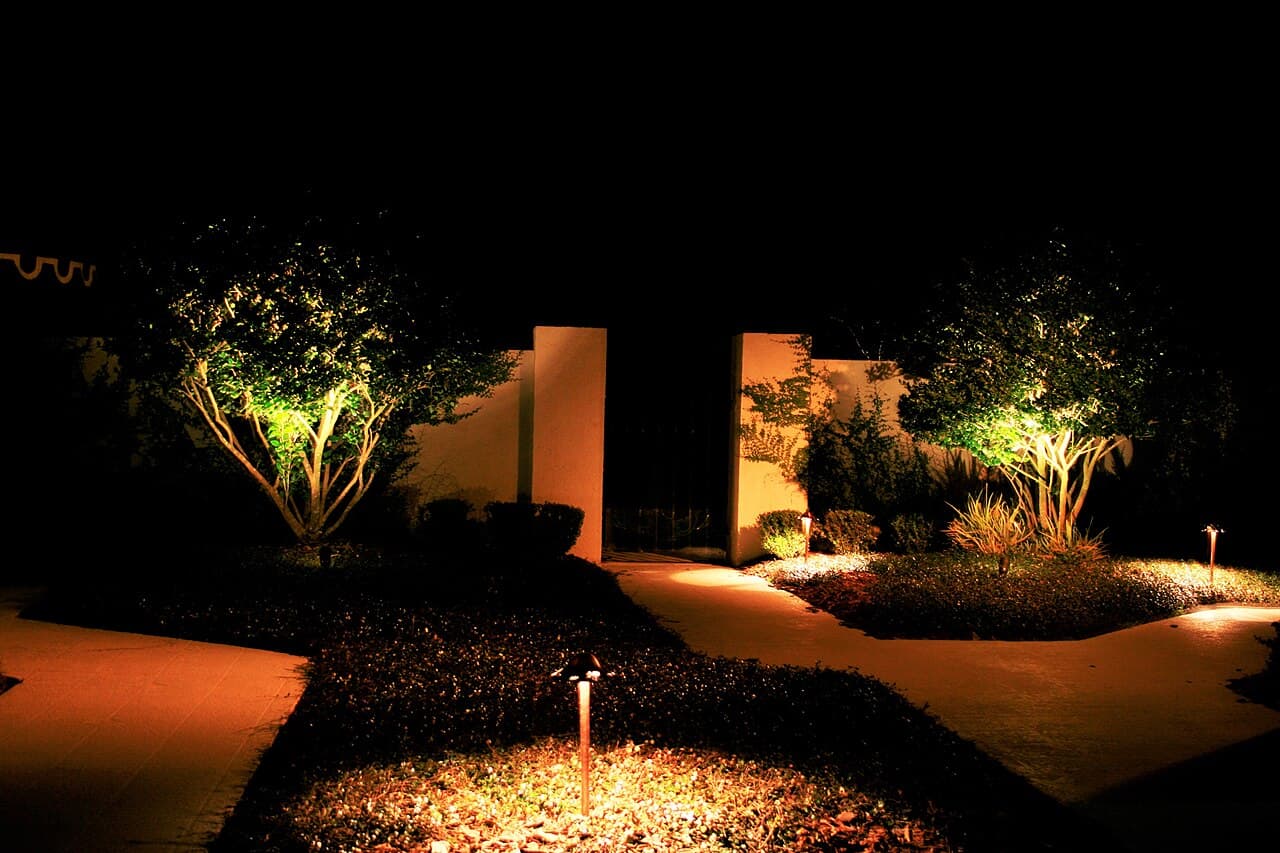
For a single dead fixture, the cause may be small. With drop-in fixtures, Kichler says, a single dead light could be as simple as replacing the lamp.[1] On accent lights the damage can run deeper: a socket can become burnt out by an overheated lamp, which can be caused by a dirty lens.[1]
If a whole run went dark after yard work
A shovel, an edger or a new planting bed can cut a buried cable. Everything beyond the cut goes out. Finding it by digging is slow and damages the lawn. Kichler lists a wire locator, which finds buried wire, and a cable fault locator, which locates where buried wire may be cut or disconnected,[1] which is why this is worth paying an electrician for. Tell them what was dug, planted or edged and when.
Permits and licensing
Virginia's building code requires a permit before installations or alterations involving electric wiring,[4] though the code exempts installation of wiring and equipment that operates at less than 50 volts, with listed exceptions.[4] Swapping a lamp is not a wiring alteration; adding a circuit or replacing line-voltage wiring may be. Ask the electrician and your local building department which applies.
When to call a licensed pro
Call a licensed electrician when a GFCI or breaker trips again after a reset, when you see burn marks, melted insulation or smell burning, when a fixture, box or outlet has been underwater, or when the fault sits in line-voltage wiring or buried cable. The Code of Virginia says no individual may work as a tradesman unless licensed or working under the supervision of a licensed tradesman.[5] Check the licence before you agree to a quote.
Where to go next
Read what an electrician checks when outdoor lights stop working to see the order of a diagnostic visit, and how much outdoor lighting repair costs in Virginia for what drives the price. You can also browse electrical repair services or more electrical repair answers.
To have a licensed electrician find the fault, describe the problem once and local electricians quote the repair.
Common questions
- Why did all my outdoor lights go out at once?
- Something upstream of the lights lost power or stopped switching them on. The usual suspects are a tripped GFCI or breaker, a timer or photocell, or the transformer. Kichler's troubleshooting guide starts with whether there is power at the outlet that feeds the system.
- Why are only some of my outdoor lights out?
- That points to the fixtures or the wire to them: a failed lamp, a burnt socket, a loose or corroded connection, or a cable cut by digging. If the lights past one point on the run are out, look at the connection just before the first dead light.
- Why do my outdoor lights not come on at night?
- Often it is the control. A photocell covered in dirt or shaded by new growth, a timer that lost its schedule, or a dead backup battery can all keep lights off. Kichler also notes that a photocell is capped while testing, and the cap has to come off afterwards.
- Why are my outdoor lights dim?
- Kichler says dim lights throughout a system or in one spot can be voltage drop from an overloaded wire run, or a loose connection. An electrician measures voltage along the run to find where it falls.
- Can rain make outdoor lights stop working?
- Yes. Moisture in an outside outlet or a fixture can cause a malfunction, and a GFCI is designed to trip when it senses a ground fault. If the device keeps tripping after a reset, there is water or damage somewhere that needs a licensed electrician.
Sources
- [1] Troubleshooting a Landscape Lighting System, Kichler Lighting. Checked October 27, 2026.
- [2] Landscape Maintenance, Kichler Lighting. Checked October 27, 2026.
- [3] Home Electrical Safety Checklist (Publication 513), U.S. Consumer Product Safety Commission. Checked October 27, 2026.
- [4] 13VAC5-63-80, Virginia Uniform Statewide Building Code, Section 108 Application for permit, Virginia Administrative Code, Legislative Information System. Checked October 27, 2026.
- [5] Code of Virginia § 54.1-1129, Necessity for licensure, Code of Virginia, Legislative Information System. Checked October 27, 2026.
Want a pro to handle it?
Describe the job once. Licensed local businesses send quotes, and you pay only when you book one.
Get a quote for Electrical Repair