What does rebuilding a chimney involve?
A rebuild takes down the failing part of the chimney, usually from the roofline up and sometimes further, and lays it again in new or salvaged brick with fresh mortar, then finishes the top with a sloped crown and a cap and reseals the roof flashing. A Virginia-licensed masonry contractor does the work, and your locality may require a permit.
Free to ask. Local shops send quotes, and you pay only when you book one.
By Kasra Taheri, Founder, LoclisPublished
Researched and drafted with AI, then checked claim by claim against the sources listed below before it was published. Prices and rules change; the dates beside each source say when it was last checked.
This is a job for a licensed pro in Virginia
This page explains what the work involves, the permits, what a licensed pro does and what drives the cost. It does not give step-by-step instructions, because this work needs a licence, a permit or both, and doing it wrong can injure someone. Before you hire, check the licence on Virginia's DPOR record.
A chimney rebuild takes down the part of the chimney that has failed and lays it again with new or salvaged brick and fresh mortar. Most rebuilds start at the roofline and work upward, because the top of a chimney takes the weather. When the damage runs deeper, the rebuild goes further down. The finished job should end with a new crown, a cap and sealed flashing where the chimney meets the roof.
It is work for a licensed masonry contractor. Here is what one involves, so you can read a quote and know what you are paying for.
When a rebuild is the answer
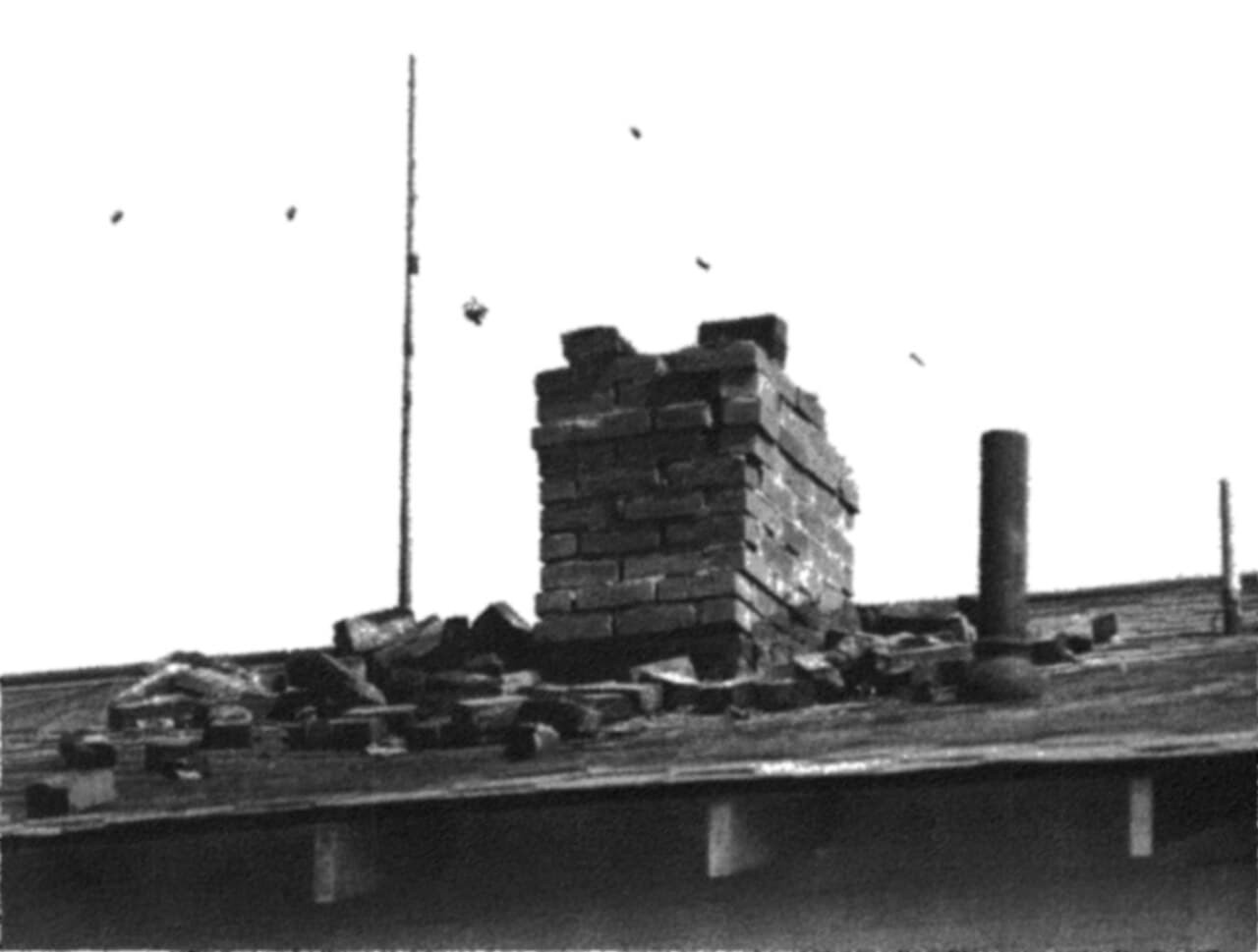
Repointing replaces mortar in the joints. A rebuild is for brick that is loose, cracked, crumbling or out of line, and for chimneys that lean or have shed bricks onto the roof. Water is usually the cause: a failed crown, no cap, open joints or bad flashing let moisture into the stack, and freezing and thawing do the rest. Many rebuilds fix the cause as well as the damage, so the quote should name both.
What the work covers
Assessment. The mason looks at the stack from the roof and inside, usually with a camera down the flue, and decides where sound masonry begins. That point sets the scope and the price. A good bid comes with photos and a written description of how far down the work goes.
Access and protection. The crew sets up ladders or scaffolding, protects the roof and covers the firebox so debris stays out of the house.
Taking down. Loose and failed masonry is removed down to sound brick, and the bricks worth saving are cleaned and set aside. Preparing mortar joints can be noisy and can generate large quantities of dust that must be controlled, as the National Park Service notes.[2]
Relaying. The mason lays the stack back up with new or salvaged brick matched as closely as possible. Mortar matters as much as brick. The National Park Service says mortar for repointing should be softer or more permeable than the masonry units, and calls it a common error to assume that hardness or high strength is a measure of appropriateness.[2] A mortar that is too hard pushes the stress into the bricks. The same agency shows that using a mechanical grinder to rake out joints can damage the edges and corners of bricks,[2] which is why technique counts for as much as materials.
Flue, crown and cap. A rebuilt chimney should meet the same checklist as a sound one. Woodstock Soapstone, a stove maker, summarizes the National Fire Protection code requirements for a safe masonry chimney as a fireclay flue liner 5/8 inch thick, a 1/2 inch air space between the flue liner and the inside face of the chimney walls, and walls no less than 4 inches nominal thickness.[1] Its list adds smooth mortar joints on the inside surface of the flue tiles,[1] a crown of concrete or non-water soluble refractory cement sloping away from the chimney and sealed with a flexible material,[1] and a cap to keep out moisture, birds or other pests.[1] It also lists a minimum 2 inch clearance to combustible materials for interior chimneys and 1 inch for exterior chimneys.[1] If the flue itself is damaged, see what a chimney liner is and whether you need one.
Flashing and cleanup. The metal where the chimney meets the roof is sealed or replaced, and the roof and yard are cleared of debris. Roof work may be a separate trade; see who repairs a chimney leak.
Permits and paperwork
Virginia's building code requires a permit before alterations involving any structural component, or involving mechanical systems or fuel supply systems.[3] It also exempts construction work deemed by the building official to be minor and ordinary and that does not adversely affect public health or general safety.[3] Whether a given rebuild counts is the building official's call, so ask your locality. When an owner or an owner's agent requests a permit for exempt work, a permit shall be issued and any related inspections shall be required.[3]
DPOR advises that the contractor should apply for and obtain any necessary building permits, and that you not allow work to start until the contractor gives you copies of the officially issued permit(s).[5] Put who pulls the permit in the contract.
How a rebuild is priced
The scope drives the price: how many courses of brick come down, how high the chimney is, how hard the roof is to reach, whether scaffolding is needed, and whether the flue, crown, cap and flashing are included. For numbers and quote advice, read how much it costs to rebuild a chimney in Virginia.
When to call a licensed pro
For all of it. A rebuild is structural masonry work at height, over a roof and above a flue that carries combustion gases, so it is not a job for a homeowner.
Virginia defines "masonry contracting" as the installation of brick, concrete block, stone, marble, slate, or other units and products common to the masonry industry, including the installation of grout, caulking, tuck pointing, sand blasting, mortar washing and parging.[4] DPOR says that if the work is valued at $1,000 or more, a valid Virginia Contractor's License is required for the license category in which the contractor is to work.[5] Check the licence before you pay a deposit, and see who repairs chimney masonry, a mason or a chimney sweep if you are not sure whom to call. Before any rebuild, a chimney inspection shows what lies below the visible damage.
Browse chimney and fireplace services or all chimney answers.
Describe your chimney once and licensed local businesses quote the rebuild.
Common questions
- Is rebuilding a chimney the same as repointing it?
- No. Repointing replaces failed mortar in the joints and leaves the bricks in place. A rebuild takes bricks down and relays them, which is needed when the brick itself is loose, cracked or has come apart. Many jobs combine both, so ask the mason which parts of your chimney need which.
- Does the whole chimney have to come down?
- Often not. The weather-exposed top section above the roof is the part that usually fails first, so many rebuilds stop at or just below the roofline. A mason should show you where sound masonry starts and quote the rebuild to that point, with photos.
- Do I need a permit to rebuild a chimney in Virginia?
- It depends on the work and your locality. The Uniform Statewide Building Code requires a permit for alterations involving structural components or mechanical systems and exempts only work the building official considers minor and ordinary. Ask your building department, and have the contractor pull any permit.
- Will the flue liner be replaced too?
- Not necessarily, but it should be checked. A rebuild exposes the top of the flue, which is the easiest time to see its condition. See what a chimney liner is and whether you need one before you approve the scope.
- Can I use my fireplace while the chimney is being rebuilt?
- No. Do not burn anything until the masonry has cured and the contractor has told you the chimney is ready. Ask for that in writing in the contract.
Sources
- [1] Masonry Chimneys, Woodstock Soapstone Company (stove manufacturer). Checked October 27, 2026.
- [2] Preservation Brief 2: Repointing Mortar Joints in Historic Masonry Buildings, National Park Service, U.S. Department of the Interior. Checked October 27, 2026.
- [3] 13VAC5-63-80. Section 108 Application for permit, Virginia Administrative Code (Uniform Statewide Building Code). Checked October 27, 2026.
- [4] 18VAC50-22-30. Definitions of specialty services, Virginia Administrative Code (Board for Contractors). Checked October 27, 2026.
- [5] What You Should Know Before You Hire a Contractor, Virginia Board for Contractors, DPOR. Checked October 27, 2026.
Want a pro to handle it?
Describe the job once. Licensed local businesses send quotes, and you pay only when you book one.
Get a quote from a local pro