Why are my low-voltage landscape lights dim at the end of the run?
Almost always voltage drop. At 12 volts, cable loses voltage over distance and under load, so the last fixtures on a long or crowded run get less. Undersized cable, too many watts on one wire, the wrong transformer tap, an overloaded transformer, halogen lamps and loose or corroded splices all cause it. A pro measures voltage along the run and corrects the cause.
Free to ask. Local shops send quotes, and you pay only when you book one.
By Kasra Taheri, Founder, LoclisPublished
Researched and drafted with AI, then checked claim by claim against the sources listed below before it was published. Prices and rules change; the dates beside each source say when it was last checked.
This is a job for a licensed pro in Virginia
This page explains what the work involves, the permits, what a licensed pro does and what drives the cost. It does not give step-by-step instructions, because this work needs a licence, a permit or both, and doing it wrong can injure someone. Before you hire, check the licence on Virginia's DPOR record.
Lights that get dimmer toward the far end of a run are usually showing voltage drop. A 12-volt system starts with very little voltage to spare, and every foot of cable and every watt on it uses some up. The fixtures closest to the transformer get close to full voltage; the last ones get noticeably less. The cure is in how the run is wired, not in the bulbs at the end.
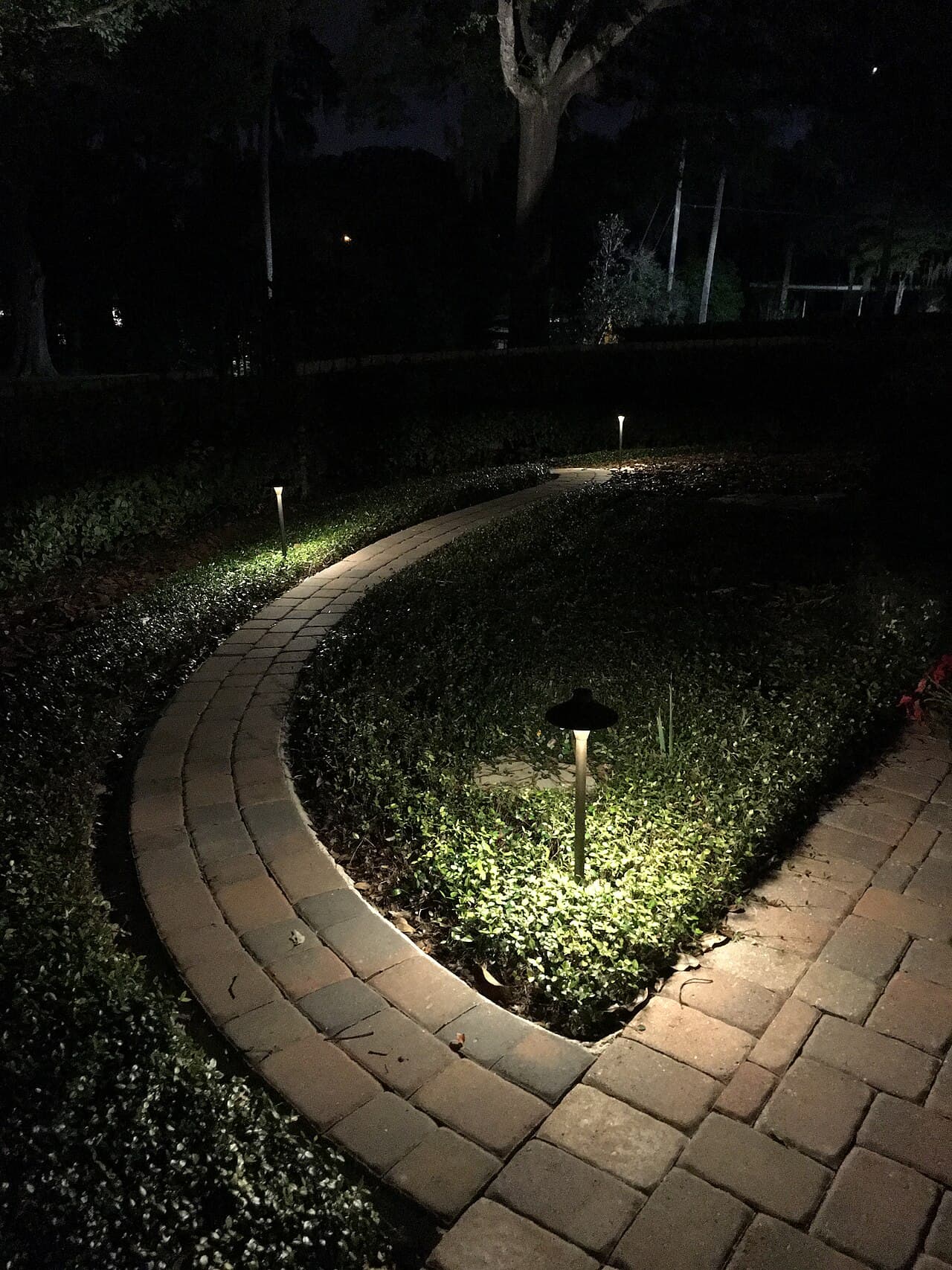
Why the far fixtures lose out
As VOLT puts it, unlike household current, 12v currents lose voltage over long wire runs or when the wire is loaded with too many lights.[1] In practical terms, voltage loss is a function of wire length, wire gauge and total wattage on the wire.[3] Double any one of those and the drop grows. Kichler warns that voltage drop causes unevenly lit fixtures and premature bulb burnout,[8] so a dim end is worth fixing even if you like the softer look.
The usual causes
Too much cable or too many watts on one run. VOLT's rule of thumb is a maximum of 100 feet of 12-gauge cable per 100 watts of light.[1] A run that has grown over the years, with fixtures added to the end of it, often goes past that.
Daisy-chain wiring. In VOLT's words, daisy-chain wiring is fine for short chains of fixtures but can run into trouble with voltage loss,[3] because each fixture sits farther down the same cable than the one before. A hub layout, with one feed to the center of a group of fixtures, evens the voltage out.
The wrong transformer tap. Multi-tap transformers have outputs above 12 volts for exactly this reason. VOLT's example is that on a long run of 100 feet the 15-volt terminal may be needed to deliver 12 volts to the far fixtures.[4] A long run left on the 12-volt tap will be dim at the end.
Loose or corroded connections. According to VOLT, voltage drops can occur when a transformer is overloaded or when fixtures are too far from the power source, but the connection points are the most common place for them.[2] Buried splices corrode if they were not sealed, and at the transformer, Kichler notes that wires can work loose over time as they heat up and expand, then contract as they cool.[7] If the lights used to be even and dimmed gradually, connections are the first suspect. A splice right before the dim section is a common culprit.
Halogen lamps. Halogen systems are the least forgiving. VOLT says halogen bulbs must be powered at 10 to 12 volts, while its LED bulbs accept 8 to 15.[5] Halogens also draw far more power: a 30-watt halogen bulb can be replaced with a 5-watt LED,[5] and cutting the watts on a run cuts the drop.
An overloaded transformer. If dimming affects every run, not just the far ends, the transformer may be carrying more than it should, often after fixtures were added.
What a technician checks
A landscape lighting pro or electrician works from the outlet out to the last fixture with a meter. VOLT's guidance is that an outdoor outlet should read between 118 and 125 volts;[2] from there the technician reads the transformer taps and then the voltage at fixtures along the run to see where it falls off. A sudden drop between two fixtures points to a bad splice; a steady slide points to cable size and load.
Kichler lists the standard remedies for real voltage drop: increase the wire gauge or move the run to a higher-voltage tap.[6] For a loose connection, it points to the terminal block at the transformer and to the connector just before the dim section.[6] Other fixes include splitting one long run into two home runs, regrouping fixtures around a hub, or swapping halogen lamps for LED. Technicians also ask about recent construction, new plantings, edging or mulching,[6] because a nicked cable can cause dimming as well as outages.
Most of these fixes stay on the 12-volt side. If the answer involves moving the transformer to a new outlet or adding a circuit for a second transformer, that is house wiring: the building code lists installations or alterations involving electric wiring among the work that needs a permit,[9] and Virginia defines a tradesman as anyone who does electrical work for the general public for compensation,[10] so that part needs a licensed electrician.
What you can safely note before the visit
You can save the technician time without touching the wiring. Note which fixtures are dim and which are fine, whether it is one run or the whole yard, when it started, and whether anything was dug, planted or edged nearby. Keep any plan or photos showing where cables run. If the entire system is dark rather than dim, that is a different problem, often the outdoor GFCI outlet, a breaker or the timer; our answer on keeping landscape lights working through winter covers those.
When to call a licensed pro
Call a landscape lighting pro or a licensed electrician when fixtures at the end of a run are dim or uneven, when lights dimmed after fixtures were added, when a section flickers, or when the transformer feels hot or hums loudly. Call an electrician straight away if the outdoor outlet trips repeatedly, is damaged or lacks GFCI protection, or if fixing the problem means a new outlet or circuit. Before you hire, check the contractor's licence.
To understand how the system is laid out, see how low-voltage landscape lighting works. You can also see outdoor lighting repair on Loclis, find electricians in Blacksburg, or read more electrical answers.
Describe your landscape lighting problem and licensed local pros quote the repair.
Common questions
- Will a bigger transformer fix dim lights?
- Only if the transformer is overloaded. If the problem is a long, thin or crowded cable run, a bigger transformer does not help; the fix is heavier cable, splitting the run, a hub layout, a higher-voltage tap or lower-wattage lamps.
- Can I just switch the run to the 15-volt tap?
- That is one of the standard fixes, but it raises the voltage at every fixture on the run, including the ones near the transformer. A pro measures the voltage at the near and far fixtures first so none of them is overdriven.
- Why did lights that used to be bright get dim?
- When a system dims over time, the usual suspects are connections: splices corrode, and terminal screws loosen as wires heat and cool. Added fixtures, recent digging or edging, and a timer or photocell problem are the other things a technician checks.
- Does switching to LED help with voltage drop?
- Usually. LED lamps draw far fewer watts than halogen, which reduces the drop on the cable, and they work over a wider voltage range, so fixtures at the end of a run stay bright at voltages that would dim a halogen lamp.
- Is dimming a safety problem?
- Mostly it is a performance problem, though Kichler notes that voltage drop leads to premature bulb burnout. A system that flickers, smells hot or trips its outlet should be looked at promptly.
Sources
- [1] Avoid Landscape Lighting Design Mistakes, VOLT Lighting. Checked October 27, 2026.
- [2] How to Use a Voltmeter to Find Voltage Drops, VOLT Lighting. Checked October 27, 2026.
- [3] How to Install A Low Voltage Lighting Hub, VOLT Lighting. Checked October 27, 2026.
- [4] How to Install a Low Voltage Transformer, VOLT Lighting. Checked October 27, 2026.
- [5] LED vs. Halogen: Choosing the Best Landscape Lighting Fixture, VOLT Lighting. Checked October 27, 2026.
- [6] Troubleshooting a Landscape Lighting System, Kichler Lighting. Checked October 27, 2026.
- [7] Landscape Maintenance, Kichler Lighting. Checked October 27, 2026.
- [8] Getting Started with Landscape Lighting, Kichler Lighting. Checked October 27, 2026.
- [9] 13VAC5-63-80, Virginia Uniform Statewide Building Code, Section 108 Application for permit, Virginia Administrative Code, Legislative Information System. Checked October 27, 2026.
- [10] Code of Virginia § 54.1-1128, Definitions (tradesmen), Code of Virginia, Legislative Information System. Checked October 27, 2026.
Want a pro to handle it?
Describe the job once. Licensed local businesses send quotes, and you pay only when you book one.
Get a quote for Electrical Repair