How much does landscape lighting cost in Virginia?
The price is set mostly by how many fixtures you want, their quality, the transformer size, how much cable has to be buried and whether an electrician must add an outdoor outlet with a permit. Running it is cheap: an LED system drawing 100 watts for six hours a night costs roughly $3 a month at Virginia's August 2026 average residential rate.
Free to ask. Local shops send quotes, and you pay only when you book one.
By Kasra Taheri, Founder, LoclisPublished
Researched and drafted with AI, then checked claim by claim against the sources listed below before it was published. Prices and rules change; the dates beside each source say when it was last checked.
This is a job for a licensed pro in Virginia
This page explains what the work involves, the permits, what a licensed pro does and what drives the cost. It does not give step-by-step instructions, because this work needs a licence, a permit or both, and doing it wrong can injure someone. Before you hire, check the licence on Virginia's DPOR record.
What you pay for landscape lighting in Virginia depends far more on the design than on the place: how many fixtures, what they are made of, how big a transformer they need, how much cable has to be buried, and whether an electrician must add an outdoor outlet first. Running the system costs little. The useful way to budget is to understand those drivers and get written quotes that price the same design.
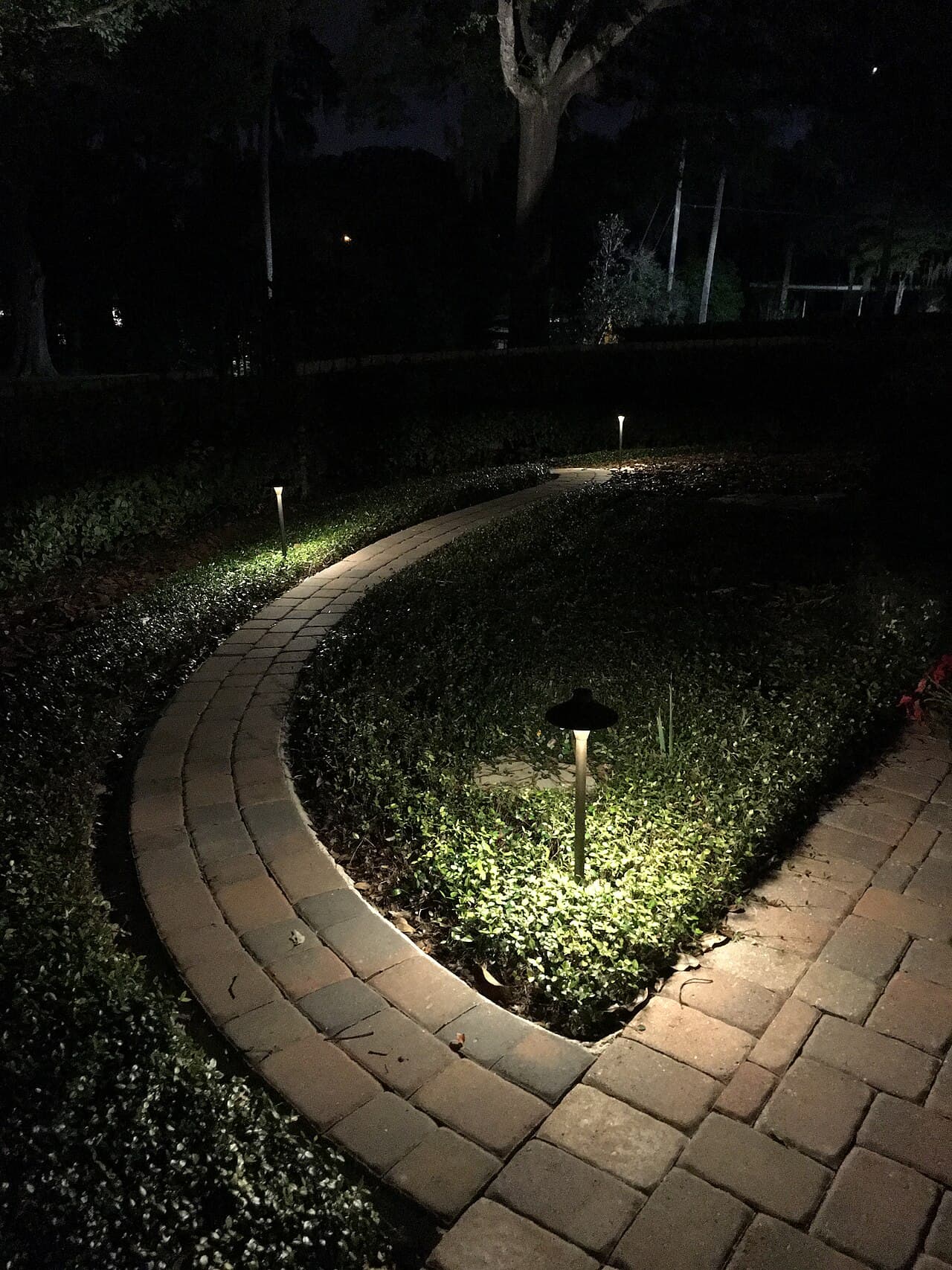
What drives the installed price
Number and type of fixtures. Fixtures are usually the largest line on a quote. Path lights, spotlights, well lights and hardscape lights differ in price, and so do materials and warranties. Fixtures that take a replaceable bulb cost differently over time from integrated ones, where if the LED board fails, the whole fixture is replaced rather than a bulb.[5]
The transformer. It is sized to the total fixture wattage plus headroom. VOLT advises staying at or below 80 percent of a transformer's rated capacity,[5] so a design with many fixtures, or one you plan to add to, needs a bigger and more expensive unit. A smart transformer or app-controlled timer adds to the cost.
Cable and connections. Long runs need heavier cable, and heavier cable costs more per foot. The wiring layout matters too: eight fixtures on a daisy chain mean eight splices, while two hubs can serve the same eight fixtures with two,[6] and fewer splices means less labor and fewer weak points.
Labor and digging. By Kichler's estimate, even a seasoned professional takes a full day or two to install a system, and a beginner could take up to a week.[8] Professionals bring equipment such as a trencher to dig the 6-inch trench for the wires, and tools to get under sidewalks and patios.[8] Rocky soil, mature beds, and runs under driveways or walks add hours. So does a design that needs testing and re-aiming at night.
The outdoor outlet. The transformer plugs into a GFCI-protected outdoor outlet. If there is not one in the right place, an electrician adds it, and that is the part of the job that brings a permit. See what a low-voltage system involves for how the parts fit together.
Permit costs
Under Virginia's Uniform Statewide Building Code, wiring and equipment that operates at less than 50 volts is exempt[3] from permits, so the 12-volt side of the system usually adds no permit fee. The 120-volt outlet is different: the same section lists installations or alterations involving electric wiring among the work that needs a permit.[3]
Fees are set by each county and city. As one example, Prince George County's fee schedule, effective July 1, 2021, lists a $100.00 minimum permit fee for residential renovations and repairs and charges the auxiliary permit at 1% of estimated cost,[2] plus a Virginia state levy of 2% of the permit fee.[2] Your own building department publishes its schedule, and the electrician normally pulls the permit and includes it in the quote.
What it costs to run
Virginia's average residential electricity price was 17.64 cents per kilowatt-hour in August 2026,[1] according to the U.S. Energy Information Administration, a preliminary figure, up from 15.85 cents in August 2025.[1] To estimate your own cost, multiply the system's total watts by the hours it runs, divide by 1,000 and multiply by your rate. For example, an LED system drawing 100 watts for six hours a night uses 18 kilowatt-hours over 30 days, roughly $3 at that average rate. Your utility bill shows your actual rate.
Older halogen systems use far more. VOLT's example is that a 30-watt halogen bulb can be replaced with a 5-watt LED,[7] which VOLT counts as an 80% saving on that fixture, and it lightens the load on the transformer.
Ongoing costs
Lights need occasional attention: lamps fail, fixtures get knocked by mowers, plants grow over beams. Kichler encourages installers to offer a maintenance contract and walk the property once or twice a year to replace lamps that are out, clean dirty fixtures and re-aim lights.[9] Ask whether a contract is offered and what a service visit costs outside one. Our answer on keeping landscape lights working through winter covers the seasonal checks.
What a written quote should show
A useful quote lists every fixture by model and location, the transformer wattage and controls, the cable gauge and footage, the connector or hub method, any boring under hardscape, the outdoor outlet and permit if needed, who requests the utility locate before digging, cleanup, and the warranty on fixtures and labor. DPOR, Virginia's licensing agency, advises homeowners to get at least three written bids based on the same specifications,[4] notes that Virginia law requires all licensed contractors to provide a written contract for residential work,[4] and suggests a deposit of no more than 10% of the total price or $1,000, whichever is less.[4]
DPOR's guide says that if the work is valued at $1,000 or more, a valid Virginia contractor's licence is required for the category of work,[4] Ask for the licence number and check it before you sign. The outlet work is done by an electrician.
When to call a licensed pro
Call a licensed electrician when the transformer needs a new outdoor outlet or circuit, when an existing outdoor outlet is not GFCI-protected or keeps tripping, or when you want 120-volt fixtures. Call a landscape lighting professional for design, fixture selection and installation of a full system, and check the licence of whoever you hire. Our answer on whether you need an electrician for landscape lighting explains who does which part.
You can also browse landscape lighting on Loclis, see what electricians charge per hour in Virginia, find electricians in Blacksburg, or read more electrical answers.
Describe your landscape lighting project and licensed local pros quote it.
Common questions
- What does it cost to run landscape lights in Virginia?
- Multiply the system's watts by the hours it is on to get watt-hours, divide by 1,000 for kilowatt-hours, and multiply by your rate. Virginia's average residential price was 17.64 cents per kilowatt-hour in August 2026, so a 100-watt LED system on six hours a night uses 18 kilowatt-hours in 30 days, about $3.
- Is switching old halogen lights to LED worth it?
- Usually, on running cost. VOLT gives the example of a 30-watt halogen bulb replaced by a 5-watt LED. Lower wattage also eases the load on the transformer and cable, which helps with dim lights at the end of long runs.
- Do I need to pay for a permit?
- Not for the 12-volt wiring itself: Virginia's building code exempts wiring under 50 volts. If an electrician has to add an outdoor outlet or circuit for the transformer, that is electric wiring and needs a permit, and its fee is set by your county or city.
- Why do two quotes for the same yard differ so much?
- Fixture quality and count, transformer size, cable gauge and length, the connector method, digging under walks and driveways, controls and whether the outlet work and permit are included all move the price. Ask each contractor to price the same fixture list so you can compare them.
- How much deposit should I pay?
- Virginia's licensing agency, DPOR, suggests a deposit of no more than 10% of the total price or $1,000, whichever is less, rising to as much as 30% when special-order items are involved.
Sources
- [1] Electric Power Monthly, Table 5.6.A. Average Price of Electricity to Ultimate Customers by End-Use Sector, by State, August 2026 and 2025, U.S. Energy Information Administration. Checked October 27, 2026.
- [2] Building Inspections Fee Schedule, Prince George County, Virginia, Community Development. Checked October 27, 2026.
- [3] 13VAC5-63-80, Virginia Uniform Statewide Building Code, Section 108 Application for permit, Virginia Administrative Code, Legislative Information System. Checked October 27, 2026.
- [4] What You Should Know Before You Hire a Contractor, Virginia Department of Professional and Occupational Regulation. Checked October 27, 2026.
- [5] How to Choose the Best Landscape Lighting for Your Home & Yard, VOLT Lighting. Checked October 27, 2026.
- [6] How to Install A Low Voltage Lighting Hub, VOLT Lighting. Checked October 27, 2026.
- [7] LED vs. Halogen: Choosing the Best Landscape Lighting Fixture, VOLT Lighting. Checked October 27, 2026.
- [8] Why Hire a Landscape Contractor, Kichler Lighting. Checked October 27, 2026.
- [9] Landscape Maintenance, Kichler Lighting. Checked October 27, 2026.
Want a pro to handle it?
Describe the job once. Licensed local businesses send quotes, and you pay only when you book one.
Get a quote for Electrical Repair