Why is my treadmill belt slipping?
Most often the walking belt has loosened and needs its tension adjusted at the two rear roller bolts. Unplug the treadmill, turn both bolts the same small amount, then test at walking pace. Oil or grease on the deck, a dry deck or a worn belt can also cause it. If it keeps slipping after a few small adjustments, call a repair technician.
Free to ask. Local shops send quotes, and you pay only when you book one.
By Kasra Taheri, Founder, LoclisPublished
Researched and drafted with AI, then checked claim by claim against the sources listed below before it was published. Prices and rules change; the dates beside each source say when it was last checked.
Step by step
Read when to stop and call a pro, further down this page, before you start.
Step 1: Confirm it is slipping
A belt that hesitates or stutters when you step on it needs more tension; a belt that creeps toward one side rail needs a tracking adjustment instead.[1]
Step 2: Switch off and unplug
Turn off the power switch, remove the safety key and unplug the power cord from the wall outlet.[1]
Step 3: Find the rear bolts
The two tension bolts are at the rear of the treadmill; on SOLE models they are reached through a small hole in each end cap, with a 6 mm hex key.[1]
Step 4: Turn both sides equally
Turn the left bolt one-quarter turn clockwise, then the right bolt exactly the same.[1]
Step 5: Test at walking pace
Plug in, reattach the safety key, set 2 to 3 mph and walk on the belt with your full weight for 30 to 60 seconds.[1]
Step 6: Repeat only if needed
If it still slips, unplug and add another equal quarter turn on each side, stopping the moment the slipping stops.[1]
Step 7: Check the deck is clean
Wipe any excess lubricant from the deck and machine surfaces, because grease or oil on the deck makes slipping more likely.[2]
Start with the belt tension
A slipping treadmill belt is most often a tension problem: the walking belt has loosened a little and no longer grips the front roller under your weight. The fix is a small, equal adjustment at the two bolts at the rear of the treadmill. As Nautilus's manual puts it: "Your treadmill has tension bolts at the rear of the treadmill."[2] Before you reach for a tool, check what the belt is actually doing, because the two common complaints need different fixes. If the belt hesitates or stutters when you step on it, SOLE says it needs a tension adjustment; if it creeps toward one side rail, it needs a tracking adjustment.[1] Doing the wrong one can create a second problem on top of the first.
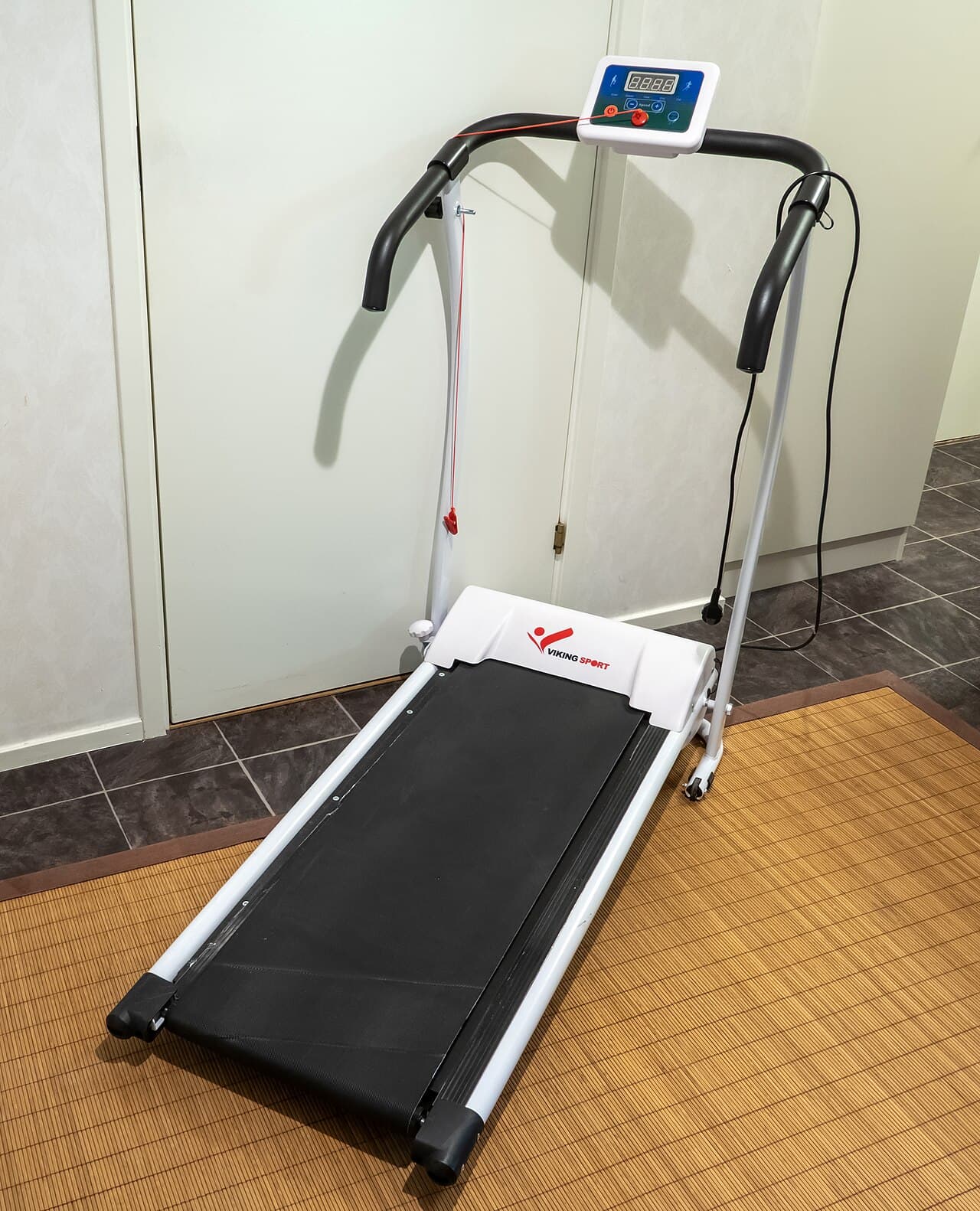
Tightening the belt
Your owner's manual is the authority on the tool, the direction and the amount, because they vary by brand. The two manufacturers checked here agree on the idea (clockwise at the rear bolts, both sides equal) and differ on the amount.
SOLE says to turn off the power switch, remove the safety key and unplug the power cord from the wall outlet before any adjustment.[1] On SOLE models, the two belt tension adjustment bolts sit at the ends of the rear step rails and are accessed through a small hole in each end cap,[1] using the 6 mm L-shaped Allen wrench supplied with your treadmill.[1] A different size risks stripping the bolt head.
SOLE has you turn the left rear bolt clockwise by one-quarter turn, then do "exactly the same to the right rear adjustment bolt: one-quarter turn clockwise, no more."[1] Resist going further in one session: a large adjustment that feels necessary in the moment often over-tightens the belt, which can damage it and cause premature bearing failure.[1]
Then test. Plug in, reattach the safety key, set a speed of around 2–3 mph, step on and "Apply your full body weight and walk normally for 30–60 seconds."[1] If it still slips, unplug again and repeat with another one-quarter-turn clockwise increment on each side.[1]
Nautilus's owner's manual for its Schwinn 810 and 510T treadmills works a little differently. It has you turn the right and left belt adjustment bolts clockwise a 1/2 turn, first one bolt and then the other bolt until the belt does not slip, testing after each side.[2] Follow whichever procedure your own manual gives.
Keep both sides equal
Nautilus warns that if you turn one side more than the other, the belt will move away from that side and may need realignment.[2] That is the usual way a tension fix turns into a drifting belt. Count your turns, keep them even, and stop as soon as the slipping stops. Nautilus notes that too much tension causes unnecessary friction and wears the belt, motor and electronics.[2]
Other causes worth ruling out
If tension does not cure it, look at what is between the belt and the deck.
Grease or oil on the deck. Nautilus says to keep the deck area free from grease or oil to decrease the possibility of slipping.[2] After lubricating, wipe off any excess.
A dry or badly lubricated deck. Friction between belt and deck can make the belt hesitate and feel like slipping. Nautilus says to lubricate the belt every 3 months or every 25 hours of use, whichever comes first, on its Schwinn model, and adds: "Always use a 100% pure silicone lubricant. Do not use a degreaser like WD-40" as it could seriously impact performance.[2] Other brands have other intervals and some decks need no lubricant at all, so check your manual first.
A worn belt or deck. A belt that looks glazed, frayed or worn through in a strip down the middle will not grip well however tight it is. That is a replacement job.
The drive belt under the motor hood. SOLE's guidance is that owner adjustment covers the walking belt at the rear roller, not the internal drive belt beneath the motor hood, which a trained service professional should handle.[1]
Stop and call a pro if
- The belt keeps slipping. If it continues after several rounds of small, equal tension adjustments, SOLE says to stop adjusting and seek service.[1]
- It will not stay centered. SOLE lists a belt that will not stay centered after correct tracking adjustment as a reason to stop and seek service.[1]
- You hear or smell something. SOLE lists grinding, a burning smell or repeated unusual noises during operation as reasons to stop.[1]
- The belt is damaged. SOLE also lists a belt that is visibly frayed, cracked or unevenly worn across its width.[1]
- You need the cover off. Anything beyond the rear bolts, such as the motor hood or electronics, is a technician's job. Nautilus's manual says to unplug the power cord and wait 5 minutes before cleaning, maintaining or repairing the machine.[2]
Getting help in Virginia
Treadmill repair is not a licensed trade in the way electrical work is, so ask a technician for a written quote that names the part and the labor, and ask whether the manufacturer's warranty is still in effect. For other fixes at home, see why a gas grill will not get hot, how much a bike tune-up costs in Virginia or more other repair answers. You can also browse other repair pros.
If the belt still slips, describe the problem and local repair pros will quote it.
Common questions
- How tight should a treadmill belt be?
- Tight enough that it does not hesitate or slip under a full walking load, and no tighter. Too much tension causes unnecessary friction and wears the belt, motor and electronics, according to Nautilus's owner's manual for its Schwinn treadmills. Stop adjusting the moment the slipping stops.
- Which way do I turn the bolts to tighten the belt?
- On the SOLE and Schwinn treadmills in the manuals checked, clockwise tightens the belt. Directions can differ between brands and models, so confirm in your own owner's manual before turning anything.
- How much should I turn the bolts?
- SOLE says one-quarter turn on each side per round, while Nautilus's Schwinn manual says a half turn, one side and then the other, testing in between. Use the figure in your own manual, and keep both sides equal so the belt does not wander toward one rail.
- Can lubricating the belt stop it slipping?
- Lubricating addresses friction between belt and deck, not tension, and the wrong product or too much of it can make things worse. Nautilus's manual calls for 100% pure silicone lubricant, says not to use a degreaser like WD-40, and says to keep grease and oil off the deck area to avoid slipping. Check whether your model needs lubricating at all.
- Is it the belt or the motor if the treadmill still slips?
- Often neither: it can be a worn belt, a worn deck or a drive belt under the motor hood. SOLE's manual says drive-belt tightening is for a trained service professional. Grinding, a burning smell or a frayed belt are reasons to stop and call for service.
Sources
- [1] How to Adjust a SOLE Treadmill Belt?, SOLE Fitness. Checked October 28, 2026.
- [2] Schwinn 810 / 510T Treadmill Owner's Manual (quick start and maintenance), Nautilus, Inc. (Bowflex and Schwinn). Checked October 28, 2026.
Want a pro to handle it?
Describe the job once. Licensed local businesses send quotes, and you pay only when you book one.
Get a quote for Other Repairs