Can a ceiling fan go where there is only a light fixture now?
Often, yes. The catch is the electrical box: most boxes behind ceiling lights are not made to hold a heavy, spinning fan, so the swap usually means a fan-rated box fixed to a joist or brace, enough headroom under the blades, and the right switch. In Virginia, anyone you pay to do this electrical work needs a licence, and new wiring needs a permit.
Free to ask. Local shops send quotes, and you pay only when you book one.
By Kasra Taheri, Founder, LoclisPublished
Researched and drafted with AI, then checked claim by claim against the sources listed below before it was published. Prices and rules change; the dates beside each source say when it was last checked.
This is a job for a licensed pro in Virginia
This page explains what the work involves, the permits, what a licensed pro does and what drives the cost. It does not give step-by-step instructions, because this work needs a licence, a permit or both, and doing it wrong can injure someone. Before you hire, check the licence on Virginia's DPOR record.
Often, yes. Most ceiling light locations can take a fan, but the light fixture's box is usually the problem. A fan is heavier than most lights and it moves, so the job normally includes a fan-rated box, solid anchoring to the framing, enough space under and around the blades, and a switch that suits the fan. In Virginia, anyone you pay to do that work needs an electrical licence.[7][6]
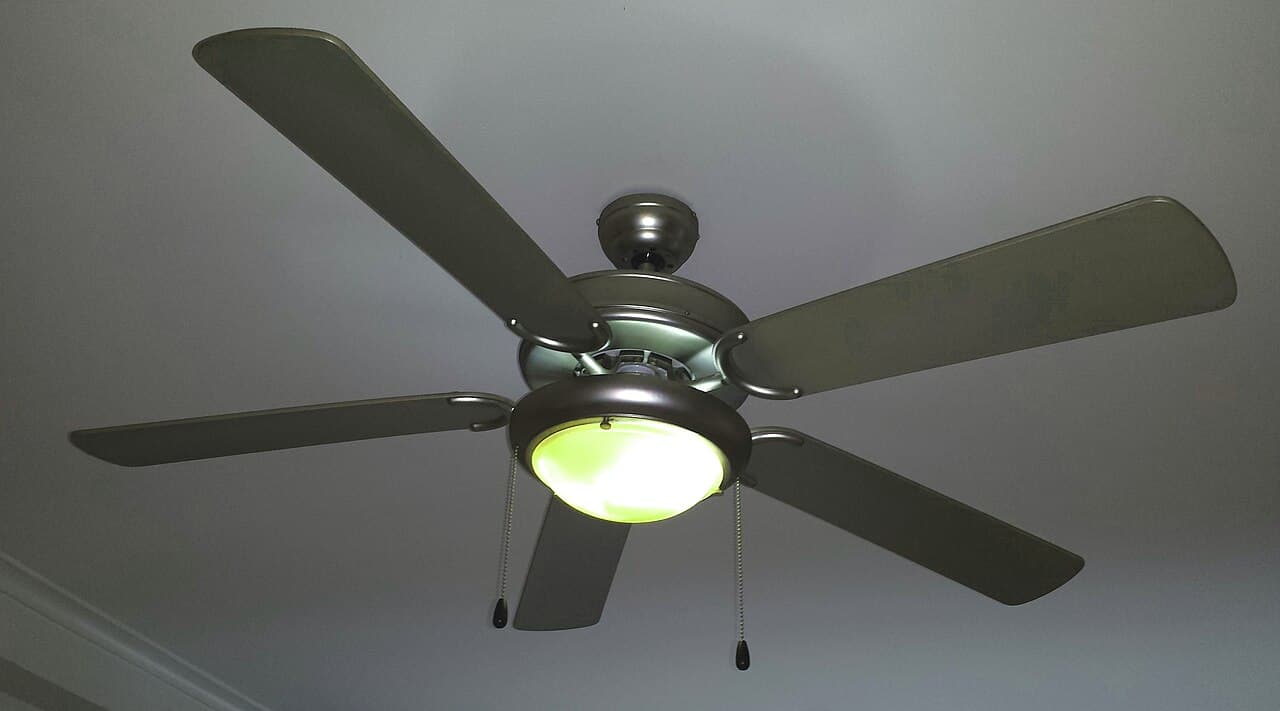
The box is the first question
"If you are replacing a ceiling fixture, most likely you will need to replace the electrical box," according to ENERGY STAR.[1] What a fan needs is a UL-listed metal box marked "For Use With Ceiling Fans," mounted above the ceiling, which is both where the fan hangs and where its wiring connects.[1]
The weight is the reason. ENERGY STAR notes that ceiling fans can weigh as much as 50 pounds.[1] The box rating a manual asks for can be well above the fan's own weight. Hunter's 2021 Ristrello manual, for example, says to mount the fan directly from building structure and/or an outlet box marked acceptable for fan support of 70 lbs (31.8 kg).[3] That particular fan weighs 19.6 lbs.[3] A box rated for a light is not rated for that.
It has to be anchored to the framing
A fan-rated box only works if it is held by something solid. ENERGY STAR's guidance is that the fan should be anchored to a ceiling joist where possible, and where the joist is not where the fan needs to go, a ceiling fan mounting bracket with spiked ends is fitted between joists.[1]
A box put in for a few pounds of light fixture is often fastened more lightly than that. Whether the electrician can fit a brace through the existing hole, or needs access from the attic above, is one of the things that sets the price.
There has to be room for the blades
A spot that suits a light does not always suit a fan. Hunter's 2021 manual calls for 7 feet from the bottom edge of the blades to the floor and 30 inches from the blade tips to the nearest wall or obstruction.[3] Check those against the room before you buy: a hallway, a small bathroom or a light over a bunk bed may not have the clearance.
Ceiling height decides the style of fan. Hunter's manual describes flush mounting for low ceilings less than 8 feet high, standard mounting from a connector pipe (a downrod) for ceilings 8 feet or higher, and an angle mount for a vaulted or angled ceiling.[4] A low ceiling means a hugging, flush-mount fan; a tall one may need a longer downrod.
The switch may need to change
The wall switch that runs your light will usually run a fan and its light kit together, with speed and lighting set by pull chains or a remote. If you want them controlled separately from the wall, ENERGY STAR's advice for a fan and light combination is to choose one that runs each function separately and can run the fan at 3 or 4 distinct speeds.[2] Do not reuse a light dimmer for the fan: running a fan from a conventional dimmer switch could make its motor hum.[2]
Separate controls sometimes need more than a new switch, such as an extra conductor between the switch and the ceiling. That is the difference between a replacement and new wiring, which matters for the permit.
What Virginia's code says about permits
Virginia's building code requires a permit before work starts on installations or alterations involving electric wiring.[5] It also lists ordinary repairs that need no permit application, and among them, replacement of luminaires (lighting fixtures) and ceiling (paddle) fans is exempt from a permit application in Groups R-3, R-4 and R-5, and in Group R-2 where serving a single dwelling unit.[5]
Two limits apply. First, the exemption does not excuse the work from the code's other requirements,[5] so the fan-rated box and anchoring still have to be right. Second, if an owner asks for a permit for exempt work, one is issued and inspected,[5] which some owners choose for the record. Whether a light-to-fan swap with a new box and brace counts as a replacement, and whether added wiring for separate controls needs a permit, is for your local building official to decide. Ask the electrician, or call the building department, before work starts.
What the electrician checks
On the visit, expect the electrician to look at the box and how it is held, the framing above the ceiling and whether there is attic access, the condition of the wiring at the box, the switch, and the ceiling height. From that they can tell you whether it is a straight swap with a new fan-rated box, a box and brace, or a job that needs new wiring and a permit. Ask for that scope in writing so quotes are comparable. Our answer on what a ceiling fan installation costs in Virginia covers what moves the price.
When to call a licensed pro
From the start. Taking down the light and mounting the fan is line-voltage electrical work at the ceiling, and the person you pay for it needs a licence: no individual may engage in, or offer to engage in, work as a tradesman unless licensed,[6] unless they work under the supervision of a tradesman licensed in that specialty.[6] Virginia's definition of a tradesman covers anyone doing electrical work for the general public for compensation,[7] which includes a handyman. Our answer on whether you need an electrician to install a ceiling fan in Virginia goes further, and you can check a contractor's licence on DPOR's record before you hire.
Call sooner rather than later if the existing light flickers, the box feels loose, the ceiling around it is cracked or sagging, or you smell burning near the fixture. Those are problems to fix before anything heavier goes up.
Find an electrician
Browse ceiling fan installers on Loclis, look up electricians in Blacksburg, or read more electrical answers.
Describe the light you want to swap for a fan and licensed local electricians quote the job.
Common questions
- How can I tell if my ceiling box is rated for a fan?
- A fan-rated box is marked as acceptable for fan support, usually with a weight rating. You normally cannot see the marking without taking the light fixture down, which means working at the wiring, so ask the electrician to check it on the quote visit. If there is no marking, plan on a new fan-rated box.
- Can I hang a light ceiling fan from a regular light box?
- Not safely. Hunter's Ristrello manual, for example, calls for a box marked as acceptable for fan support, or mounting to the building structure. A running fan also moves and vibrates in a way a light fixture does not.
- Will my existing wall switch run the fan?
- Usually it will turn the fan and light on and off together, with speed and light set by pull chains or a remote. Separate wall control of the fan and light may need a fan-rated wall control and sometimes extra wiring, which the electrician can price.
- My ceiling is under 8 feet. Can I still have a fan?
- Often, with a flush-mount (hugging) fan. Hunter's manual describes flush mounting for ceilings less than 8 feet high, and its newer manual calls for 7 feet from the bottom of the blades to the floor. Measure before you buy.
- Do I need a permit to swap a light for a fan in Virginia?
- Virginia's building code exempts replacement of light fixtures and ceiling fans in the residential groups it lists from a permit application, but new wiring, such as a new switch run or circuit, needs a permit. Whether a particular swap counts as replacement is your local building official's call, so ask the electrician or the building department before work starts.
Sources
- [1] Ceiling Fan Installation and Usage Tips, ENERGY STAR, U.S. Environmental Protection Agency. Checked October 26, 2026.
- [2] Ceiling Fan Accessories and Purchasing Choices, ENERGY STAR, U.S. Environmental Protection Agency. Checked October 26, 2026.
- [3] Ristrello Ceiling Fan Installation Manual (PG3865, 2021), Hunter Fan Company. Checked October 26, 2026.
- [4] Installation and Operation Manual for Hunter Ceiling Fans (41459-01, 2001), Hunter Fan Company. Checked October 26, 2026.
- [5] 13VAC5-63-80, Virginia Uniform Statewide Building Code, Section 108 Application for permit, Virginia Administrative Code, Legislative Information System. Checked October 26, 2026.
- [6] Code of Virginia § 54.1-1129, Necessity for licensure, Code of Virginia, Legislative Information System. Checked October 26, 2026.
- [7] Code of Virginia § 54.1-1128, Definitions, Code of Virginia, Legislative Information System. Checked October 26, 2026.
Want a pro to handle it?
Describe the job once. Licensed local businesses send quotes, and you pay only when you book one.
Get a quote for Electrical Repair