How much does it cost to install a ceiling fan in Virginia?
It depends on the job more than the fan. A swap onto a fan-rated box costs least; a new box and brace, new wiring, a separate wall control, a tall ceiling and patching add to it. Where a permit is needed, Montgomery County's minimum residential electrical permit was $45 when we checked on October 26, 2026, plus a 2% state levy and a technology fee of at least $10.
Free to ask. Local shops send quotes, and you pay only when you book one.
By Kasra Taheri, Founder, LoclisPublished
Researched and drafted with AI, then checked claim by claim against the sources listed below before it was published. Prices and rules change; the dates beside each source say when it was last checked.
This is a job for a licensed pro in Virginia
This page explains what the work involves, the permits, what a licensed pro does and what drives the cost. It does not give step-by-step instructions, because this work needs a licence, a permit or both, and doing it wrong can injure someone. Before you hire, check the licence on Virginia's DPOR record.
A ceiling fan installation in Virginia is priced by the job, so the useful thing to know in advance is what moves the number. The fan itself is one line. The rest depends on what is already in your ceiling: a fan-rated box, a light fixture to swap, or nothing at all. Get that scope in writing and you can compare quotes on equal terms.
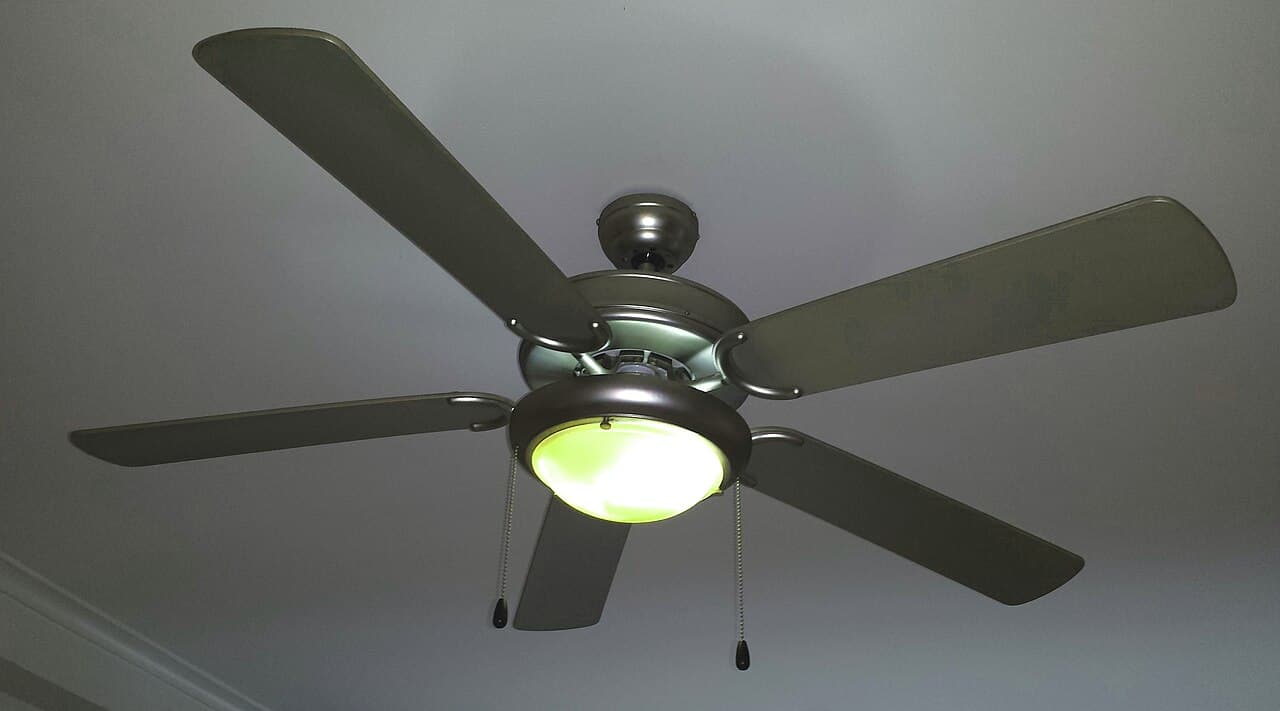
What moves the price
What is in the ceiling now. Replacing an old fan with a new one, on a box already rated for a fan, is the simplest job. Replacing a light often adds a step, because "If you are replacing a ceiling fixture, most likely you will need to replace the electrical box," according to ENERGY STAR.[1] Our answer on putting a fan where there is only a light fixture explains why.
How the box is supported. ENERGY STAR advises that the fan should be anchored to a ceiling joist where possible, with a ceiling fan mounting bracket with spiked ends fitted between joists when the joist is not where the fan needs to go.[1] A brace that goes in through the existing hole is quicker than one that needs work from the attic or a larger ceiling opening.
New wiring. A fan where there is no fixture at all means a new box, new cable and usually a new switch. It is the biggest step up in price, and Virginia's building code says a permit is required before work starts on installations or alterations involving electric wiring.[6]
Controls. Pull chains and the existing switch cost nothing extra. A remote, or a wall control that runs the fan and light separately, adds parts and sometimes wiring. ENERGY STAR's advice is to look for controls that match the fan's maximum amps, number of speeds, total lamp wattage and brand.[2]
Ceiling height and shape. Tall ceilings need a longer downrod and a taller ladder or scaffold. Hunter's manual describes standard mounting from a connector pipe (a downrod) for ceilings 8 feet or higher,[5] a very tall ceiling may need a longer one, and an angle mount for a vaulted or angled ceiling.[5] A two-storey great room costs more than a bedroom.
The fan. Heavier fans take more handling, and ceiling fans can weigh as much as 50 pounds.[1] Running cost matters too: ENERGY STAR certified ceiling fans are up to 44% more efficient than conventional fans.[3] If you want a light kit, check how it is supplied; light kits are sold three ways: integrated into the fan, included with it, or separately,[2] and some light kits fit only fans of the same brand.[2]
Finishing work. Removing and disposing of the old fixture, patching around a larger box, and painting the ceiling are often priced separately or left to you. Ask.
Warranty labour. Read the fan's warranty before you buy. Hunter's limited warranty, for example, does not cover any costs or fees associated with the labor (including electrician's fees) required to install, remove, or replace a fan or any fan parts.[4] If a fan fails, the service call to take it down is usually yours to pay.
Permit fees: a local example
Many fan jobs need no permit. Virginia's building code says replacement of luminaires (lighting fixtures) and ceiling (paddle) fans needs no permit application in Groups R-3, R-4 and R-5, and in Group R-2 where serving a single dwelling unit.[6] New wiring is different, and the local building official decides where a particular job falls.
When a permit is needed, each city or county sets its own fee. In Montgomery County, when we checked on October 26, 2026, a residential electrical trade permit was $0.03 per square foot of gross building area, with a $45 minimum.[7] Gross building area there counts every floor, including the basement.[7] The county adds a 2% Virginia state levy and a 2% technology fee with a $10 minimum, and a re-inspection costs $50.[7] Other localities charge differently, so check your own building department's schedule, and ask whether the quote includes the permit.
What a complete quote should list
Ask every electrician to price the same written scope. "It is advisable to get at least three written bids or estimates using identical plans and specifications," according to the Board for Contractors.[8] Check that each quote covers:
- Whether the existing box stays or is replaced with a fan-rated box, and how it is braced.
- Any new wiring, switch or wall control, and whether a permit is included.
- Assembly and hanging of the fan, the downrod length, and the light kit.
- Removal and disposal of the old fixture, and any ceiling patching.
- Whether they install a fan you supply, and what their workmanship warranty covers.
Protect yourself on payment and paperwork. The Board for Contractors advises: "Limit your deposit to 10% down or $1,000, whichever is less."[8] It adds that "Virginia law requires all licensed contractors to provide a written contract for residential work."[8]
When to call a licensed pro
The quote should come from a licensed electrician. In Virginia, no individual may engage in, or offer to engage in, work as a tradesman unless licensed,[9] and a tradesman is anyone doing electrical work for the general public for compensation.[10] The business licence is a separate question: the Class C contractor licence covers a single contract or project with a total value over $1,000 but less than $30,000,[11] and the Board requires a master tradesman licence as a condition of licensing an electrical contractor.[11] A cheap quote from someone without an electrical licence is not a saving. See whether you need an electrician to install a ceiling fan in Virginia for the details, and check a contractor's licence before you sign.
Get quotes
Browse ceiling fan installers on Loclis, find electricians in Blacksburg, or read more electrical answers.
Describe your ceiling fan job and licensed local electricians quote it on the same scope.
Common questions
- Why do ceiling fan quotes vary so much?
- Because the fan is the smallest part of the variation. Whether the existing box is fan-rated, whether a brace can go in from below or needs attic access, whether new wiring or a separate wall control is wanted, and how high the ceiling is all change the labour. Ask each electrician to price the same written scope.
- Does a ceiling fan installation need a permit in Virginia?
- Replacing an existing light fixture or ceiling fan in the residential groups the building code lists needs no permit application, but new wiring does. Your local building official decides where a particular job falls, so ask the electrician whether a permit is included.
- Is it cheaper to install a fan where a light already is?
- Usually, because there is already a box, a switch and wiring at that spot. The box often still needs replacing with a fan-rated one. A fan where there is no fixture at all means running new wiring and a switch, which costs more and needs a permit.
- Will the fan's warranty pay for reinstalling it if it fails?
- Usually not. Hunter's limited warranty, for example, excludes labour, including electrician's fees, to install, remove or replace a fan or its parts. Budget for a service call if a fan under warranty has to come down.
- Can I save money by buying the fan myself?
- Often, but confirm with the electrician first. Ask whether they install customer-supplied fans, whether their workmanship warranty still applies, and check the fan's weight and its box rating requirement so the quote includes the right box.
Sources
- [1] Ceiling Fan Installation and Usage Tips, ENERGY STAR, U.S. Environmental Protection Agency. Checked October 26, 2026.
- [2] Ceiling Fan Accessories and Purchasing Choices, ENERGY STAR, U.S. Environmental Protection Agency. Checked October 26, 2026.
- [3] Ceiling Fans, ENERGY STAR, U.S. Environmental Protection Agency. Checked October 26, 2026.
- [4] Ristrello Ceiling Fan Installation Manual (PG3865, 2021), Hunter Fan Company. Checked October 26, 2026.
- [5] Installation and Operation Manual for Hunter Ceiling Fans (41459-01, 2001), Hunter Fan Company. Checked October 26, 2026.
- [6] 13VAC5-63-80, Virginia Uniform Statewide Building Code, Section 108 Application for permit, Virginia Administrative Code, Legislative Information System. Checked October 26, 2026.
- [7] Permit & Inspection Fees, Montgomery County, Virginia, Building Permits & Inspections. Checked October 26, 2026.
- [8] What You Should Know Before You Hire a Contractor, Virginia Board for Contractors, DPOR. Checked October 26, 2026.
- [9] Code of Virginia § 54.1-1129, Necessity for licensure, Code of Virginia, Legislative Information System. Checked October 26, 2026.
- [10] Code of Virginia § 54.1-1128, Definitions, Code of Virginia, Legislative Information System. Checked October 26, 2026.
- [11] Code of Virginia § 54.1-1100, Definitions, Code of Virginia, Legislative Information System. Checked October 26, 2026.
Want a pro to handle it?
Describe the job once. Licensed local businesses send quotes, and you pay only when you book one.
Get a quote for Electrical Repair