How are ice dams removed safely?
Safely means by a trained crew, not by you on a ladder in the snow. A removal crew clears snow from the lower roof, opens channels so trapped meltwater can drain, takes the ice down without chopping at the roofing, and checks the attic for wet insulation. Hacking at a dam damages roofs and injures people, and the lasting fix is stopping the attic heat loss behind it.
Free to ask. Local shops send quotes, and you pay only when you book one.
By Kasra Taheri, Founder, LoclisPublished
Researched and drafted with AI, then checked claim by claim against the sources listed below before it was published. Prices and rules change; the dates beside each source say when it was last checked.
This is a job for a licensed pro in Virginia
This page explains what the work involves, the permits, what a licensed pro does and what drives the cost. It does not give step-by-step instructions, because this work needs a licence, a permit or both, and doing it wrong can injure someone. Before you hire, check the licence on Virginia's DPOR record.
An ice dam is removed safely by a crew that works from the ground, from properly set ladders or from the roof with the right equipment, takes the ice down without chopping into the shingles, and then looks for the water that already got in. The unsafe version, a homeowner on a ladder with a hammer in freezing weather, is how people get hurt and roofs get damaged. Removal is also only half the job: the dam formed because heat from the house melted the snow above it, and it will come back until that is fixed.
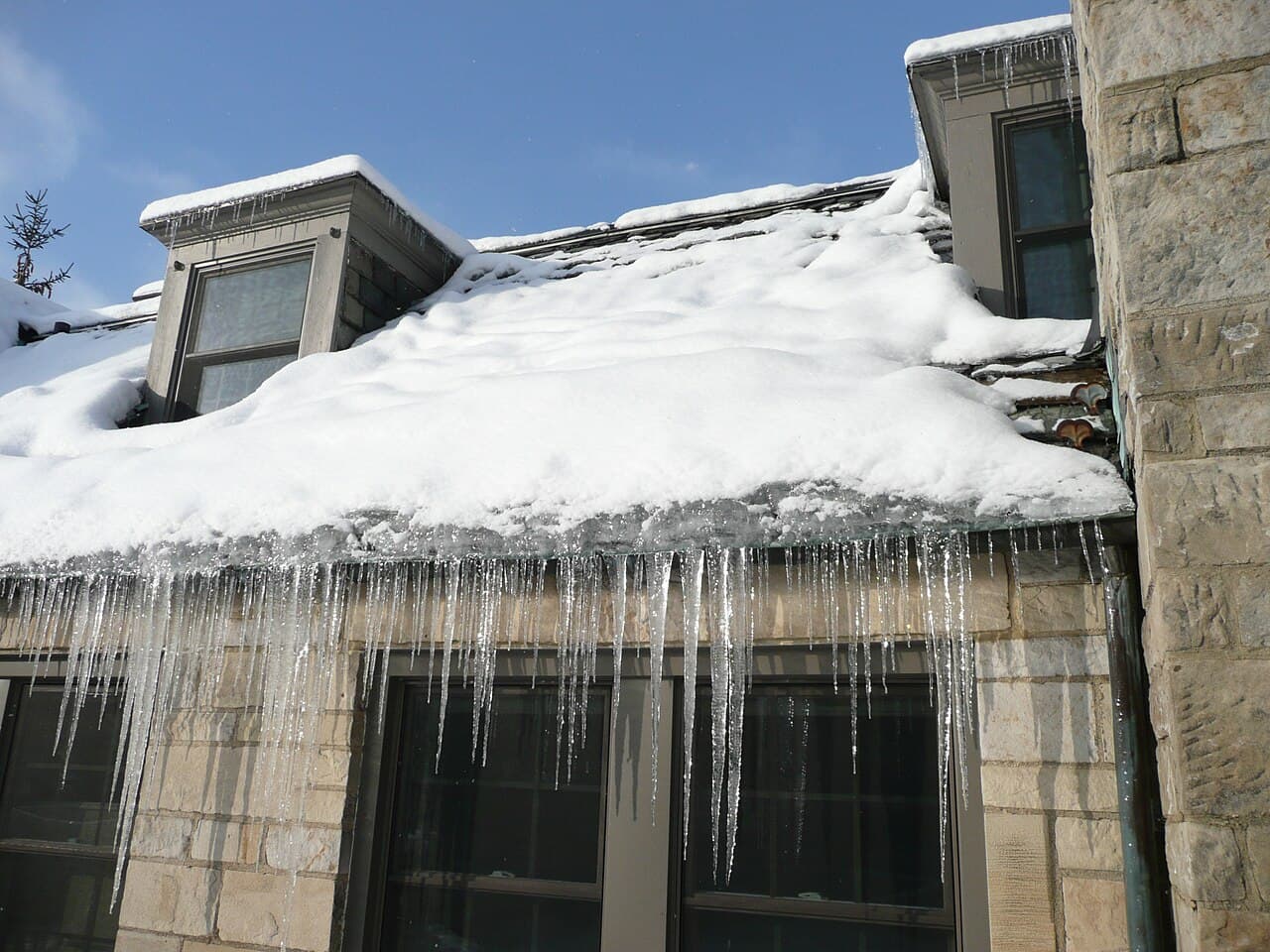
What the ice dam is doing
University of Minnesota Extension describes an ice dam as a ridge of ice that forms at the edge of a roof and keeps melting snow from draining off.[1] The water that backs up behind it is the problem, not the ice you can see. The Department of Energy's Building America Solution Center notes that icicles are often a sign that more liquid water is building up behind the dam, where it can be drawn up beneath the shingles by capillary action.[2] It also warns that If enough water and ice accumulates on the roof, it could overwhelm the roof structure and cause a roof collapse.[2]
That is why the goal of removal is to let the trapped water drain and to stop new water from collecting, without creating fresh leaks in the process.
Why removal is a job for a crew
Ice on a roof edge combines three hazards: a slippery, sloped surface, heavy ice that can break loose, and a ladder set on frozen ground. University of Minnesota Extension puts it plainly: "Anyone on the roof during the winter or performing work on the roof from below risks injury and may cause damage to the roof and house."[1]
An archived building-science article from UMass Amherst observes that people go after roof snow and ice with hammers, shovels, ice picks, crowbars and even chainsaws, and that more damage is done to life, limb and roof in the process.[3]
The City of Alexandria's winter guidance is direct: "Do not climb on your roof to remove snow, as this is extremely dangerous."[5] Power lines add a legal limit as well. Virginia's Overhead High Voltage Line Safety Act bars work that puts a person, a ladder or tools within 10 feet of an overhead high voltage line.[6]
What a professional removal visit involves
A good crew starts from the cause and the damage, not just the ice.
- Snow off the lower roof. Removing snow from the roof takes away one of the ingredients an ice dam needs.[1] Crews usually clear the band of roof just above the dam so less meltwater feeds it. University of Minnesota Extension notes that a roof rake and push broom can remove snow but may damage the roofing materials,[1] so a careful crew leaves a little snow rather than scraping the shingles bare.
- Drainage channels. Where water is already coming inside, making channels through the ice dam lets the water behind it drain off the roof.[1] It is emergency relief: a channel stops working within days and is only a temporary fix.[1]
- Taking the ice down without damaging the roof. This is where crews differ most. Ask how they remove the ice and how they protect the shingles, flashing and gutters while they do it. A plan built around hammers, axes or picks on the roofing is one to turn down.
- Gutters and the roof edge. As gutters fill with ice, they often bend and rip away from the house, bringing fascia, fasteners and downspouts with them.[3] Expect the crew to report any gutter or fascia damage, which may need a separate repair.
- Looking for hidden water. The same UMass article recommends checking the underside of the roof sheathing and the roof trim for wetting, and checking the insulation for dampness,[3] even where no ceiling stain has appeared yet.
What to avoid
Chopping at the ice is the obvious one. The other common mistake is treating heat cable as the fix. North Dakota State University Extension says homeowners too often treat the symptoms of ice dams with things like heat tape instead of preventing the problem,[4] and the archived UMass article says heat tape embrittles shingles, creates a fire risk and can leak water through loose fasteners.[3] Cable is not a removal method.
If water is already coming in
University of Minnesota Extension advises that you dry out wet or damp parts of the house immediately to head off mold and mildew,[1] and not to repair interior damage until ceilings and walls are dry.[1] Move belongings out of the way while you wait for the crew.
Call your insurer early. Virginia's Bureau of Insurance says most homeowners policies cover the reasonable costs of emergency clean-up and temporary repairs,[7] and advises that you take photographs before you clean up and keep every receipt.[7] Whether a particular ice dam leak is covered depends on your policy, so ask before you assume.
The City of Alexandria adds a warning about snow load: If you see signs of roof sagging, see new cracks in walls or ceilings, or hear popping and creaking noises, evacuate the building immediately,[5] and call 911 if anything collapses.
When to call a licensed pro
Call right away when water is coming through a ceiling or wall, when the dam is above a second storey or over a porch you cannot reach from the ground, when gutters are pulling off under the weight of ice, or when the roof shows any sign of sagging.
The repair that often follows is licensed work in Virginia. Under the Board for Contractors' rules, "Roofing contracting" covers the installation, repair, removal or improvement of the materials that form a watertight, weather resistant surface for roofs,[9] and a Class C licence covers construction, removal, repair or improvement jobs with a single contract over $1,000 and under $30,000.[8] Check the licence in DPOR's License Lookup before you sign. After a big storm, DPOR advises that you be wary of door-to-door solicitations promising repairs at a discounted price, insist on a written contract, don't pay in cash, and never pay for the entire job upfront.[10]
For what the work costs, see how much ice dam removal costs in Virginia; for who to call, see who removes ice dams; and to stop the next one, read why ice dams form and how to prevent ice dams. Browse the roofing answers or exterior and roofing businesses around Blacksburg, and when you are ready, describe the ice dam once and licensed local businesses quote it.
Common questions
- Can I knock an ice dam off with a hammer or a shovel?
- It is the method most likely to hurt you and the roof. People go after roof ice with hammers, ice picks, crowbars and even chainsaws, and an archived UMass Amherst building-science article notes that more damage is done to life, limb and roof that way. Leave the ice itself to a crew.
- Is a roof rake a safe way to do it myself?
- Leave it to a crew. University of Minnesota Extension notes that a roof rake can remove snow but may damage the roofing materials, and North Dakota State University Extension warns about overhead power lines when using one. Virginia law bars work that puts a person or tools within 10 feet of an overhead high voltage line.
- Will opening a channel in the ice stop the leak for good?
- No. A channel lets the trapped water drain in an emergency, but University of Minnesota Extension says it stops working within days and is only a temporary fix. The dam comes back until the attic heat loss that feeds it is fixed.
- Should I put heat cable on the roof after the dam is gone?
- Heat cable treats the symptom. North Dakota State University Extension says homeowners too often reach for heat tape instead of preventing the problem, and an archived UMass Amherst article says it can embrittle shingles and creates a fire risk. Sealing attic air leaks and adding insulation deals with the cause.
- Does homeowners insurance pay for ice dam removal?
- It depends on your policy, so call your agent. Virginia's Bureau of Insurance says most homeowners policies cover the reasonable costs of emergency clean-up and temporary repairs, and tells you to photograph damage first and keep receipts.
Sources
- [1] Dealing with and preventing ice dams, University of Minnesota Extension. Checked October 27, 2026.
- [2] Attic Air Sealing, Insulating, and Ventilating for Ice Dam Prevention, Building America Solution Center, Pacific Northwest National Laboratory, U.S. Department of Energy. Checked October 27, 2026.
- [3] Preventing Ice Dams (archived article), Building and Construction Technology, University of Massachusetts Amherst. Checked October 27, 2026.
- [4] Reduce Ice Dam and Icicle Damage, North Dakota State University Extension. Checked October 27, 2026.
- [5] Snow and Ice Control, City of Alexandria, Virginia. Checked October 27, 2026.
- [6] Va. Code § 59.1-408, Prohibited activities (Overhead High Voltage Line Safety Act), Code of Virginia, Virginia General Assembly. Checked October 27, 2026.
- [7] When Disaster Strikes: Insured Homeowner's Loss, Bureau of Insurance, Virginia State Corporation Commission. Checked October 27, 2026.
- [8] Va. Code § 54.1-1100, Definitions (Contractors), Code of Virginia, Virginia General Assembly. Checked October 27, 2026.
- [9] 18VAC50-22-30, Definitions of specialty services (Board for Contractors Regulations), Virginia Administrative Code, Virginia General Assembly. Checked October 27, 2026.
- [10] Disaster Recovery: Avoiding Fraud, Virginia Department of Professional and Occupational Regulation. Checked October 27, 2026.
Want a pro to handle it?
Describe the job once. Licensed local businesses send quotes, and you pay only when you book one.
Get a quote for Roofing