Why do I get ice dams on my roof?
You get ice dams when heat escaping from the house warms the upper roof enough to melt snow while the eaves stay below freezing. The meltwater runs down, refreezes at the cold edge and builds a ridge that traps more water behind it. Air leaks into the attic, thin insulation over the outside walls, blocked ventilation and warm ducts or chimneys are the usual sources of that heat.
Free to ask. Local shops send quotes, and you pay only when you book one.
By Kasra Taheri, Founder, LoclisPublished
Researched and drafted with AI, then checked claim by claim against the sources listed below before it was published. Prices and rules change; the dates beside each source say when it was last checked.
This is a job for a licensed pro in Virginia
This page explains what the work involves, the permits, what a licensed pro does and what drives the cost. It does not give step-by-step instructions, because this work needs a licence, a permit or both, and doing it wrong can injure someone. Before you hire, check the licence on Virginia's DPOR record.
You get ice dams because heat from your house is reaching the roof. It warms the upper part of the roof deck enough to melt the snow on it, while the overhang at the eaves, which sits outside the heated house, stays below freezing. Meltwater runs down under the snow, refreezes at the cold edge and builds a ridge of ice that holds back more water. That water is what leaks into the house. The heat usually comes from air leaking into the attic, thin insulation where the roof meets the outside walls, poor ventilation, or warm equipment in the attic.
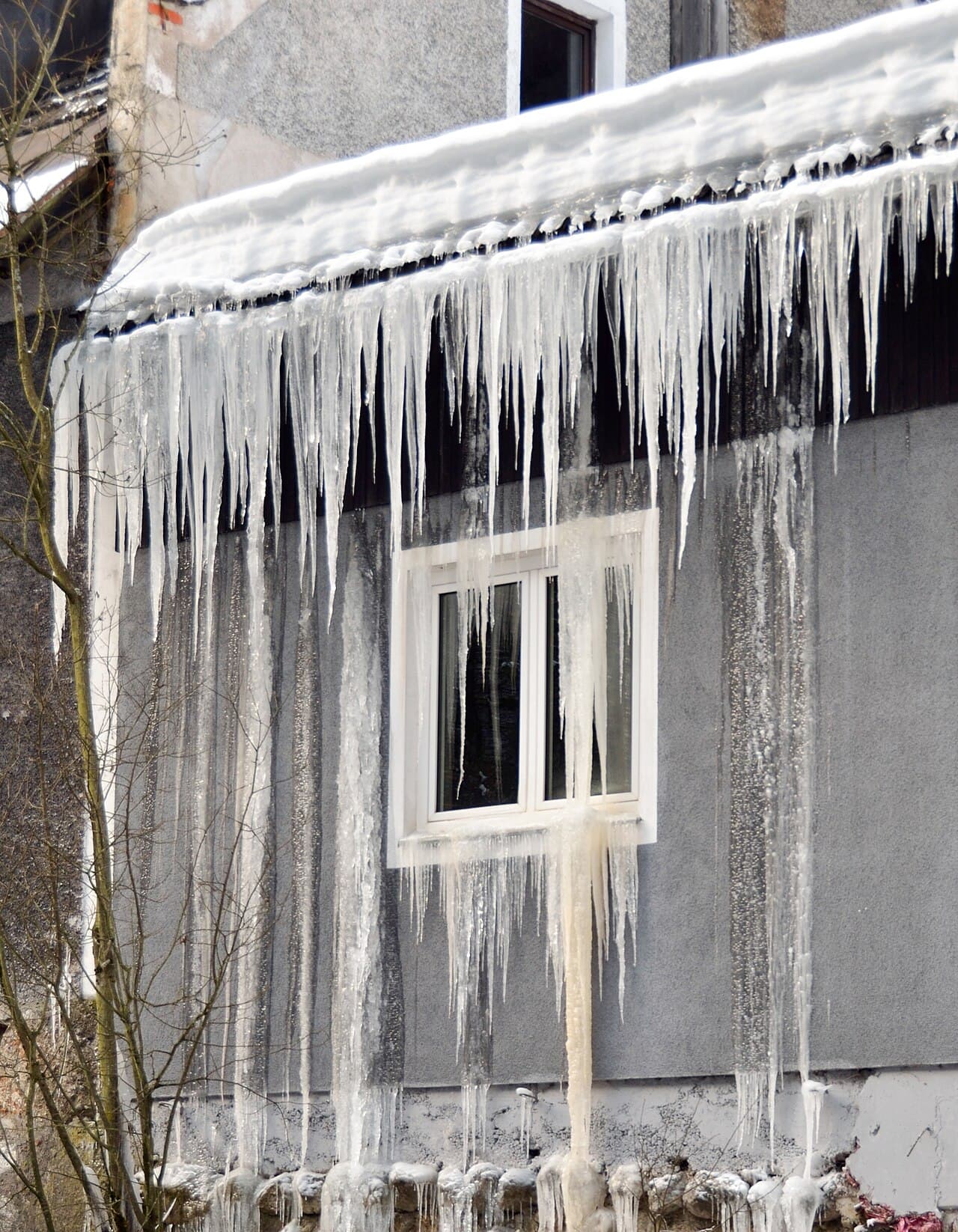
How an ice dam forms
University of Minnesota Extension explains that for an ice dam to form, there must be snow on the roof while higher parts of the roof's outside surface are above 32 degrees F and lower parts are below 32F.[1] The snow over the warm part melts, the water runs down to the cold part and freezes, and the dam grows. The water backed up behind the dam stays liquid, finds cracks and openings in the roof covering, and flows into the attic,[1] then into walls or through the ceiling.
It does not take much snow. The Department of Energy's Building America Solution Center notes that Ice dams can form with as little as 2 inches of snow on a roof,[2] and lists the three ingredients as snow on the roof, a poorly air sealed or poorly insulated attic, and freezing temperatures.[2] North Dakota State University Extension adds that dams and icicles are most common when snow is on the roof and outdoor temperatures are just below freezing.[6]
You cannot control the snow or the weather. The attic is the part you can change.
Cause 1: warm air leaking into the attic
This is the big one. University of Minnesota Extension says that in many homes air leakage is the major mode of heat transfer that leads to ice dams.[1] Warm, moist air rises out of the living space through every gap in the ceiling and warms the underside of the roof.
The Building America guide lists the common leaks: gaps around electrical wiring, light fixtures (especially recessed can lights), plumbing stacks, furnace flues and chimneys, attic hatches and stairs, dropped ceilings, open soffits, exhaust fan housings, top plates, ceiling drywall seams and attic kneewalls.[2] The Virginia Energy Savers Handbook calls these hidden paths thermal bypasses and warns that heated air leaking into the attic through these thermal bypasses can cause ice dams, wet insulation, mold growth and structural decay.[4]
Cause 2: thin insulation over the outside walls
Even a well-insulated attic often has a weak spot right where ice dams form. An archived UMass Amherst building-science article explains that rafters on most homes sit directly on top of the exterior walls, leaving a shallow space for insulation there, and that spot is often poorly air sealed.[5] The roof just above the wall line runs warmer than the overhang beyond it, which is exactly the temperature split a dam needs.
Cause 3: blocked or missing ventilation
A vented attic is meant to wash the underside of the roof with cold outside air. When insulation is packed into the eaves and blocks the soffit vents, that air stops moving. The Building America guide calls for an air gap of at least 2 inches between the top of the insulation and the underside of the roof deck.[2] University of Minnesota Extension says natural roof ventilation can help maintain uniform roof temperatures, though if the air sealing and insulation are done well only small amounts of roof ventilation are needed.[1] Ventilation is a supporting fix, not a substitute for stopping the heat.
Cause 4: heat sources in and above the attic
University of Minnesota Extension notes that Exhaust systems like those in the kitchen or bathroom that terminate just above the roof may also contribute to snow melting.[1] Other attic heat sources it names are chimneys, frequently used wood stoves and fireplaces, poorly insulated or leaky ductwork in the attic, and knee wall spaces.[1] It also warns that Recessed lights, skylights, complex roof designs, and heating ducts in the attic will all increase the risk of ice dam formation.[1]
Things that make it worse
Deep snow. Snow insulates the roof deck and traps the heat under it. The UMass article estimates that Each inch of snow has an R-value of approximately 0.5 – 1,[5] so a deep snowfall makes a marginal attic behave like a poor one.
Sun on the eaves. North Dakota State University Extension notes that solar heating can warm the gutter and the edge of the soffit enough to melt snow, creating icicles and ice dams near the edge of the roof.[6]
Gutters. They get blamed, but the UMass article says gutters do not cause ice dams, but they do concentrate ice and water at a vulnerable spot.[5]
Reading the signs
Look at your roof the day after a snowfall. The Building America guide notes that icicles along with a bare spot on the roof indicate that heat from the room below may be warming the underside of the roof deck.[2] Bare patches over a bathroom, a kitchen full of recessed lights or a finished attic room can point to where the heat is escaping. ENERGY STAR lists ice dams on the roof in winter among the signs that a house needs air sealing and insulation.[9]
Why it happens in Virginia
Ice dams in Virginia usually follow a heavy snow and a cold spell. The Department of Energy's 2015 county guide puts every Virginia county and independent city in climate zone 4A,[7] and federal Building America guidance aims its eave membrane recommendation at climate zones 5 and higher.[3] Still, Prince William County's building division explains that the Virginia code requires an ice barrier in areas where there has been a history of ice forming along the eaves causing a backup of water.[8] A house with a leaky, thinly insulated attic can get ice dams in an ordinary Virginia snowstorm.
When to call a licensed pro
Call a roofer now if water is coming inside or ice is pulling gutters off. Then have the cause found. University of Minnesota Extension says The contractor you hire should conduct a blower door test to evaluate how airtight your ceiling is,[1] and the contractor may also use an infrared camera to find places in the ceiling with excessive heat loss.[1] In Virginia, "Insulation and weather stripping contracting" covers installing, repairing or removing insulating materials used for temperature or sound control,[10] and a Class C licence covers construction, removal, repair or improvement jobs with a single contract over $1,000 and under $30,000.[11]
See how to prevent ice dams, how ice dams are removed safely and where the biggest air leaks in a house are. Browse the roofing answers or energy audit businesses, and when you are ready, describe the ice dam once and licensed local businesses quote it.
Common questions
- Why does my house get ice dams when my neighbor's doesn't?
- Two houses in the same snow usually differ in how much heat reaches the roof. More air leaks into the attic, thinner insulation over the outside walls, blocked soffit vents, ducts or recessed lights in the attic, skylights and complicated roof shapes all make a house more prone to ice dams.
- Do gutters cause ice dams?
- No. An archived UMass Amherst building-science article says gutters do not cause ice dams, but they do concentrate ice and water at a vulnerable spot, and ice-filled gutters can bend and pull away from the house. Keeping gutters clear helps them drain but does not stop the heat loss that makes the dam.
- Are icicles a sign of an ice dam?
- Often. The Department of Energy's Building America Solution Center says icicles are often a sign that more liquid water is building up behind the dam. Icicles together with a bare patch of roof above a heated room point to heat leaking through the roof deck.
- Do ice dams happen in Virginia?
- Yes, usually after heavy snow followed by a cold spell. Federal Building America guidance aims its eave membrane recommendation at climate zones 5 and higher, and Virginia is in zone 4A, but Prince William County's building division notes the Virginia code still requires an ice barrier at the eaves where there is a history of ice backing up water.
- Will more attic ventilation fix my ice dams?
- It helps, but it is not the first fix. Air sealing the ceiling and adding insulation come first, and University of Minnesota Extension says powered attic ventilation is not a recommended solution to ice dams because it can create other attic moisture problems and may cause negative pressure in the home.
Sources
- [1] Dealing with and preventing ice dams, University of Minnesota Extension. Checked October 27, 2026.
- [2] Attic Air Sealing, Insulating, and Ventilating for Ice Dam Prevention, Building America Solution Center, Pacific Northwest National Laboratory, U.S. Department of Energy. Checked October 27, 2026.
- [3] Roof Eaves Sealed with Self-Adhering Membrane in Cold Climates, Building America Solution Center, Pacific Northwest National Laboratory, U.S. Department of Energy. Checked October 27, 2026.
- [4] The Virginia Energy Savers Handbook, Third Edition, Virginia Department of Mines, Minerals and Energy and Virginia Tech. Checked October 27, 2026.
- [5] Preventing Ice Dams (archived article), Building and Construction Technology, University of Massachusetts Amherst. Checked October 27, 2026.
- [6] Reduce Ice Dam and Icicle Damage, North Dakota State University Extension. Checked October 27, 2026.
- [7] Guide to Determining Climate Regions by County (Building America Best Practices Series, Volume 7.3, August 2015), Pacific Northwest National Laboratory, U.S. Department of Energy. Checked October 27, 2026.
- [8] Residential Roof Replacements (FAQ), Prince William County Department of Development Services, Building Development Division. Checked October 27, 2026.
- [9] Identify the Problems You Want to Fix, ENERGY STAR, U.S. Environmental Protection Agency. Checked October 27, 2026.
- [10] 18VAC50-22-30, Definitions of specialty services (Board for Contractors Regulations), Virginia Administrative Code, Virginia General Assembly. Checked October 27, 2026.
- [11] Va. Code § 54.1-1100, Definitions (Contractors), Code of Virginia, Virginia General Assembly. Checked October 27, 2026.
Want a pro to handle it?
Describe the job once. Licensed local businesses send quotes, and you pay only when you book one.
Get a quote for Roofing