How do I prevent ice dams?
Prevent ice dams by keeping the whole roof cold. Seal the air leaks from the house into the attic first, then bring attic insulation up to the recommended level and keep soffit-to-ridge ventilation open. Work on the roof itself belongs with a licensed roofer, and an ice barrier along the eaves at reroofing time limits the damage if a dam forms.
Free to ask. Local shops send quotes, and you pay only when you book one.
By Kasra Taheri, Founder, LoclisPublished
Researched and drafted with AI, then checked claim by claim against the sources listed below before it was published. Prices and rules change; the dates beside each source say when it was last checked.
This is a job for a licensed pro in Virginia
This page explains what the work involves, the permits, what a licensed pro does and what drives the cost. It does not give step-by-step instructions, because this work needs a licence, a permit or both, and doing it wrong can injure someone. Before you hire, check the licence on Virginia's DPOR record.
You prevent ice dams by keeping the whole roof as cold as the outdoor air, so snow does not melt over the heated part of the house and refreeze at the eaves. That means stopping heat from reaching the roof deck: seal the air leaks into the attic first, then add insulation, and keep the attic ventilated from soffit to ridge. Short-term measures such as heat cable treat the symptom. An ice barrier under the shingles at the eaves does not stop dams but limits the damage when one forms.
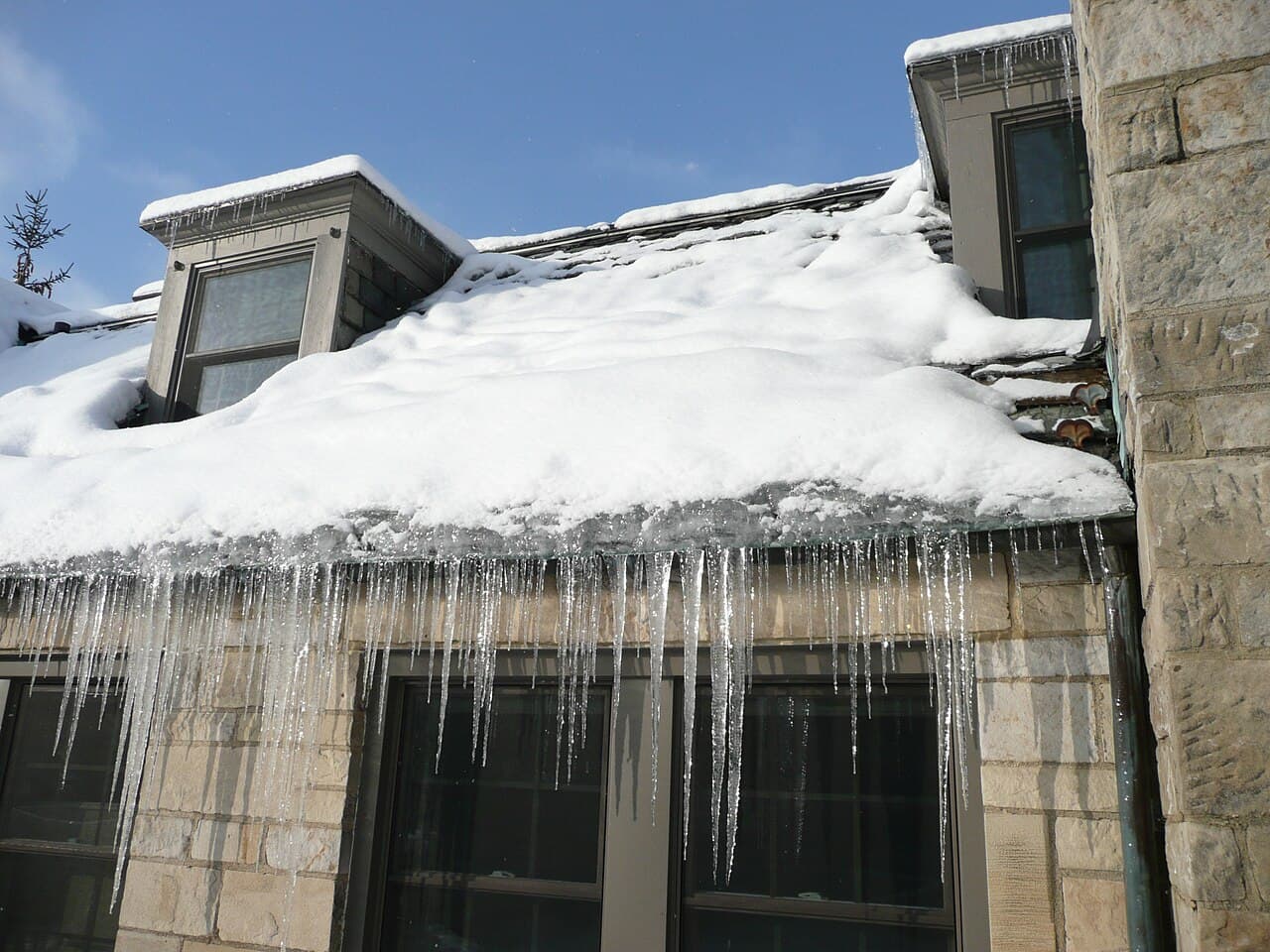
Seal the air leaks first
The Department of Energy's Building America Solution Center says the most important step is to seal all of the air leaks from the living space into the attic, to keep warm air from entering it in the first place.[1] University of Minnesota Extension gives the same order: first make the ceiling airtight, then consider adding ceiling or roof insulation.[2] Insulation slows heat conducted through the ceiling, but warm air leaking through gaps carries heat straight past it.
The usual leaks, from the Building America guide, are gaps around electrical wiring, recessed can lights, plumbing stacks, furnace flues and chimneys, attic hatches and stairs, dropped ceilings, exhaust fan housings, top plates and ceiling drywall seams.[1] University of Minnesota Extension recommends a contractor who runs a blower door test to see how airtight the ceiling is.[2]
When you hire for it, ENERGY STAR's guide is blunt: if a contractor will not agree to seal attic holes and gaps before adding insulation, call another contractor.[5] Once insulation is piled on top, the leaks are buried and much harder to reach.
Then bring the insulation up to level
ENERGY STAR publishes recommended attic insulation levels by climate zone. For an uninsulated attic in climate zones 4A and 4B it recommends R60, and R49 if you already have 3 to 4 inches of insulation.[3] The Department of Energy's 2015 county guide puts every Virginia county and independent city in climate zone 4A.[4]
The spot that matters most for ice dams is the edge of the attic, right above the outside walls, where the roof slopes down and there is little room for insulation. The Building America guide notes that Raised-heel energy trusses can allow the full depth of insulation over the top plates to keep the roof deck area above the eaves cooler.[1] Where space is that tight, University of Minnesota Extension stresses using insulation with a high R-value per inch.[2]
Keep the attic ventilated
Ventilation carries away the heat that does get into the attic. In the Building America guide, baffles and insulation dams keep insulation out of the soffit vents and direct cooling air from the soffits up along the underside of the roof deck to the ridge vents,[1] with an air gap of at least 2 inches between the top of the insulation and the underside of the roof deck.[1] ENERGY STAR adds that any estimate should include insulation baffles so the soffit vents stay open as insulation is added.[5]
More fans are not the answer. University of Minnesota Extension says Mechanical attic ventilation is not a recommended solution to ice dams in Minnesota,[2] and adds that it can create other attic moisture problems and may cause undesirable negative pressure in the home.
Deal with the other heat sources
University of Minnesota Extension notes that kitchen or bathroom exhausts that end just above the roof may have to be moved or extended in areas of high snowfall.[2] Kitchen, bath and dryer vents that exhaust into the attic instead of outdoors are a problem to fix as well.[6]
Ask the contractor about attic ductwork and the flues at the chimney as well, since furnace flues can be very hot[6] and sealing around them is work for a professional.
Safety checks before the attic work
ENERGY STAR recommends a professional when the attic has any of these: difficult attic access, wet or damp insulation, moldy or rotted rafters or joists, kitchen, bath or dryer vents that exhaust into the attic, little or no attic ventilation, and knob and tube wiring (pre-1930), which can be a fire hazard when in contact with insulation.[6]
A tighter house also changes how fuel-burning appliances breathe. ENERGY STAR warns that Sealing in some cases can cause naturally venting combustion appliances to back-draft gases back into your home,[6] and recommends that a Home Performance Contractor test oil and gas appliances before and after sealing.
Add an ice barrier when you reroof
An ice barrier will not stop a dam from forming, but it keeps backed-up water out of the house. Prince William County's building division explains that the Virginia code requires one in areas with a history of ice backing up at the eaves, made of not fewer than two layers of underlayment cemented together, or a self-adhering polymer-modified bitumen sheet, extending from the lowest edges of all roof surfaces to a point at least 24 inches inside the exterior wall line.[7] The county's summary adds: On roofs with slope equal to or greater than 8 units in 12 units horizontal, the ice barrier shall also be applied not less than 36 inches[7] measured along the slope from the eave.
The Building America guide explains why the self-adhering membrane works: it stays somewhat soft and seals around the nails driven through it to hold the shingles.[8] It goes under the shingles, so it is added when the roof is replaced, not afterwards. Ask any roofer quoting a replacement how far up the roof they will run it.
Short-term help during a snowy winter
Do not climb onto an icy roof or work from a ladder in the snow. If a dam is already forming, see how ice dams are removed safely.
Heat cable is a common quick fix. North Dakota State University Extension says Trying to remedy the ice dam problem with electric cables on the roof deck also is wasting energy,[9] and an archived UMass Amherst building-science article says heat tape embrittles shingles, creates a fire risk, and that the cable can create an ice dam just above it.[10]
When to call a licensed pro
Air sealing and insulating an attic with any of the conditions above, sealing around flues, moving exhaust ducts, and anything on the roof itself belong with licensed contractors. In Virginia, "Insulation and weather stripping contracting" covers installing, repairing or removing insulating materials used for temperature or sound control,[11] and "Roofing contracting" covers the installation, repair, removal or improvement of the materials that form a watertight, weather resistant surface for roofs.[11] Check the licence in DPOR's License Lookup before you sign.
For the cause, see why ice dams form; if you have one now, see how ice dams are removed safely and who removes ice dams. Related: where the biggest air leaks in a house are. Browse the roofing answers or energy audit businesses, and when you are ready, describe the job once and licensed local businesses quote it.
Common questions
- What is the single most effective way to prevent ice dams?
- Air sealing the ceiling. The Department of Energy's Building America guide calls sealing the air leaks from the living space into the attic the most important step, and University of Minnesota Extension says to make the ceiling airtight first and then add insulation.
- How much attic insulation do I need in Virginia?
- ENERGY STAR recommends R60 for an uninsulated attic in climate zones 4A and 4B, or R49 if you already have 3 to 4 inches. The Department of Energy's 2015 county guide puts every Virginia county and independent city in zone 4A. Seal the air leaks before the insulation goes in.
- Do heat cables prevent ice dams?
- They treat the symptom rather than the cause. North Dakota State University Extension says electric cables on the roof waste energy, and an archived UMass Amherst article says heat tape embrittles shingles, creates a fire risk and can cause a new dam just above the cable.
- Should I add a powered attic fan?
- University of Minnesota Extension says mechanical attic ventilation is not a recommended solution to ice dams in Minnesota, because it can create other attic moisture problems and may cause negative pressure in the home. Continuous soffit-to-ridge ventilation with clear baffles is the usual approach.
- Does the Virginia code require ice and water shield on a new roof?
- Prince William County's building division explains that the Virginia code requires an ice barrier where there is a history of ice forming along the eaves and backing up water, extending at least 24 inches inside the exterior wall line. Ask your roofer what applies where you live.
Sources
- [1] Attic Air Sealing, Insulating, and Ventilating for Ice Dam Prevention, Building America Solution Center, Pacific Northwest National Laboratory, U.S. Department of Energy. Checked October 27, 2026.
- [2] Dealing with and preventing ice dams, University of Minnesota Extension. Checked October 27, 2026.
- [3] Recommended Home Insulation R-Values, ENERGY STAR, U.S. Environmental Protection Agency. Checked October 27, 2026.
- [4] Guide to Determining Climate Regions by County (Building America Best Practices Series, Volume 7.3, August 2015), Pacific Northwest National Laboratory, U.S. Department of Energy. Checked October 27, 2026.
- [5] How to Hire an Attic Insulation Contractor, ENERGY STAR, U.S. Environmental Protection Agency. Checked October 27, 2026.
- [6] Attic Air Sealing Project, ENERGY STAR, U.S. Environmental Protection Agency. Checked October 27, 2026.
- [7] Residential Roof Replacements (FAQ), Prince William County Department of Development Services, Building Development Division. Checked October 27, 2026.
- [8] Roof Eaves Sealed with Self-Adhering Membrane in Cold Climates, Building America Solution Center, Pacific Northwest National Laboratory, U.S. Department of Energy. Checked October 27, 2026.
- [9] Reduce Ice Dam and Icicle Damage, North Dakota State University Extension. Checked October 27, 2026.
- [10] Preventing Ice Dams (archived article), Building and Construction Technology, University of Massachusetts Amherst. Checked October 27, 2026.
- [11] 18VAC50-22-30, Definitions of specialty services (Board for Contractors Regulations), Virginia Administrative Code, Virginia General Assembly. Checked October 27, 2026.
Want a pro to handle it?
Describe the job once. Licensed local businesses send quotes, and you pay only when you book one.
Get a quote for Roofing