Who removes ice dams?
Roofing contractors are the usual call to remove an ice dam and repair what it damaged, and some snow removal and gutter companies offer removal too. In Virginia, check the business's contractor licence with DPOR for any job over $1,000. To stop the dams coming back, hire an insulation or weatherization contractor, ideally after an energy audit, to fix the attic heat loss behind them.
Free to ask. Local shops send quotes, and you pay only when you book one.
By Kasra Taheri, Founder, LoclisPublished
Researched and drafted with AI, then checked claim by claim against the sources listed below before it was published. Prices and rules change; the dates beside each source say when it was last checked.
This is a job for a licensed pro in Virginia
This page explains what the work involves, the permits, what a licensed pro does and what drives the cost. It does not give step-by-step instructions, because this work needs a licence, a permit or both, and doing it wrong can injure someone. Before you hire, check the licence on Virginia's DPOR record.
Roofing contractors are the usual call to remove an ice dam, because the job is on the roof and the damage it leaves, lifted shingles, wet decking, torn gutters, is roofing work. Some snow removal companies and gutter companies also clear roof snow and ice. Removal alone does not end the problem, though. The dam formed because heat escaped into the attic, and fixing that is a job for an insulation or weatherization contractor, often after an energy audit. Most homes with a real ice dam end up needing both.
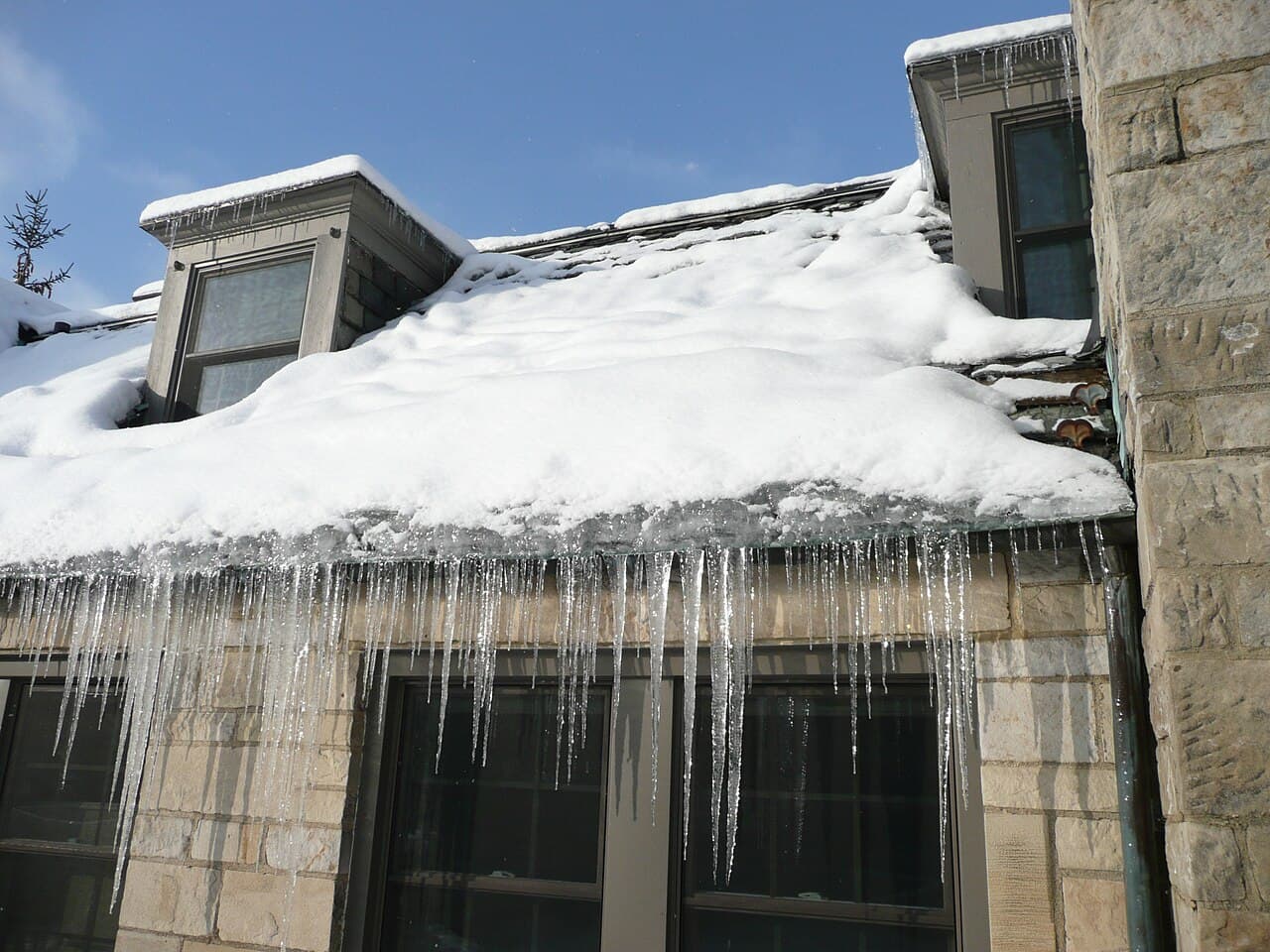
Why not do it yourself
University of Minnesota Extension is clear about the risk: "Anyone on the roof during the winter or performing work on the roof from below risks injury and may cause damage to the roof and house."[1] The City of Alexandria's winter guidance says homeowners concerned about snow depth should contact a licensed snow removal professional[2] instead of going up themselves. For how a crew does the work, see how ice dams are removed safely.
Who removes the ice and repairs the roof
Roofing contractors. Under Virginia's Board for Contractors rules, "Roofing contracting" covers the installation, repair, removal or improvement of the materials that form a watertight, weather resistant surface for roofs.[3] The home improvement (HIC) specialty, which covers repairs or improvements to houses and townhouses, also provides for that function.[3] A roofer can take the ice down, then repair shingles, flashing and the roof edge, and is the right call when water is already inside.
Snow removal and gutter companies. Some offer roof snow clearing and ice removal as a winter service. They are a reasonable choice for clearing heavy snow before a dam forms, but if roofing or gutters are damaged, a roofer or gutter contractor should do that repair.
Restoration and drywall trades. Once water has reached ceilings and walls, the drying and interior repair are separate jobs. A good roofer will tell you what they found, including checking the underside of the roof sheathing and the roof trim for wetting, and checking the insulation for dampness,[10] which an archived UMass Amherst building-science article recommends after any ice dam.
Who fixes the cause
University of Minnesota Extension says Weatherization contractors are professionals who can deal with the heat transfer problem that creates ice dams,[1] and that the contractor should run a blower door test to see how airtight the ceiling is, and may use an infrared camera to find places with excessive heat loss.[1]
In Virginia's licensing rules, "Insulation and weather stripping contracting" covers installing, repairing or removing insulating materials used for temperature or sound control.[3] An energy auditor or home performance contractor can test the house first and tell you where the heat is escaping.
ENERGY STAR's hiring guide says a good contractor has a license to work in your state, has insurance, and is trained and certified to do the work.[7] It also says that if a contractor will not agree to seal attic holes and gaps before adding insulation, call another contractor,[7] and that any estimate should include insulation baffles so the soffit vents stay open as insulation is added.[7] One more question matters after sealing: if you have an oil or gas appliance, have a Home Performance Contractor test that it drafts properly before and after sealing,[8] because sealing can in some cases cause naturally venting combustion appliances to back-draft gases into the home.[8]
If cost is a barrier, Virginia's Weatherization Assistance Program, run by the Department of Housing and Community Development, seals air leaks, adds insulation and repairs heating and cooling systems for eligible households through a network of local nonprofit providers.[9]
Checking the licence
In Virginia, a Class C licence covers construction, removal, repair or improvement jobs with a single contract over $1,000 and under $30,000.[4] Class B covers single jobs of $30,000 or more but under $150,000, and Class A covers $150,000 and up.[4] The licence should also carry the right specialty for the work.
DPOR's consumer guide warns that A license number in an advertisement or on a business card does not necessarily mean the contractor's license is valid.[5] You can verify a contractor's licence with DPOR's License Lookup or by calling (804) 367-8511.[6]
Questions to ask before you hire
- How will you remove the ice, and what will you not do to the shingles and gutters?
- Is snow clearing included, and how much of the roof will you clear?
- What happens if you find damaged roofing, decking or gutters, and how will that be priced?
- Will you check the attic for wet insulation and tell me what you see?
- What is your licence number, class and specialty, and do you carry insurance?
Ice dams arrive with storms, and so do opportunists. DPOR advises that you be wary of door-to-door solicitations promising repairs at a discounted price,[6] that you insist on a written contract, don't pay in cash, and never pay for the entire job upfront,[6] and that you limit the deposit to 10 percent or $1,000, whichever is less.[6] For more on spotting scams, see how to avoid roofing scams after a storm.
When to call a licensed pro
Call a licensed roofing contractor right away when water is coming through a ceiling or wall, when the dam is above a second storey or a porch roof, when gutters are pulling away under the ice, or when the roof sags or creaks. Call an insulation or weatherization contractor once the emergency is over, before next winter, if you have had ice dams more than once.
For prices, see how much ice dam removal costs in Virginia; for the cause, see why ice dams form. Browse the roofing answers, energy audit businesses or exterior and roofing pros around Blacksburg, and when you are ready, describe the ice dam once and licensed local businesses quote it.
Common questions
- Do I call a roofer or a snow removal company for an ice dam?
- If water is coming in or the roof may be damaged, call a roofing contractor, because the repair that follows is roofing work. A snow removal company can help clear heavy snow. The City of Alexandria tells homeowners worried about snow depth to contact a licensed snow removal professional rather than climb on the roof.
- Does an ice dam company need a Virginia licence?
- Virginia requires a contractor licence for construction, removal, repair or improvement work above $1,000 on a single contract, starting with Class C. Roofing repairs after an ice dam fall under the Board for Contractors' roofing and home improvement specialties. Check the licence in DPOR's License Lookup before you sign.
- Who fixes the cause so ice dams stop coming back?
- An insulation or weatherization contractor, often after an energy audit. University of Minnesota Extension says weatherization contractors can deal with the heat transfer that creates ice dams, and that they should run a blower door test to measure how airtight the ceiling is.
- What should I ask an insulation contractor?
- Ask whether they will seal attic air leaks before adding insulation, whether the estimate includes baffles to keep soffit vents open, and whether they hold a Virginia licence and insurance. ENERGY STAR's hiring guide says to call another contractor if one will not agree to seal before insulating.
- Someone knocked on my door offering to remove ice dams cheaply. Should I hire them?
- Be careful. DPOR warns consumers to be wary of door-to-door solicitations promising repairs at a discounted price, to insist on a written contract, not to pay in cash, and never to pay for the whole job upfront. Look up the licence before agreeing to anything.
Sources
- [1] Dealing with and preventing ice dams, University of Minnesota Extension. Checked October 27, 2026.
- [2] Snow and Ice Control, City of Alexandria, Virginia. Checked October 27, 2026.
- [3] 18VAC50-22-30, Definitions of specialty services (Board for Contractors Regulations), Virginia Administrative Code, Virginia General Assembly. Checked October 27, 2026.
- [4] Va. Code § 54.1-1100, Definitions (Contractors), Code of Virginia, Virginia General Assembly. Checked October 27, 2026.
- [5] What You Should Know Before You Hire a Contractor, Virginia Department of Professional and Occupational Regulation, Board for Contractors. Checked October 27, 2026.
- [6] Disaster Recovery: Avoiding Fraud, Virginia Department of Professional and Occupational Regulation. Checked October 27, 2026.
- [7] How to Hire an Attic Insulation Contractor, ENERGY STAR, U.S. Environmental Protection Agency. Checked October 27, 2026.
- [8] Attic Air Sealing Project, ENERGY STAR, U.S. Environmental Protection Agency. Checked October 27, 2026.
- [9] Weatherization Assistance Program (WAP), Virginia Department of Housing and Community Development. Checked October 27, 2026.
- [10] Preventing Ice Dams (archived article), Building and Construction Technology, University of Massachusetts Amherst. Checked October 27, 2026.
Want a pro to handle it?
Describe the job once. Licensed local businesses send quotes, and you pay only when you book one.
Get a quote for Roofing