How are leaking screws on a metal roof fixed?
A roofer first works out why each screw leaks, then reseats it or replaces it. A screw driven too loose never compresses its washer, one driven too tight crushes it, a stripped hole needs an oversized screw or a fresh hole, and an aged washer needs a new fastener. Caulk smeared over the heads is usually a stopgap. On a roof, this is work for a licensed roofer.
Free to ask. Local shops send quotes, and you pay only when you book one.
By Kasra Taheri, Founder, LoclisPublished
Researched and drafted with AI, then checked claim by claim against the sources listed below before it was published. Prices and rules change; the dates beside each source say when it was last checked.
This is a job for a licensed pro in Virginia
This page explains what the work involves, the permits, what a licensed pro does and what drives the cost. It does not give step-by-step instructions, because this work needs a licence, a permit or both, and doing it wrong can injure someone. Before you hire, check the licence on Virginia's DPOR record.
A leaking screw on a metal roof is fixed by finding out why that screw leaks and then making the washer seal again: reseating a screw that was driven too loose, replacing one that was driven too tight or has an aged washer, and dealing properly with any hole that has stripped. Caulk smeared over the heads is usually a stopgap, not a repair. Below is what a proper repair involves, what to ask for, and why it is a job for a licensed roofer rather than a ladder project.
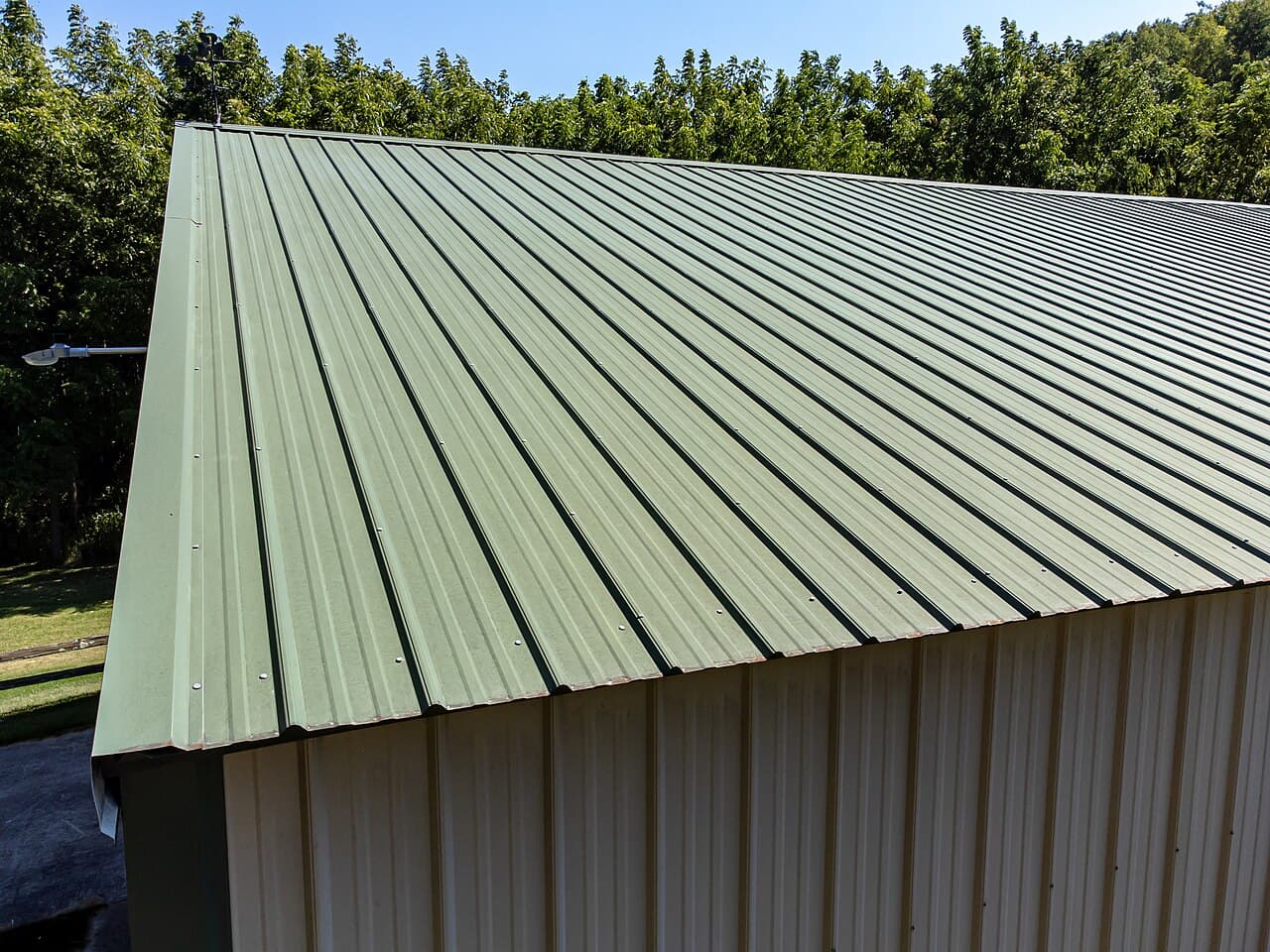
Why the washer is the whole story
On a screw-down roof, every screw is a hole through the panel. Exposed fastener systems use screws with sealing washers to protect each penetration through the panel,[3] and McElroy Metal, a panel maker, notes that thermal movement, installation conditions, and washer aging can create maintenance needs over time.[3] So the repair is less about the screw than about getting a sound, properly compressed washer back on every hole.
Panel makers show what that looks like. In Metal Sales' installation guide, a correctly driven screw leaves the sealing material slightly visible at the edge of the washer, and the assembly is watertight.[1] If no sealing material shows, the screw is too loose and the washer is not compressed enough to seal.[1] If the washer is deformed and the sealing material is squeezed out past the edge, the screw is too tight.[1] The guide sums it up: "Apply sufficient torque to seat the washer - do not overdrive the fastener."[1]
That gives a homeowner a simple way to judge photos a roofer sends: you want to see washers just barely bulging at the edge, not flat gaps and not crushed rubber.
What a roofer does about each kind of leak
Loose screws. A screw that has backed out or was never driven home can often be snugged down to seat the washer, as long as the threads still grip and the washer is in good shape.
Overdriven screws and crushed washers. A crushed washer will not recover, so the usual fix is a new fastener. The screw gun matters here: Metal Sales notes that the right tool speed and torque setting helps prevent thread strip-out and damage to the panel or its coating,[1] and its standing seam guide calls for a screw gun with a depth-locating nose or adjustable clutch, and no impact tools.[2] It is a fair question to ask a roofer what they will drive the screws with.
Stripped holes. Once a hole has stripped, the same size screw will spin without clamping. Metal Sales' standing seam guide, writing about the screws that hold its panel clips, says a stripped fastener must go into a new hole at least 3/8 inch from the stripped one, or be replaced with an oversized fastener in the same hole, or the roof's wind uplift resistance is weakened.[2] If a new hole is used, the old one still has to be sealed, or it becomes the next leak.
Aged washers. When washers have dried out or cracked across the roof, spot repairs tend to chase leaks from one screw to the next. A roofer may recommend replacing every exposed fastener, which is a bigger job and should be quoted that way.
The replacement screws themselves. In its post-frame guide, for screw-down panels on wood framing, Metal Sales recommends a painted or plated screw, Type A or driller tip, with a flat rubber washer.[1] Englert's panel warranty says fasteners are to be electrically insulated from the panel surface, for example with elastomeric grommets, to prevent dissimilar metal contact,[5] and it excludes panel damage caused by overdriving fasteners.[5] Ask the roofer to match the fastener to what your panel maker specifies.
Small details that decide whether the repair lasts
Drilling and cutting leave steel chips on the roof, and Metal Sales is blunt about them: "Metal shavings will rust on the surface, voiding the warranty."[1] A careful crew sweeps or wipes the panels clean before leaving. Scratches from the work get touch-up paint, but touch-up paint does not have the chalk and fade resistance of the factory finish and will normally discolor faster,[1] so small touch-ups are better than large ones.
Foot traffic is the other hidden cost. Englert's warranty excludes damage caused by walking on the roof,[5] and Metal Sales tells installers never to walk on frosty, icy or wet panels, to step on the flat areas rather than the ribs, and to use fall protection such as harnesses, guardrails and lifelines.[2]
When the screws are not the leak
Water travels along metal before it drips, so a stain under a screw line is not proof the screws are at fault. Side laps are a common culprit on low slopes: it is customary to put sealant in exposed-fastener side laps on slopes below 3:12 to cut the chance of a leak.[4] Flashing at walls, chimneys, vents and the ridge can leak too, and condensation under the panels can look like a leak on cold nights. A roofer who reseats every screw without checking these may not stop the drip. For the full list of causes, see why a metal roof leaks at the screws.
When to call a licensed pro
Every screw repair on a roof is a job for a roofer. Falls are the leading cause of work-related injuries and deaths among roofers,[6] and a roofing crew brings the harnesses, anchors and training that a homeowner on a ladder does not have. Metal panels are slick when damp, dusty or frosty, and a dented rib or a scuffed finish from a misplaced step is easy to cause and hard to undo.
In Virginia, roofing contracting is the licensed specialty for installing, repairing or removing the materials that form a watertight, weather-resistant roof surface, and the CBC and RBC classes and the HIC and CIC specialties also cover it.[7] A Class C contractor can take a single job over $1,000 but less than $30,000,[8] so ask the roofer what class and specialty the licence covers for the quoted price. Check any roofer's licence using DPOR's License Lookup or by calling (804) 367-8511,[9] or read how to check a contractor's licence in Virginia.
When you call, describe the roof type (screw-down or standing seam), roughly how old it is, where the water shows up inside, and whether it leaks in every rain or only in wind-driven storms. Ask the roofer to photograph the screws they replace. For what the work usually costs, see what fixing a leaking metal roof costs in Virginia. Browse all roofing answers or find metal roof repair businesses.
Describe the leak and add photos, and licensed local roofers send quotes you can compare side by side.
Common questions
- Can I just put caulk or roof sealant over a leaking screw?
- It may slow a drip for a while, but it does not fix a washer that was never compressed, was crushed, or has aged out, and it hides the screw from the next inspection. A proper repair reseats or replaces the fastener so the washer seals on its own.
- Should every screw on the roof be replaced, or only the leaking ones?
- It depends on why they leak. One overdriven screw is a spot fix. If the washers are aging across the whole roof, a roofer may recommend reworking every exposed fastener. Ask the roofer to show you photos of the screws they want to replace and say why.
- What is an oversized screw?
- A fastener with a larger diameter than the original, used when the old hole has stripped and will no longer grip. The alternative is a new hole a short distance away. Either way, the old hole still has to be sealed so it does not become the next leak.
- Will a screw repair affect my metal roof warranty?
- It can. Panel warranties can exclude damage from overdriven fasteners, walking on the roof, metal shavings left on the panels and incompatible fasteners. Read your warranty, and ask the roofer to use fasteners the panel maker approves.
- Do standing seam roofs leak at screws too?
- Standing seam panels hide their fasteners under the seams, so there are no exposed screws across the main roof. Leaks there usually come from flashings, trim, penetrations or the seams themselves, which is a different repair.
Sources
- [1] Post Frame Installation Guide (10/25), Metal Sales Manufacturing Corporation. Checked October 27, 2026.
- [2] Magna-Loc 90 Installation Guide (10/26), Metal Sales Manufacturing Corporation. Checked October 27, 2026.
- [3] Standing Seam Metal Roofing Materials: A Homeowner's Guide, McElroy Metal. Checked October 27, 2026.
- [4] Understanding Roofing Fastener Spacing and Patterns: Key Considerations, McElroy Metal. Checked October 27, 2026.
- [5] Englert U.S. Roof Warranty (sample, rev. 7), Englert, Inc.. Checked October 27, 2026.
- [6] Protecting Roofing Workers (OSHA 3755), U.S. Occupational Safety and Health Administration. Checked October 27, 2026.
- [7] 18VAC50-22-30, Definitions of specialty services, Virginia Board for Contractors (Virginia Administrative Code). Checked October 27, 2026.
- [8] § 54.1-1100. Definitions (contractor classes), Code of Virginia. Checked October 27, 2026.
- [9] Disaster Recovery: Avoiding Fraud, Virginia Department of Professional and Occupational Regulation. Checked October 27, 2026.
Want a pro to handle it?
Describe the job once. Licensed local businesses send quotes, and you pay only when you book one.
Get a quote for Roofing