Why is my metal roof leaking at the screws?
Most screw leaks on a screw-down metal roof come back to the sealing washer: a screw driven too loose never compresses it, one driven too tight crushes it, and washers age with sun and the panels' thermal movement. Stripped holes, angled screws and rust from mixed metals or left-behind shavings cause leaks too. Some apparent screw leaks are really side laps, flashing or condensation.
Free to ask. Local shops send quotes, and you pay only when you book one.
By Kasra Taheri, Founder, LoclisPublished
Researched and drafted with AI, then checked claim by claim against the sources listed below before it was published. Prices and rules change; the dates beside each source say when it was last checked.
This is a job for a licensed pro in Virginia
This page explains what the work involves, the permits, what a licensed pro does and what drives the cost. It does not give step-by-step instructions, because this work needs a licence, a permit or both, and doing it wrong can injure someone. Before you hire, check the licence on Virginia's DPOR record.
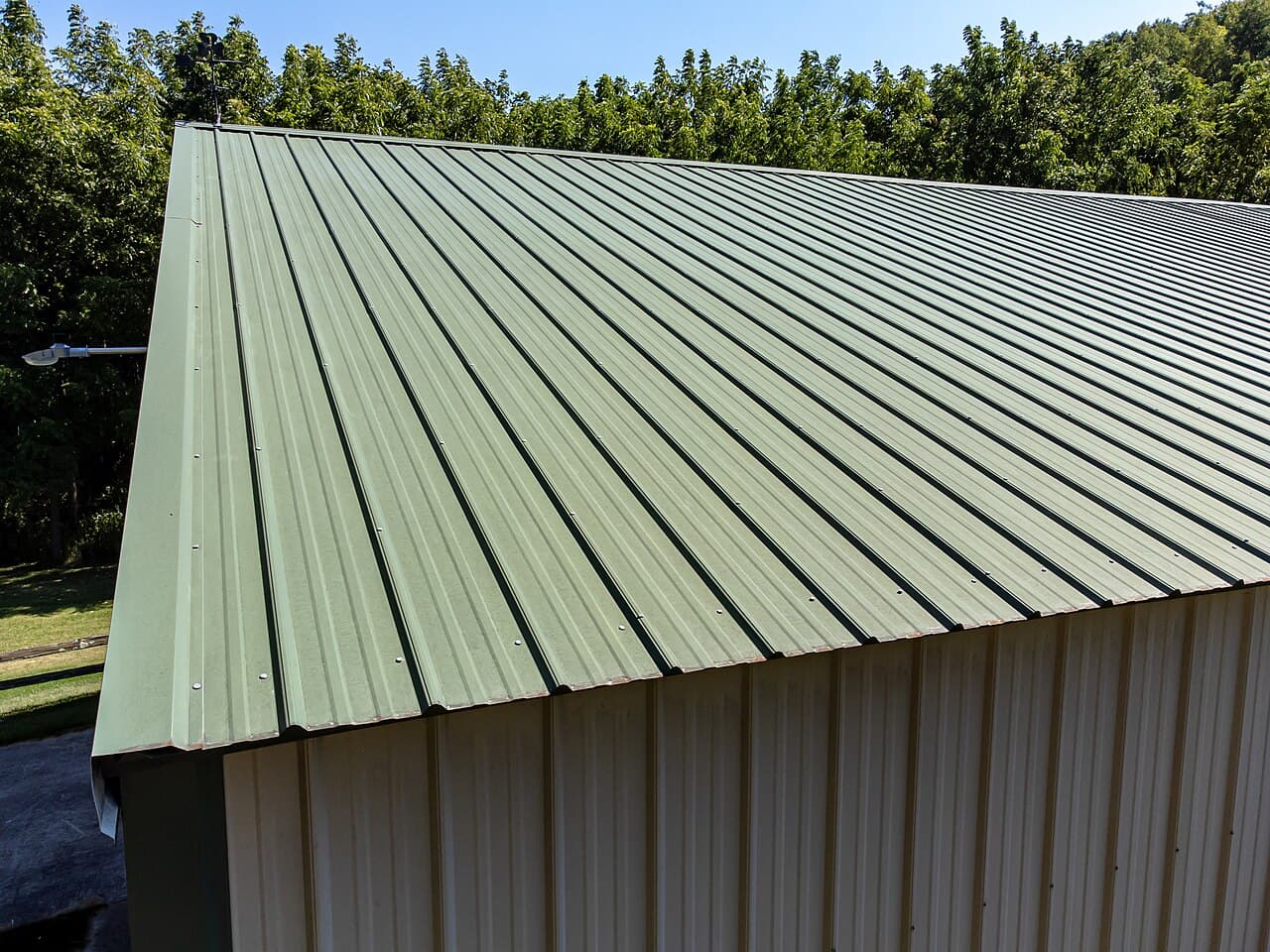
When a metal roof leaks at the screws, the cause is most often the small rubber washer under each screw head, or the hole it is supposed to seal. Exposed fastener systems use screws with sealing washers to protect each penetration through the panel,[1] and a panel maker notes that thermal movement, installation conditions, and washer aging can create maintenance needs over time.[1] Here are the common reasons a screw stops sealing, the problems that only look like screw leaks, and what to tell a roofer.
Screws driven too loose or too tight
Driving a screw to the wrong depth is a common installation fault. Metal Sales' installation guide shows three cases. Done right, the sealing material shows just slightly at the edge of the washer. By contrast, a screw driven too loose leaves no sealing material visible, with not enough compression to seal.[2] A screw driven too tight deforms the washer and presses the sealing material beyond the edge,[2] and a crushed washer leaks just as surely as a loose one.
Overdriving does other harm. Metal Sales warns: "Overdriven fasteners will cause stress and induce oil canning across the face of the panel at or near the point of attachment."[3] Waviness or dimples around screw heads are a clue that the screws went in too hard.
In a case study published by Atlas, a fastener maker, a metal roofing supplier lists overtightening that could blow out washers[5] among its main worries with conventional screws.
Stripped holes
When a screw spins without tightening, its threads have torn out of the wood or steel below. The washer can never compress, so water gets in. The installation tool matters: the right speed and torque setting on the screw gun helps prevent fastener thread strip-out.[2] A stripped screw is also a structural problem, not only a leak: Metal Sales warns that a stripped fastener left in place weakens the roof's wind uplift resistance.[4]
Screws set at an angle
A screw driven crooked seats its washer on one side only. Atlas, a fastener maker, recommends a socket that keeps the fastener perpendicular to the work surface,[6] and sells a washer design meant to seal even when a screw is not installed at a perfect angle, to reduce leaks from real-world installation variability.[5] If you can see from below or from photos that screw heads tilt, that is a likely leak point.
Aging washers and thermal movement
A roof that was dry for years and now leaks at many screws at once often has tired washers. Steel roofing panels are subject to dimensional changes after installation due to exposure to varying temperatures,[4] and Metal Sales adds: "The greatest influence is solar energy."[4] Standing seam roofs are built around this: their panels interlock at raised vertical seams and attach with concealed clips or fastening flanges,[1] which lets them expand and contract without placing the same stress on exposed attachment points.[1] A screw-down roof has an exposed attachment point at every screw, and each one carries a washer that ages.
Rust and mixed metals
Rust around a screw can open a path for water. Three causes are common:
- Incompatible fasteners. Englert's panel warranty says fasteners should be electrically insulated from the panel surface, for example with elastomeric grommets, to prevent dissimilar metal contact.[7]
- Copper and bare steel nearby. Metal Sales says Galvalume panels should not touch, or take runoff from, copper, lead or uncoated steel,[2] and that condensate from air conditioning units typically contains dissolved copper.[2] A condensate line dripping onto the roof can corrode panels around the screws below it.
- Shavings left after drilling. Every screw makes steel chips. Metal Sales puts it plainly: "Metal shavings will rust on the surface, voiding the warranty."[2]
Leaks that only look like screw leaks
Water runs along the underside of metal and drips at the lowest point, which is often a screw tip. Before anyone replaces screws, rule out:
- Side laps. Where two panels overlap, water can be drawn sideways. Because of capillary action, it is customary to put sealant in exposed-fastener side laps on slopes below 3:12[8] to reduce leaks.
- Condensation. If water appears on cold, clear mornings rather than during rain, it is probably condensation. The underside of a metal roof can dip below the dew point on clear, cool nights, even in summer.[9] Uninsulated barns, garages and shops are prone to it.
- Flashing and penetrations. McElroy notes that flashings, sealants, penetrations, snow-retention devices and transitions often take more stress than the open panel field.[1] Vent pipes, chimneys, skylights and wall joints deserve a look.
From inside, without going on the roof, note when the water appears (during rain, in wind-driven rain only, or on cold dry mornings), mark the drip spots, and take photos. That record saves the roofer time. For leaks that only show in storms, see why a roof leaks only when it rains hard.
When to call a licensed pro
Finding and fixing screw leaks means working on the roof, which is a job for a licensed roofer, not a homeowner with a ladder and a drill. Overdriving a screw while trying to stop a leak can crush the washer and dent the panel, making things worse. In Virginia, roofing contracting is the licensed specialty for repairing the materials that form a watertight, weather-resistant roof surface.[10] Check a roofer's licence using DPOR's License Lookup or by calling (804) 367-8511,[11] or see how to check a contractor's licence.
To understand the repair itself, read how leaking screws on a metal roof are fixed, or browse all roofing answers and metal roof repair businesses.
Describe the leak and add photos, and licensed local roofers send quotes you can compare side by side.
Common questions
- My metal roof is only a few years old. Why are the screws already leaking?
- On a young roof, installation is the usual suspect: screws driven too loose or too tight, stripped holes, or screws set at an angle. Those leaks often show up in the first hard rains. If the installer is still around, ask them to come back and look before anyone else touches it.
- Why do the screws leak more after a few years?
- Sealing washers age, and steel panels grow and shrink with every sunny day and cold night, working at each screw hole. That is why panel makers advise periodic checks of exposed fasteners.
- Water drips from the screws inside my barn on cold mornings, but not in the rain. Is that a leak?
- Probably not. That pattern points to condensation: warm, moist air meeting cold metal and forming droplets that run to the screw tips and fall. Ventilation, insulation or an anti-condensation backing is the fix, not new screws.
- Why are the screw heads rusting?
- Usually the fastener's coating has worn or did not match the panel, or steel shavings were left on the roof after drilling. Rust from copper or bare steel nearby, including copper-laden air conditioner condensate, can attack the panels too.
- Can I go up and tighten the screws myself?
- It is not safe or wise. Metal panels are slippery, a missed step can dent ribs or open laps, and tightening too far crushes the washer and makes the leak worse. Have a licensed roofer check it.
Sources
- [1] Standing Seam Metal Roofing Materials: A Homeowner's Guide, McElroy Metal. Checked October 27, 2026.
- [2] Post Frame Installation Guide (10/25), Metal Sales Manufacturing Corporation. Checked October 27, 2026.
- [3] Residential Design Manual (2024), Metal Sales Manufacturing Corporation. Checked October 27, 2026.
- [4] Magna-Loc 90 Installation Guide (10/26), Metal Sales Manufacturing Corporation. Checked October 27, 2026.
- [5] Case Study: True Metal Supply Standardizes Atlas Wood Ultimate, Atlas Bolt & Screw (Marmon Fasteners). Checked October 27, 2026.
- [6] General Fastener Technical Data, Atlas Bolt & Screw (Marmon Fasteners). Checked October 27, 2026.
- [7] Englert U.S. Roof Warranty (sample, rev. 7), Englert, Inc.. Checked October 27, 2026.
- [8] Understanding Roofing Fastener Spacing and Patterns: Key Considerations, McElroy Metal. Checked October 27, 2026.
- [9] Condensation, Ventilation, and Your Metal Roof, McElroy Metal. Checked October 27, 2026.
- [10] 18VAC50-22-30, Definitions of specialty services, Virginia Board for Contractors (Virginia Administrative Code). Checked October 27, 2026.
- [11] Disaster Recovery: Avoiding Fraud, Virginia Department of Professional and Occupational Regulation. Checked October 27, 2026.
Want a pro to handle it?
Describe the job once. Licensed local businesses send quotes, and you pay only when you book one.
Get a quote for Roofing