How do movers move a piano safely?
A good crew never carries a piano's full weight by hand. They pad and strap it, roll an upright on a heavy dolly, take a grand's legs off and lay it on its side on a padded piano board, and put people above and below it on stairs. Your part is to measure the route, clear it, and choose a spot away from heat and sun.
Free to ask. Local shops send quotes, and you pay only when you book one.
By Kasra Taheri, Founder, LoclisPublished
Researched and drafted with AI, then checked claim by claim against the sources listed below before it was published. Prices and rules change; the dates beside each source say when it was last checked.
Step by step
Read when to stop and call a pro, further down this page, before you start.
Step 1: Note what you have
Write down whether it is an upright or a grand, the brand and model, and the height of an upright or the length of a grand, and give these to the mover.
Step 2: Measure the route
Measure every doorway, hall turn and stair width the piano will pass through, and count the steps inside and outside both homes.
Step 3: Clear the path
Move rugs, small furniture, wall art and plants out of the route, and keep children and pets in another room while the crew works.
Step 4: Empty the piano
Take photos, music, lamps and anything else off the piano and out of the bench, and close the lid and keyboard cover.
Step 5: Photograph its condition
Take dated photos of the case, legs, pedals and keys from every side so you can compare them after delivery.
Step 6: Plan for parking
Keep a space clear for the truck as close to the door as you can, at both addresses.
Step 7: Choose the new spot
Pick a place with stable temperature and humidity, away from direct sunlight, exterior walls and open windows.[6]
Step 8: Let the crew lift
Stay out of the path while the piano is moving and leave the lifting, tilting and strapping to the movers.
Step 9: Check it before signing
Look over the case, legs and pedals and play every key before you sign, and write any damage on the delivery receipt.
Step 10: Book a tuning
Schedule a piano technician once the piano has had time to adjust to its new room, and ask the technician how long to wait.
A piano crew moves a piano safely by never carrying its full weight by hand. They wrap it in pads, strap it to a heavy dolly or a padded piano board, and put enough people around it to control it on stairs and ramps. The weight is the reason: Steinway lists its K-52 upright at a net weight of 650 lbs,[1] and Kawai's uprights range from 440 lbs for the GL-1 to 683 lbs for the K-500.[4] Moving one yourself puts you, the instrument and your home at risk, so book a mover that handles pianos regularly.
This guide explains what a good crew does with an upright and a grand, what you can do to make the day go smoothly, and what to check when the piano arrives.
What makes a piano hard to move
Weight is only part of it. Grands are heavier than most people expect. Steinway lists its 5-foot-7 Model M grand at 603 lbs[2] and its 8-foot-11¾ Model D concert grand at 1,064 lbs,[3] and Kawai's grands run from 617 lbs for the GL-10 baby grand to 1,280 lbs for the SK-EX concert grand.[5]
Size and balance matter as much. For one example, the K-52 upright stands 52 inches tall, 60 inches wide and 26¾ inches deep,[1] so it is tall and shallow, top-heavy, and quick to tip once it leaves level ground. Inside, the strings pull hard on the frame: Steinway gives the string tension of its Model M as 33,823 lbs.[2] A drop or a hard knock on a step is the kind of accident a crew is there to prevent.
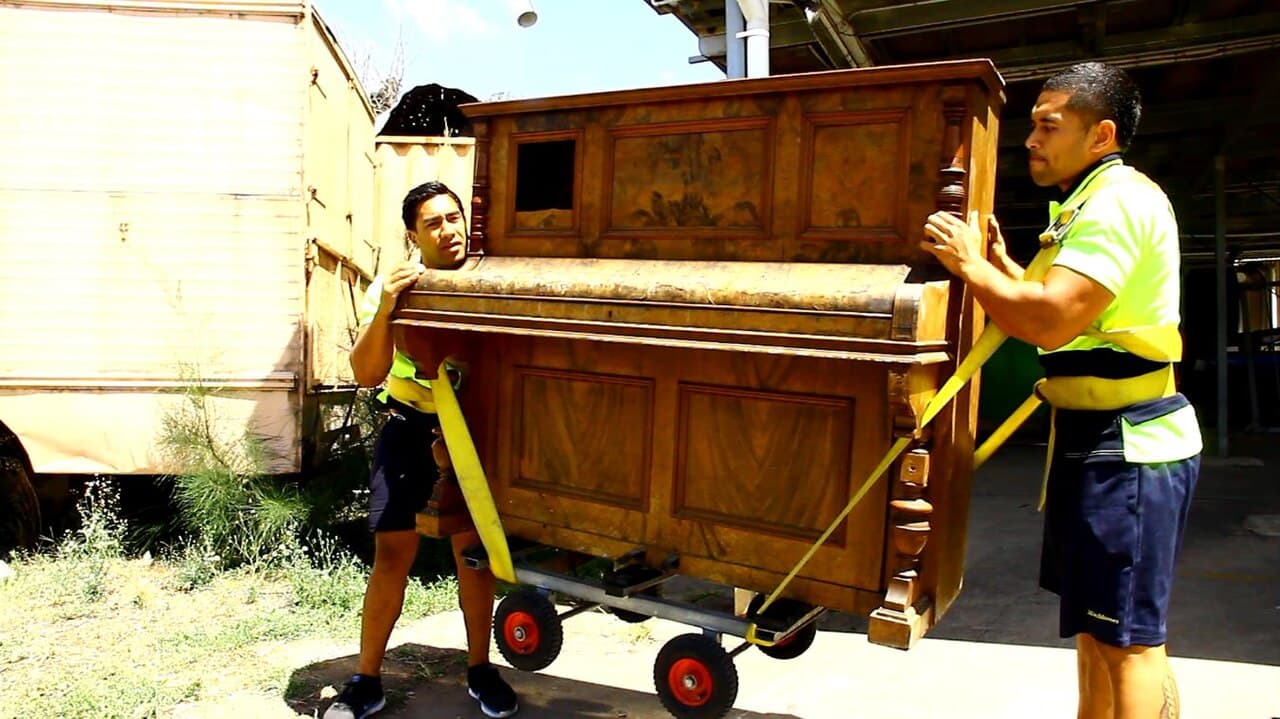
How a crew moves an upright
The usual sequence looks like this, though every crew has its own habits:
- Protect it. The lid and keyboard cover are closed, and the case is wrapped in thick moving pads held with tape or stretch wrap over the pads, not on the finish.
- Get it onto a dolly. Two or more people tilt the piano just enough to set it on a heavy piano dolly, then strap it on. From there it rolls instead of being carried.
- Handle stairs slowly. On steps, the crew usually puts at least one person above and one below, keeps the piano under control with straps, and moves it one step at a time, sometimes on a padded board.
- Load it upright. On the truck, pianos usually travel standing against a wall, padded and strapped so they cannot shift or tip.
How a crew moves a grand
A grand usually will not fit through a door on its legs, so it is moved on its side. The lid and the pedal assembly normally come off first. The crew then tilts the piano onto its straight side on a padded piano board, sometimes called a skid board, straps it down, and takes off the legs. The board goes onto a dolly, and the piano rolls through the house and up the ramp on its side. In the new room the crew reverses the process: legs on, piano lifted back onto them, pedals and lid back in place.
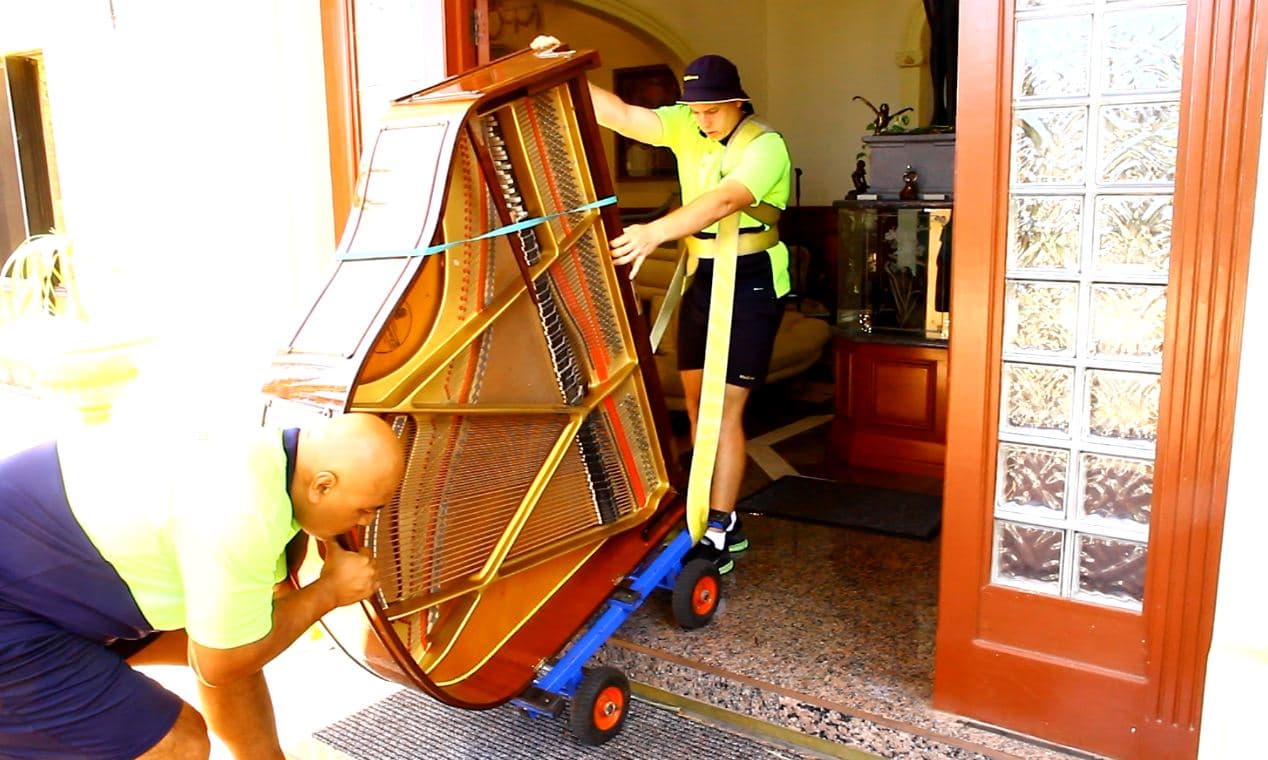
Your part on moving day
The steps on this page are what you can do without lifting anything. The two that save the most trouble are measuring and choosing the new spot before the truck arrives.
Measure the doorways, the tightest turn in each hall and the width of each staircase, and count the steps at both homes, including the front steps. A crew that knows about a narrow landing or a long outdoor staircase arrives with the right equipment and enough people. Pass the numbers on when you ask for a quote; what piano moving costs in Virginia explains why stairs and distance change the price.
For the new spot, Kawai advises a location with stable temperature and humidity, away from direct sunlight, exterior walls and open windows, and says not to use a western-facing wall, which heats daily from the afternoon sun.[6] Heating registers, vents and fireplaces are also poor neighbours for a piano. Decide before the crew arrives, so the piano is set down once, in the right place.
Protect your floors and door frames too: how to protect floors and walls on moving day covers runners, door jamb protectors and what to ask the crew to bring.
When the piano arrives
Before you sign, walk around the piano with the crew lead. Look at the case, legs and pedals, and play every key. If you are moving with a Virginia household goods carrier, a delivery receipt you sign may not contain language that releases the carrier from liability, other than a statement that the goods arrived in apparent good condition except as noted.[8] Write any damage on that receipt.
If you find damage later, send the mover a written claim with photos. Under Virginia law, a household goods carrier must acknowledge a written damage claim within thirty calendar days[9] and pay, decline or make a firm settlement offer in writing within 120 days.[9] What to do if movers damage your furniture walks through the claim.
Then plan the tuning. Kawai says temperature and humidity fluctuations can cause unstable tuning,[6] so a piano that has just changed rooms, or spent a day in a truck, will usually drift. Let it settle, then book a technician. For routine care, Kawai recommends tuning at least twice a year, and says 2 to 4 tunings a year is the standard recommendation.[7]
Stop and call a pro if
- You are thinking of moving the piano yourself with friends, a rented truck or a furniture dolly. Book a mover that moves pianos regularly.
- The route includes stairs, a tight turn, a landing or a doorway you are not sure the piano will clear. Tell the mover before the day, not when the crew arrives.
- The piano would have to go over a balcony, through a window or up a steep slope. That can need rigging or a hoist, which is a specialty job.
- Keys stick, a pedal does not work, or you hear buzzing or rattling after the move. Call a piano technician before anyone plays it hard.
- The case is cracked, a leg is loose or the piano was dropped. Photograph it, note it on the paperwork and file a written claim.
Finding a piano mover
Not every moving company takes pianos, and whether you need a specialty piano mover covers what to ask before you book. Browse more junk removal and moving answers, see specialty item movers, find junk removal and moving businesses around Blacksburg, or describe your piano move and get quotes.
Common questions
- Can a few friends and I move an upright piano?
- Hiring a mover who handles pianos regularly is the safer choice, because an accident can injure people and damage the instrument and the home. Even a modest upright weighs several hundred pounds and is top-heavy, so the risk is in tipping and stairs, not only the lifting.
- Do movers take the legs off a grand piano?
- Usually, yes. The lid and pedal assembly normally come off, the piano is tilted onto its straight side on a padded piano board, and the legs are taken off once it is strapped down. The crew reverses the process in the new room.
- How soon should a piano be tuned after a move?
- Give it time to adjust to the new room's temperature and humidity first, then book a technician, and ask the technician how long to wait. Humidity swings affect tuning stability, so tuning it the day it arrives can mean tuning it again soon after.
- What should I do if the piano is damaged in the move?
- Write the damage on the delivery receipt, photograph it, and send the mover a written claim. For a Virginia household goods carrier, the law sets deadlines for acknowledging and answering written claims.
Sources
- [1] Steinway Upright Piano, Traditional K-52, Steinway & Sons. Checked October 27, 2026.
- [2] Steinway Model M Grand Piano, Steinway & Sons. Checked October 27, 2026.
- [3] Steinway Model D Concert Grand Piano, Steinway & Sons. Checked October 27, 2026.
- [4] How much do Kawai upright pianos weigh?, Kawai America Corporation. Checked October 27, 2026.
- [5] How much do Kawai grand pianos weigh?, Kawai America Corporation. Checked October 27, 2026.
- [6] Where should I place my piano in my home?, Kawai America Corporation. Checked October 27, 2026.
- [7] How often should I tune my piano?, Kawai America Corporation. Checked October 27, 2026.
- [8] Va. Code § 46.2-2162, Carrier liability, Code of Virginia, Virginia General Assembly. Checked October 27, 2026.
- [9] Va. Code § 46.2-2168, Claims, Code of Virginia, Virginia General Assembly. Checked October 27, 2026.
Want a pro to handle it?
Describe the job once. Licensed local businesses send quotes, and you pay only when you book one.
Get a quote from a local pro