Do I need a permit to tear down a shed in Virginia?
Often, yes. Virginia's building code requires a permit to demolish a building or structure, and although it exempts small sheds of 256 square feet or less, localities differ on whether that covers tearing one down. Call your building department first. State law also requires a Virginia 811 locate request before any demolition, and wiring, plumbing or asbestos bring their own permits.
Free to ask. Local shops send quotes, and you pay only when you book one.
By Kasra Taheri, Founder, LoclisPublished
Researched and drafted with AI, then checked claim by claim against the sources listed below before it was published. Prices and rules change; the dates beside each source say when it was last checked.
This is a job for a licensed pro in Virginia
This page explains what the work involves, the permits, what a licensed pro does and what drives the cost. It does not give step-by-step instructions, because this work needs a licence, a permit or both, and doing it wrong can injure someone. Before you hire, check the licence on Virginia's DPOR record.
Often, yes, and the only way to be sure is to ask your county or city building department before the work starts. Virginia's Uniform Statewide Building Code says a permit must be obtained before the construction or demolition of a building or structure.[1] Its well-known exemption for small sheds is read differently from one locality to the next when the shed is coming down rather than going up. Separately from any permit, state law requires a Virginia 811 locate request before a demolition, and wiring, plumbing or asbestos in the shed bring their own rules.
What the building code says
The code's list of work that needs a permit starts with "Construction or demolition of a building or structure."[1] The same section then exempts one-story detached structures used as tool and storage sheds, playhouses or similar uses, provided the building area does not exceed 256 square feet.[1] It adds that the exemption does not excuse the work from the code's other requirements,[1] and that a building official may still require a permit for exempted work in a special flood hazard area.[1]
Whether the small-shed exemption also covers tearing one down is a question the code leaves to local building officials, and Virginia's localities answer it in different ways.
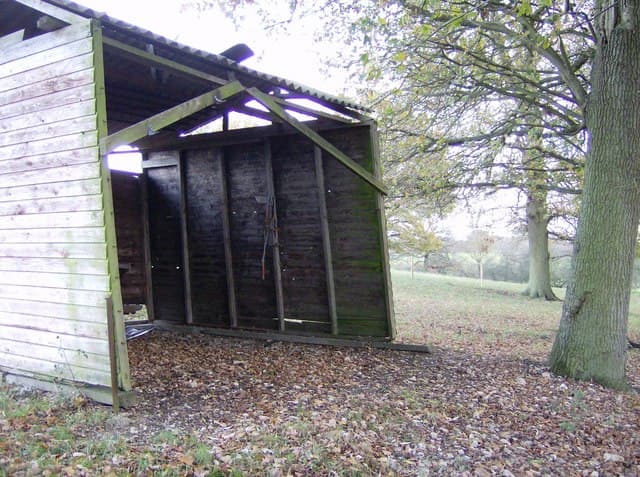
How some Virginia localities handle it
- Pittsylvania County. Pittsylvania County lists "Demolition of buildings, structures, pools, or fuel tanks" among the work that needs a building permit,[2] while listing only sheds and playhouses over 256 square feet as needing one to build.[2]
- Botetourt County. Botetourt County's fee schedule, effective November 1, 2025, lists a $40 residential demolition fee,[4] and lets an applicant ask for it to be waived for single-story residential structures without utilities that do not exceed 256 square feet.[4] In other words, a small shed still goes through the permit desk, at no charge if the waiver is granted.
- Montgomery County. Montgomery County's fee schedule lists a $45 demolition fee for each structure.[5]
- Fairfax County. Fairfax County lists the removal of a building or structure among residential projects that need a permit,[3] and says no permit is needed to build a detached storage shed of up to 256 square feet and one story.[3]
If your locality is not listed here, its building department's "do I need a permit" page or front counter will tell you. Ask specifically about demolishing an accessory structure of your shed's size, and whether it has power or water.
Utilities bring their own permits
A shed with a light and outlet, or a hose bib, has utilities that have to be ended safely before it comes down. In Virginia's building code, electric wiring and water supply and distribution systems are on the code's list of work that needs a permit.[1] Fairfax County, for example, lists connecting or disconnecting to sewer or water among plumbing work that needs a permit.[3] That work goes to a licensed electrician or plumber, who normally pulls the trade permit.
Asbestos
The code also requires a permit for "Removal or disturbing of any asbestos containing materials during the construction or demolition of a building or structure, including additions."[1] A separate state law requires an asbestos inspection certificate before a building department issues a demolition permit for a building first permitted before January 1, 1985, but it does not apply to single-family dwellings or residential housing with four or fewer units, unless the demolition is for commercial or public development purposes.[9] Old roofing, siding panels or floor tiles in a shed may still contain asbestos, and the building-code permit rule applies regardless.
Virginia 811 is required either way
Whatever your building department says, Virginia's Underground Utility Damage Prevention Act says no person may make or begin any excavation or demolition without first submitting a locate request to the notification center.[6] The law defines demolition as any operation by which a structure is wrecked, razed, moved or removed with tools or equipment which could damage underground utility lines.[7] Virginia 811 asks for the request at least 3 working days in advance.[8] Under the same law, an excavator who willfully fails to submit a locate request is liable to the operator for three times the cost to repair the damaged property.[6] Read more about what the teardown involves in what tearing down a shed involves.
Who pulls the permit
The building code says anyone applying for a permit to construct, remove or improve a structure must furnish proof that they are licensed under Virginia's contractor law, or file a written statement that they are not subject to licensure.[1] A homeowner doing their own work signs that statement. A business doing it for you is usually a contractor: Virginia's definition covers anyone who, for a fee, undertakes the removal of any building or structure permanently annexed to real property.[11]
Virginia's Board for Contractors says the contractor should apply for and obtain any necessary building permits, and that this should be in your contract; otherwise, you may be held legally responsible for failure to obtain any required permits.[10] Ask for a copy of the permit before work begins.
When to call a licensed pro
- The building department says a demolition permit is needed and you would rather the contractor handle it.
- The shed has electrical wiring, a water line or a gas line.
- It may contain asbestos: old roofing, cement-type siding panels or floor tiles you cannot identify.
- The shed is in a flood zone or near a property line.
- It sits on a slab or piers that will be broken out or dug up.
For what the permit and the rest of the job cost, see what shed demolition costs in Virginia. Browse more junk removal and moving answers, see shed and structure teardown businesses, or find junk removal businesses around Blacksburg. When you are ready, describe the shed on Loclis, including its size and whether it has power or water, and licensed businesses quote on the same job.
Common questions
- My shed is under 256 square feet. Does that mean no permit?
- Not necessarily. The 256-square-foot exemption in Virginia's building code covers small sheds, but the code also lists demolition as work that needs a permit, and some counties, such as Pittsylvania, list demolition of structures without a size limit. Ask your building department how it treats a small shed.
- Do I need a permit to take down a metal or plastic kit shed?
- The same rules apply whatever the shed is made of; the code talks about buildings and structures, not materials. A kit shed sitting on blocks with no utilities is the kind of case a building official may treat lightly, but only the official can say so.
- Is the 811 call really required for a small shed?
- Yes, if the work fits the state's definition of demolition, which covers removing a structure with tools or equipment that could damage underground utility lines. Virginia 811's service is free, and it asks for the request at least 3 working days ahead.
- What if the shed is in a flood zone?
- Expect more review. Virginia's building code lets a building official require a permit for otherwise exempt work in a special flood hazard area. Call the building department before scheduling the work.
- Who applies for the permit, me or the contractor?
- Either can, but the applicant must show a contractor's licence or sign a statement that they are not subject to licensing. If you hire a contractor, the Board for Contractors suggests the contract say the contractor will get the permits.
- What happens if I tear down a shed without a required permit?
- That depends on the locality and the circumstances, and it is a question for your building department. Doing the work without the 811 locate request carries its own risk: an excavator who willfully skips it can be liable to the utility for three times the cost of repairing its damaged line.[^va-code-56-265-17]
Sources
- [1] 13VAC5-63-80. Section 108 Application for permit (Virginia Uniform Statewide Building Code), Virginia General Assembly, Legislative Information System. Checked October 27, 2026.
- [2] Do I Need a Permit, Pittsylvania County Community Development. Checked October 27, 2026.
- [3] Does My Project Require a Permit?, Fairfax County Land Development Services. Checked October 27, 2026.
- [4] Botetourt County Development Services Fee Schedule, effective November 1, 2025, Botetourt County Development Services. Checked October 27, 2026.
- [5] Permit & Inspection Fees, Montgomery County, Virginia, Building Permits & Inspections. Checked October 27, 2026.
- [6] Code of Virginia § 56-265.17. Notification required prior to excavation or demolition, Virginia General Assembly, Legislative Information System. Checked October 27, 2026.
- [7] Code of Virginia § 56-265.15. Definitions, Virginia General Assembly, Legislative Information System. Checked October 27, 2026.
- [8] Homeowners, Virginia 811. Checked October 27, 2026.
- [9] Code of Virginia § 36-99.7. Asbestos inspection in buildings to be renovated or demolished; exceptions, Virginia General Assembly, Legislative Information System. Checked October 27, 2026.
- [10] What You Should Know Before You Hire a Contractor, Virginia Board for Contractors, Department of Professional and Occupational Regulation. Checked October 27, 2026.
- [11] Code of Virginia § 54.1-1100. Definitions, Virginia General Assembly, Legislative Information System. Checked October 27, 2026.
Want a pro to handle it?
Describe the job once. Licensed local businesses send quotes, and you pay only when you book one.
Get a quote from a local pro