How long does a roof last in Virginia?
A 2000 U.S. Forest Service overview puts 3-tab fiberglass shingles at 15 to 25 years and architectural shingles at 20 to 30, the most common house roofs; standing-seam steel, tile and slate last longer. Sun, wind, ice and poor attic ventilation shorten a roof's life, while clean gutters, trimmed trees and regular professional inspections help it reach its full age.
Free to ask. Local shops send quotes, and you pay only when you book one.
By Kasra Taheri, Founder, LoclisPublished
Researched and drafted with AI, then checked claim by claim against the sources listed below before it was published. Prices and rules change; the dates beside each source say when it was last checked.
This is a job for a licensed pro in Virginia
This page explains what the work involves, the permits, what a licensed pro does and what drives the cost. It does not give step-by-step instructions, because this work needs a licence, a permit or both, and doing it wrong can injure someone. Before you hire, check the licence on Virginia's DPOR record.
Asphalt shingles are the usual house roof, and a 2000 U.S. Forest Service overview of roofing materials gives them 15 to 25 years for 3-tab fiberglass shingles and 20 to 30 years for architectural ones.[2] Steel, tile and slate last longer. Where your roof lands in its range depends on the weather it faces, how well the attic is ventilated, and whether small problems get fixed before they spread.
Typical lifespans by roofing material
The U.S. Forest Service's overview of roofing materials, published in March 2000, gives these lifespans:[2]
- Asphalt 3-tab shingles, fiberglass mat: 15 to 25 years, possibly shorter in cold climates
- Architectural (heavy, laminated) asphalt shingles: 20 to 30 years
- Painted standing-seam steel: 30 to 50 years, thanks to factory-applied coatings
- Concrete tile: 40 to 50 years
- Glazed clay tile: at least 50 years
- Slate, best grades of clear slate: a minimum of 50 years
- Cedar shakes and shingles: up to 30 years with maintenance
- EPDM rubber and modified bitumen on low-slope roofs: about 20 years with maintenance
The grade of material helps determine the expected life of the roof,[2] so two roofs of the same type can wear out years apart. A shingle roof at or past the end of its range is a prime candidate for replacement.
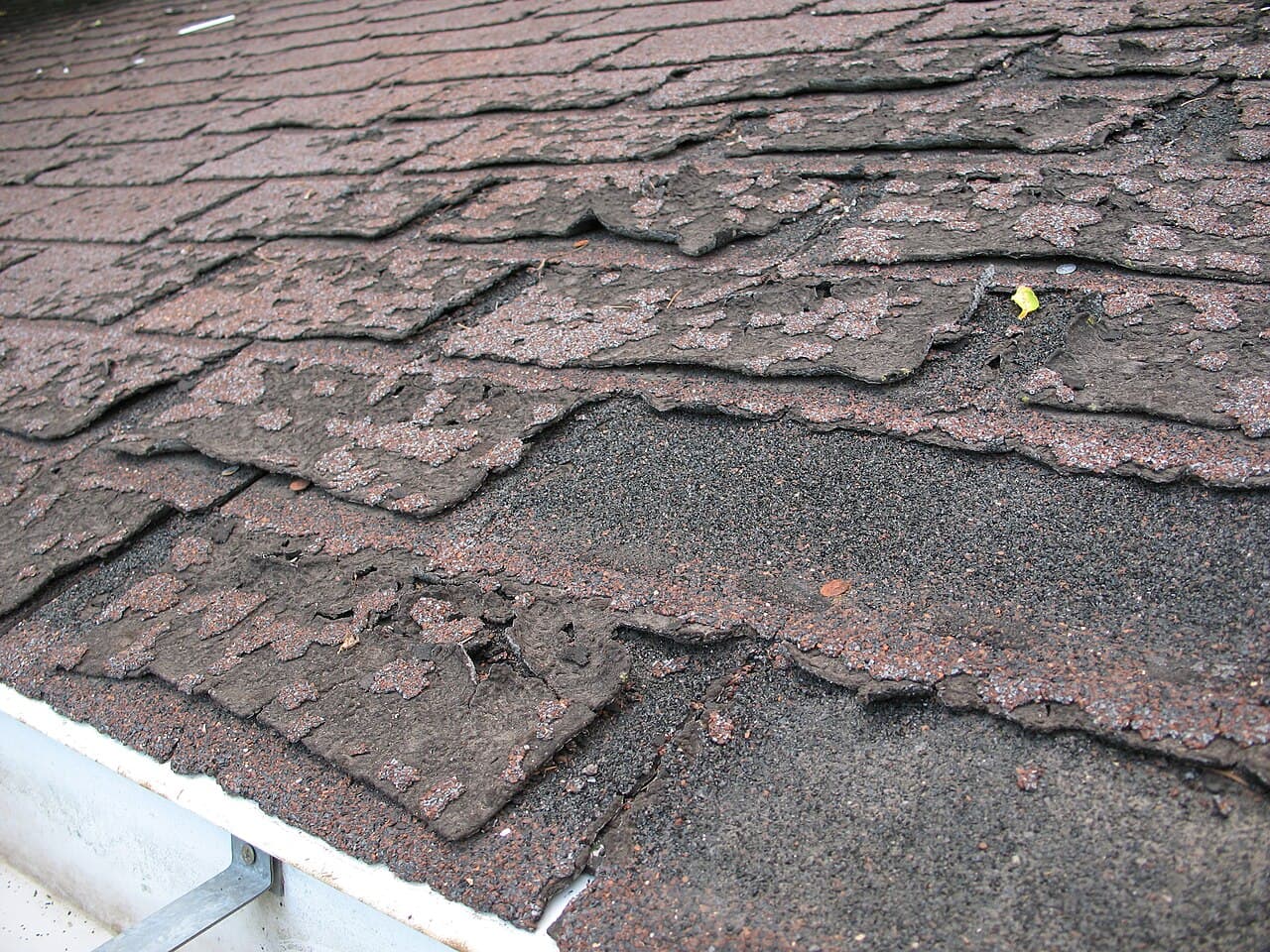
What shortens a roof's life
Weather, the attic below and the trees around the house all wear on a roof. The main things working against a Virginia roof:
- Heat and sun. Heat and ultraviolet rays wear roofing down over time, and the wear can come faster on sides facing west or south.[2] One slope can be worn out while another still looks fine.
- Storms. High winds can lift shingle edges and force water and debris underneath,[2] and falling branches from overhanging trees can damage or puncture shingles.[2]
- Ice. In winter, melting snow often refreezes at the overhang and forms an ice dam, and water can back up under the roofing and into the house.[2] That is why, as Prince William County's building division notes, the Virginia code requires an ice barrier along the eaves in areas where there has been a history of ice forming along the eaves and backing up water, as designated in the code's Table R301.2(1).[3]
- A hot, damp attic. Moisture in poorly ventilated attics promotes decay of the wooden roof sheathing and rafters.[2]
What helps a roof reach its full age
Most of what extends a roof's life happens from the ground and the attic, plus a professional's eye now and then.
Ventilation. Good ventilation keeps the attic temperature closer to the outside air and keeps moisture from building up. It needs air coming in low, at the soffit or eave, and leaving at or near the top, typically the ridge. Check that insulation, stored boxes or a past project have not covered the soffit vents. "Never block off sources of roof ventilation, such as louvers, ridge vents, or soffit vents."[2]
Routine upkeep. The basics are clean gutters and downspouts, and trees and shrubs trimmed back from the house to cut down on damp, shaded areas.[2] Branches that touch the roof scratch and gouge it in the wind, and leaves left on the roof hold moisture.[2] Gutter cleaning from a ladder is covered in how often gutters should be cleaned. Have a tree service handle limbs over the roof.
Inspections. The Forest Service advises checking flashings twice a year when the roof is inspected and the gutters are cleaned.[2] Spring and fall work well, so repairs can be made in warm weather and before winter. Between visits, look at the roof from the ground after big storms, and in the attic after heavy rain.
Prompt repairs. Missing or torn shingles leave the roof structure and the inside of the house open to water damage, and the problem is likely to spread.[2] A small repair done quickly helps a roof reach its expected age.
Caution with add-on products. Coatings sold to extend a roof's life are not always compatible with shingles, so ask the shingle manufacturer before having a coating or rejuvenator applied.
Stay off the roof yourself. Walking on it is dangerous and can damage it.
What a "lifetime" warranty does and doesn't mean
A shingle warranty is not a lifespan. Owens Corning's System Protection warranty shows how these work. Its limited lifetime coverage applies only to single-family detached homes where the purchaser of the roof is the resident occupying the home, and there it lasts for as long as the owner owns the home.[4] On such a home, the TRU PROtection period for its limited lifetime shingle lines covers years 1 to 50, and during it the warranty provides compensation to repair, replace or recover defective products, including the cost of tear-off and disposal subject to certain limitations.[4] From year 51, compensation is prorated at 20%.[4] On other types of structures, including homes owned by a trust, condominium or homeowners association, the TRU PROtection period is 20 years.[4] After a TRU PROtection period ends, the warranty provides prorated compensation of the costs of the defective Owens Corning products, and no other costs.[4] Shorter lines work differently: Supreme shingles carry a 25-year warranty with a 15-year TRU PROtection period.[4] The stronger coverage also depends on the roof being installed by one of the maker's Platinum or Preferred contractors and registered by that contractor within 60 days.[4] Keep that paperwork with the house records.
When to call a licensed pro
Call a licensed roofer for the spring and fall inspections, after any storm that drops branches or strips shingles, when you find water stains in the attic, or once an asphalt roof reaches about 20 years. Anything on the roof is their work, because roof work is dangerous.
A roofer needs a Virginia contractor's licence for a single job over $1,000: Class C contractors take single jobs over $1,000 but less than $30,000.[1] DPOR's 2017 consumer guide puts the line at "$1,000 or more";[5] where the two differ, the statute governs. For roofing-only work you may want a contractor licensed in that specialty.[5] Check any roofer using DPOR's License Lookup or by calling (804) 367-8511.[6]
If your roof is near the end of its range, read how to know if you need a new roof and what a new roof costs in Virginia, or browse more exterior answers. Licensed roofers are listed under roof repair and exterior contractors in Blacksburg.
Ask for a roof inspection or repair and licensed local roofers quote or offer to come and look.
Common questions
- How long do architectural shingles last?
- A 2000 U.S. Forest Service overview of roofing materials gave heavy, laminated architectural shingles 20 to 30 years, against 15 to 25 for 3-tab fiberglass shingles. A roof that takes full sun, sits under trees or has poor attic ventilation can fall short of that.
- Does a lifetime shingle warranty mean the roof lasts a lifetime?
- No. A warranty describes what the maker will pay for and when, not how long the roof lasts. In Owens Corning's System Protection warranty, for example, lifetime coverage applies only to a single-family detached home lived in by the purchaser, for as long as that owner owns it. There, full coverage of defects, including tear-off and disposal, runs for the first 50 years; on other types of structures it runs for 20 years before proration.
- How long does a metal roof last?
- It depends on the type. A 2000 U.S. Forest Service overview gave painted standing-seam steel roofs 30 to 50 years, thanks to factory-applied coatings, well beyond asphalt shingles. Like any roof, it still needs periodic inspection by a roofer who knows metal systems.
- How often should a roof be inspected?
- The Forest Service advises checking the flashings twice a year when the roof is inspected, and spring and fall work well, so repairs can be done in warm weather and before winter. Have it checked after any major wind or hail storm too.
- Can I make my roof last longer myself?
- Yes, from the ground and the attic. Keep the gutters and downspouts clean, have a tree service cut back branches that hang over or touch the roof, keep attic vents clear, and look for leaks in the attic after heavy rain. Leave anything on the roof itself to a licensed roofer.
Sources
- [1] § 54.1-1100. Definitions (contractor classes), Code of Virginia, Legislative Information System. Checked October 26, 2026.
- [2] Overview of Roofing Materials for Forest Service Facilities (Tech Tip 0071-2314-MTDC, March 2000), USDA Forest Service, Missoula Technology and Development Center. Checked October 26, 2026.
- [3] Residential Roof Replacements (FAQ, version 2021-06-24), Prince William County Department of Development Services, Building Development Division. Checked October 26, 2026.
- [4] System Protection Limited Lifetime Warranty, Owens Corning Roofing and Asphalt, LLC. Checked October 26, 2026.
- [5] What You Should Know Before You Hire a Contractor, Virginia Board for Contractors, DPOR. Checked October 26, 2026.
- [6] Disaster Recovery: Avoiding Fraud, Virginia Department of Professional and Occupational Regulation. Checked October 26, 2026.
Want a pro to handle it?
Describe the job once. Licensed local businesses send quotes, and you pay only when you book one.
Get a quote for Roofing