How do I know if I need a new roof?
Age and widespread wear are the main signs. Shingle roofs are generally rated for 15 to 30 years, so one in or past that range deserves an inspection. From the ground, look for cracked, curled or missing shingles and heavy granule loss; in the attic, look for stains or wet spots on the deck. Sagging, soft decking or wear across the whole roof points to replacement.
Free to ask. Local shops send quotes, and you pay only when you book one.
By Kasra Taheri, Founder, LoclisPublished
Researched and drafted with AI, then checked claim by claim against the sources listed below before it was published. Prices and rules change; the dates beside each source say when it was last checked.
This is a job for a licensed pro in Virginia
This page explains what the work involves, the permits, what a licensed pro does and what drives the cost. It does not give step-by-step instructions, because this work needs a licence, a permit or both, and doing it wrong can injure someone. Before you hire, check the licence on Virginia's DPOR record.
You probably need a new roof when it is old and the wear is spread across the whole surface, not just in one spot. Every shingle roof wears out eventually, and one at or past the end of its expected life is a prime candidate for replacement. A younger roof with a single leak or a few damaged shingles is usually a repair. Here is how to tell which you have, without climbing up there.
Start with the roof's age
Find out when the roof went on. A home inspection report, the seller's paperwork, a permit record or the original roofer's invoice often says. Then compare it with what the material usually gives. A March 2000 U.S. Forest Service overview of roofing materials gave 3-tab fiberglass shingles a lifespan of 15 to 25 years, possibly shorter in cold climates, and heavy, laminated architectural shingles 20 to 30 years.[2] The grade of material helps determine the expected life of the roof,[2] so the shingle line on the original invoice is worth knowing too.
Conditions move the number. Heat and ultraviolet rays wear materials down over time, and the wear can come faster on sides facing west or south,[2] so check those slopes first. Weather adds to it: high winds can lift the edges of shingles and force water and debris underneath them.[2]
What to look for from the ground
Walk around the house with binoculars and look for cracked, curled or missing shingles, as well as any excessive loss of the protective mineral granules. Granules are the mineral coating on the exposed surface of the shingle. When they wear away you often see dark, bare patches, and find the grit piling up in gutters and at downspout outlets.
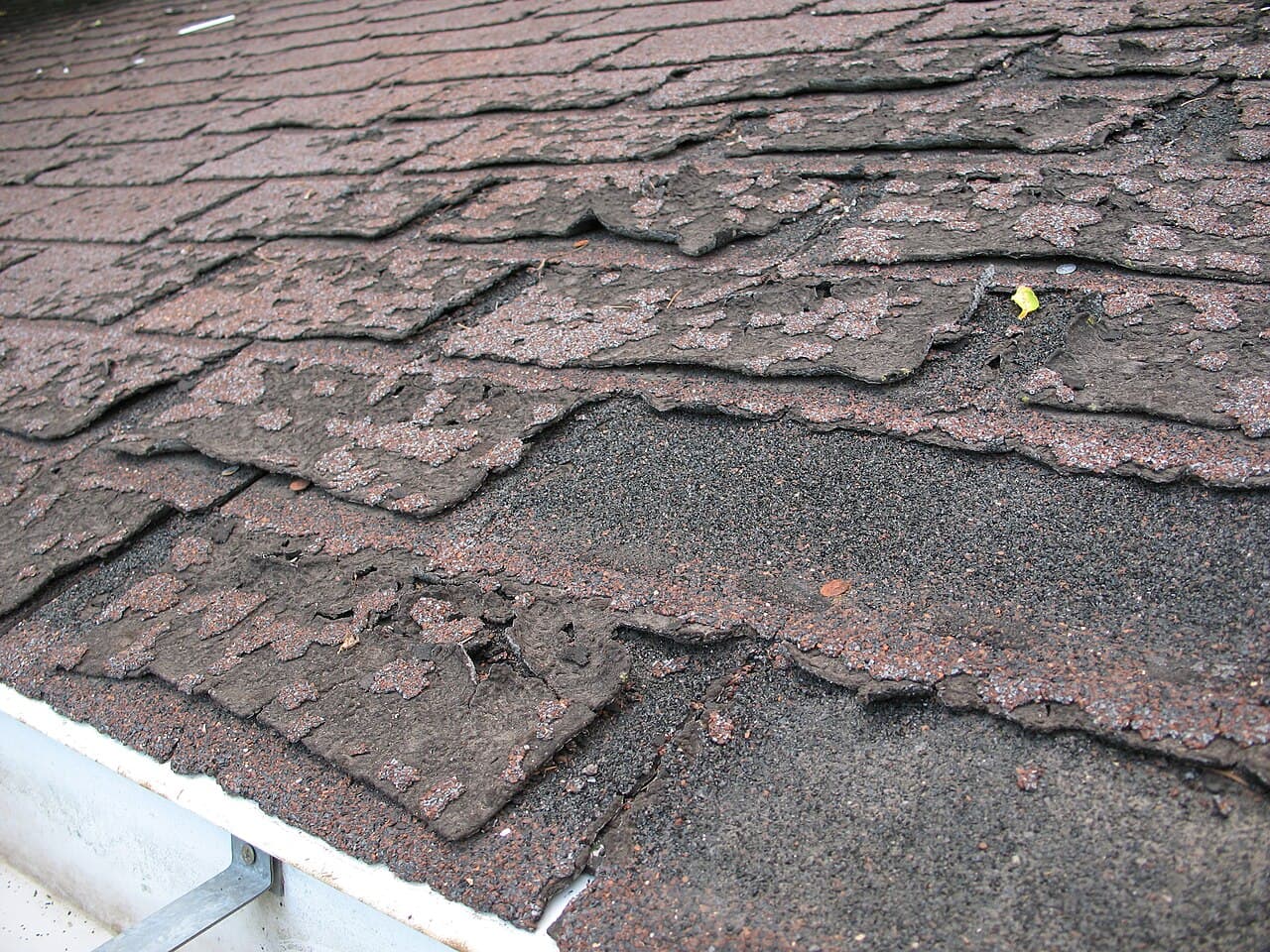
The photo above is a roof at the end of its life: shrunken, cracked shingles with the granules gone and pieces torn away. Other signs worth noting from the ground:
- Curling and splitting. When shingles become old and worn out, they curl, split and lose their waterproofing effectiveness.[2]
- Missing pieces after wind. One or two lost tabs is usually a repair. Weakened old shingles are easily blown off, torn or lifted by the wind,[2] so losses after every storm, all over the roof, point to the end of its life.
- A wavy or dipping roofline. A sag along the ridge or between rafters is a structural warning, covered below.
- Dark stains in shaded areas. Algae grows in damp, shaded areas on asphalt-shingle roofs and leaves a black-green stain that can hold moisture.[2] It is a reason to trim back trees and have the roof checked, not by itself a reason to replace it.
Stay off the roof itself. Walking on it is dangerous and can damage the shingles.
What to look for in the attic
The attic tells you whether water is already getting in. With a flashlight, look at the underside of the roof deck and rafters for stains or wet spots that show water getting in. Check around chimneys, vent pipes and valleys first, since leaks often start there. Daylight showing through the boards, frost or damp on the underside of the deck in winter, or insulation that is matted or wet are all worth reporting to a roofer.
A damp attic is not always a roof leak. Moisture in poorly ventilated attics promotes decay of the wooden roof sheathing and rafters,[2] so blocked or missing vents can look like a leak.
Signs a repair won't be enough
Some conditions mean the shingles have to come off, which makes a full replacement the honest answer:
- rotted or warped wood or large gaps between deck boards;
- several layers of shingles already on the roof;
- sagging along the ridge or between rafters or trusses, in which case a licensed structural engineer should look at the structure;
- shingles so uneven and distorted that new ones could not be made to lie flat over them.
When a repair is the right call
Asphalt roofs are easy to repair in small areas. Typical repairs include replacing shingles damaged or punctured by windborne debris, resealing shingles lifted by high winds, repairing backed-out fasteners and renewing flashing. Many apparent roof leaks are really flashing leaks,[2] and missing or torn shingles should be repaired as soon as possible.[2] If the roof is well short of its expected age and the damage is in one area, a repair is usually the better value.
Be careful with quick fixes in both directions. Roofing cement over a puncture may work as a temporary repair but is not a suitable long-term one. And before paying for a spray-on product that promises to add years, ask the shingle manufacturer whether it is compatible, since an incompatible coating can harm the roof.
When to call a licensed pro
Call a licensed roofer when you see an active leak, a sagging roofline, widespread curling or granule loss, or damage after a storm. Anything on the roof itself is their job, because roof work is dangerous. Even when nothing looks wrong, have the roof inspected regularly: the Forest Service advises checking flashings twice a year when the roof is inspected and the gutters are cleaned.[2] Spring and fall are sensible times, so repairs can be made in warm weather and before winter.
After a storm, be careful who you let on the roof. DPOR's warning is direct: "Be wary of door-to-door solicitations promising repairs at a discounted price."[3] A roofer needs a Virginia contractor's licence for a single job over $1,000: Class C contractors take single jobs over $1,000 but less than $30,000.[1] DPOR's 2017 consumer guide puts the line at "$1,000 or more";[4] where the two differ, the statute governs. For roofing-only work you may want a contractor licensed in that specialty.[4] Check any roofer using DPOR's License Lookup or by calling (804) 367-8511,[3] or follow how to check a contractor's licence.
If replacement is likely, read what happens during a roof replacement and what a new roof costs in Virginia. Overflowing gutters can also look like a roof leak, so see why gutters overflow, or browse all exterior answers. Licensed roofers are listed under roof repair and exterior contractors in Blacksburg.
Describe what you're seeing on your roof, add a few photos from the ground, and licensed local roofers quote or offer to come and look.
Common questions
- How old is too old for a shingle roof?
- A shingle roof at or past the end of its expected life is a prime candidate for replacement. A 2000 U.S. Forest Service overview gave 3-tab fiberglass shingles 15 to 25 years and architectural shingles 20 to 30. Sun, wind and storms wear a roof down, so age is a reason to have the roof looked at, not proof it has failed.
- Is finding granules in the gutter a bad sign?
- A few granules are common, especially from a new roof. Heavy, steady granule loss on an older roof usually means the shingles are wearing out, because the granules protect the asphalt beneath them. Look for bare, dark patches on the shingles from the ground to confirm it.
- Can one leak mean I need a whole new roof?
- Not by itself. Leaks often come from flashing, a pipe boot or a few damaged shingles, and asphalt roofs are easy to repair in small areas. Replacement makes more sense when the roof is old, the wear is spread across it, the decking is soft or there are already several layers.
- Should I walk on my roof to check it?
- No. Walking on the roof is dangerous and can damage it. Check from the ground with binoculars and from inside the attic with a flashlight, and leave anything on the roof itself to a licensed roofer.
- A roofer knocked on my door after a storm and says I need a new roof. What should I do?
- Be wary of door-to-door offers of discounted repairs. Check the company's Virginia licence with DPOR's License Lookup or by calling (804) 367-8511, get other licensed roofers to look, and insist on a written contract before agreeing to anything.
Sources
- [1] § 54.1-1100. Definitions (contractor classes), Code of Virginia, Legislative Information System. Checked October 26, 2026.
- [2] Overview of Roofing Materials for Forest Service Facilities (Tech Tip 0071-2314-MTDC, March 2000), USDA Forest Service, Missoula Technology and Development Center. Checked October 26, 2026.
- [3] Disaster Recovery: Avoiding Fraud, Virginia Department of Professional and Occupational Regulation. Checked October 26, 2026.
- [4] What You Should Know Before You Hire a Contractor, Virginia Board for Contractors, DPOR. Checked October 26, 2026.
Want a pro to handle it?
Describe the job once. Licensed local businesses send quotes, and you pay only when you book one.
Get a quote for Roofing